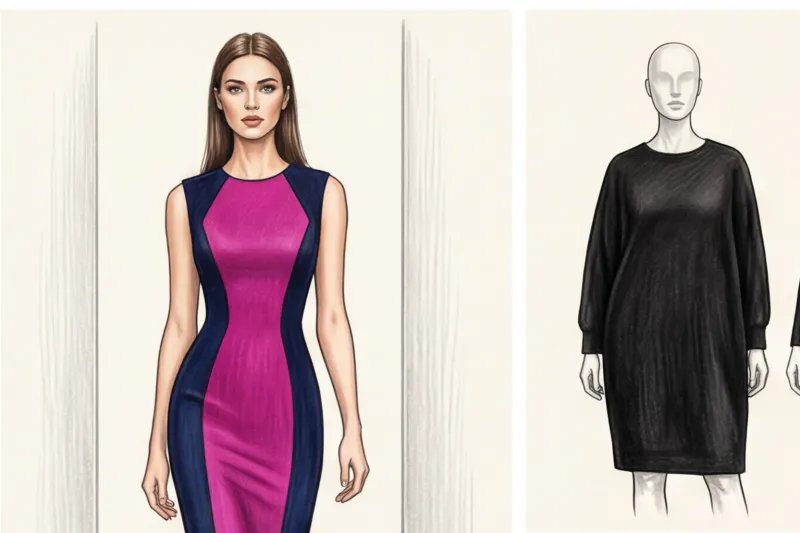
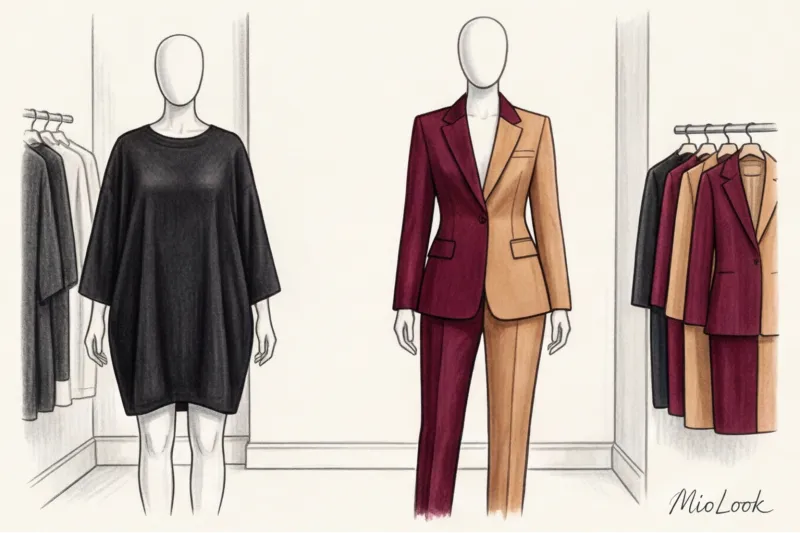
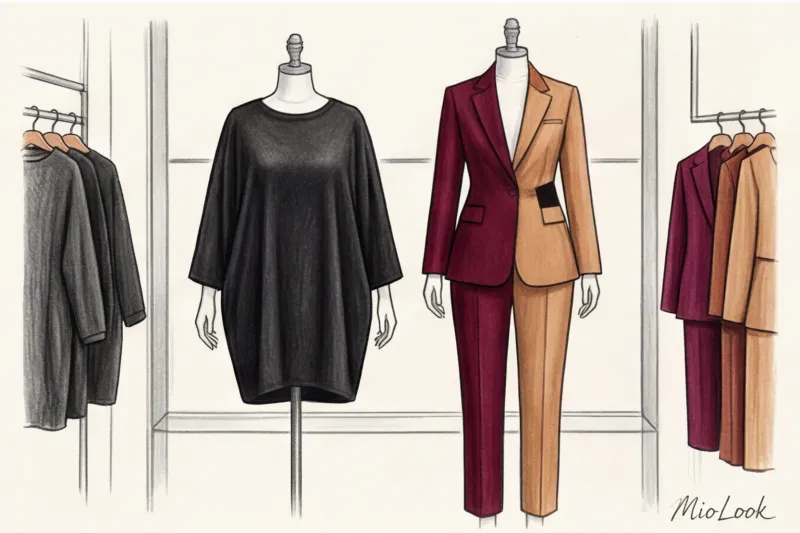
Over the 12 years I've been working as a personal stylist, I've thrown out hundreds of black, loose dresses from my clients' wardrobes. You know what women in sizes 50+ say when we send these items for recycling? "But black is slimming!" I have to bust this myth: a solid, plus-size dark spot looks like a massive, monolithic block. If you really want to change your proportions, you need color blocking in clothing for plus-size women We won't hide the body behind shapeless meters of fabric. We'll literally "re-draw" the silhouette.
I've already covered how basic geometry works and why the brain distorts real volumes in more detail in our detailed guide: Visual figure correction: concealing flaws Today we'll talk about color not as a cheerful palette, but as a strict architectural tool.
Color architecture: how color blocking works in plus-size clothing
In styling, color blocking is the combination of large, contrasting blocks of color in a single garment or outfit. Most people see this technique as a fashion statement, but to me, it's a form of optical surgery. The human brain is lazy: it doesn't read the actual physical centimeters of your waist, but rather the contrasting lines you present to it.
According to a study on the perception of optical illusions in fashion, published in Journal of Vision (2023), the eye reacts to a color boundary 40% faster than to texture or shadow. The classic Müller-Lyer illusion and the illusion of filled space are at work here: contrasting vertical lines force the gaze to move up and down, preventing it from settling on the hip-width line.
"Color blocking works like a theatrical spotlight: it highlights only the part of the figure you want to show, while pushing everything else into deep shadow," says Katarzyna Nowak.
This is the principle behind the design of premium European brands like Marina Rinaldi's custom-fit clothing. They don't try to squeeze women in. They shift color accents so that the viewer's eye sees only the narrow central portion of the silhouette.
The All-Black Myth: Why Bright Blocks Are More Slimming
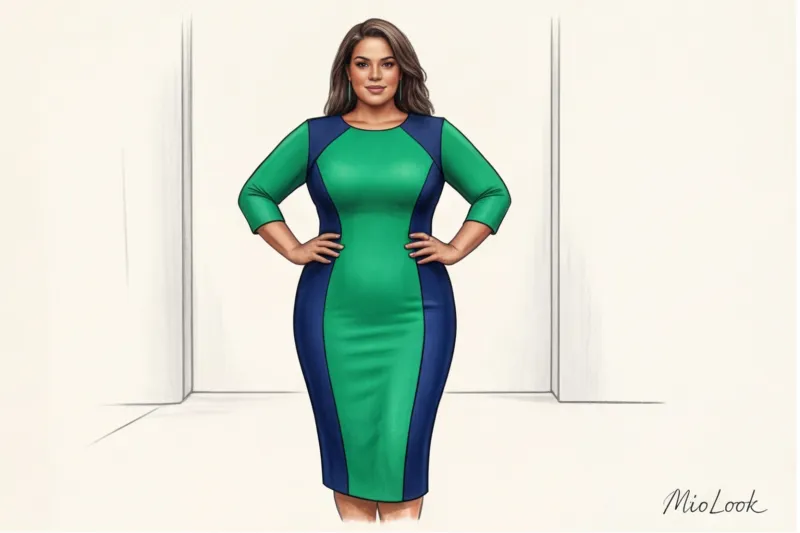
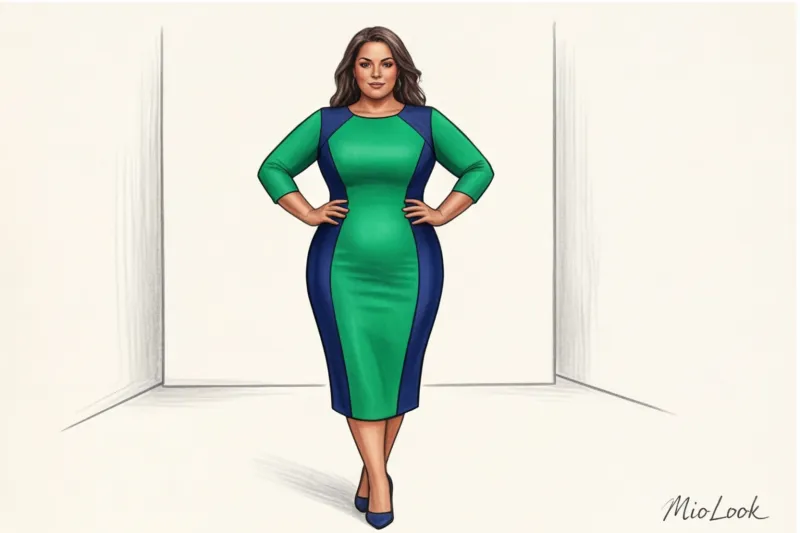
Let me tell you the story of one of my clients. Anna (size 54) wore exclusively black tunics and wide-leg dark pants for years. She was convinced that bright colors would make her look bigger. When, during a fitting, I suggested a COS dress divided into two contrasting vertical blocks (deep emerald and navy blue), she refused to leave the fitting room.
But when she looked in the mirror, she couldn't believe her eyes. The dress had visually "stolen" at least 10 centimeters from her waist. How did this happen?
It's all about focus. When you wear an oversized black dress, you create a single, continuous blur. The other person's brain evaluates its total area. However, if you divide the same physical area in half with different, yet saturated, colors, the brain simply can't perceive both colors simultaneously as a single array. It only registers one half—the one they're looking at. Visually, you appear exactly half as thin.
Moreover, a WGSN psychological report (2024) shows that geometric color accents subconsciously convey confidence and energy to others. You stop being "invisible in black" and become a woman in control of her image.
Three key color blocking techniques for elongating the silhouette
Enough theory. Let's move on to specific stylistic techniques. Treat clothing as a proportional constructor. In my experience, three schemes work flawlessly.
Vertical split: dividing the figure in half
These are items where two colors meet exactly along the body's central axis. These are most often shirts, midi dresses, or pleated skirts. The left half might be, for example, caramel, and the right, graphite gray.
The main secret of this technique lies in the quality of the tailoring. The center seam (or button line) should perfectly align with the axis of your body and not twist as you walk. It's this sharp line, cutting the figure in half, that draws the eye vertically, completely ignoring the actual width of your shoulders or hips.
Your perfect look starts here
The smart MioLook algorithm analyzes your proportions and selects clothes that truly flatter your figure.
Get access — €0.99 onceThe Magic of Sidebars
The most powerful trick for creating the illusion of an hourglass, even if you have a pronounced apple or rectangle body shape. Choose dresses or tops with a light or bright center and dark panels on the sides.
There's an important anatomical nuance here that cheap brands ignore: the dark side panels shouldn't be positioned strictly along the side seam. For the illusion to work, they should extend slightly over the front thigh and waist. The eye only notices the light center, while the dark edges blend into the background.
Dark base and bright vertical accent
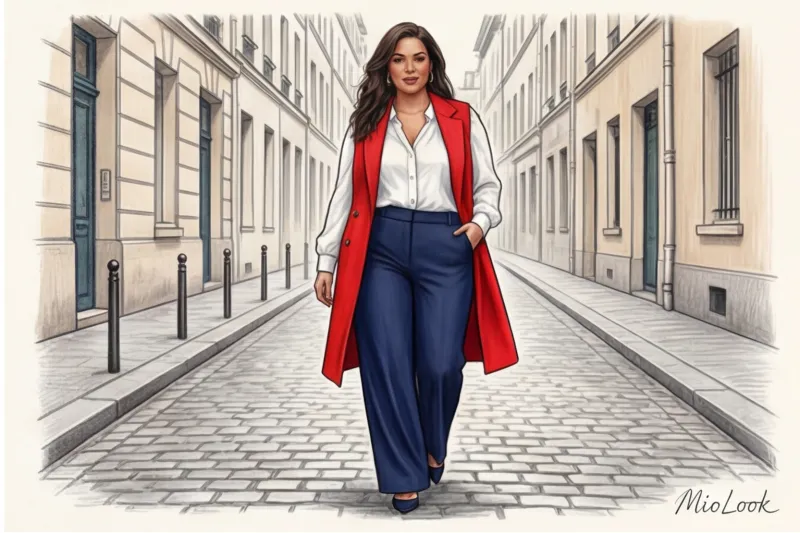
I often use this technique on myself during shopping trips, when I need to look put together but still move around a lot. The idea is simple: we create color blocking through layering.
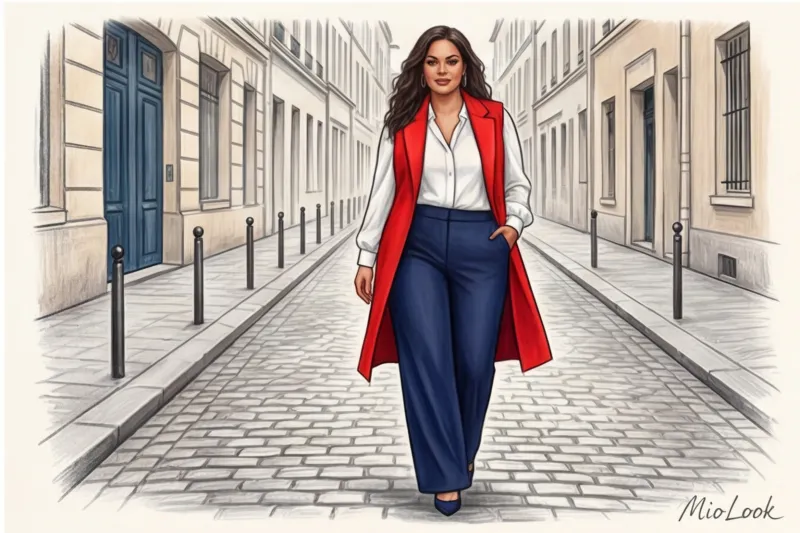
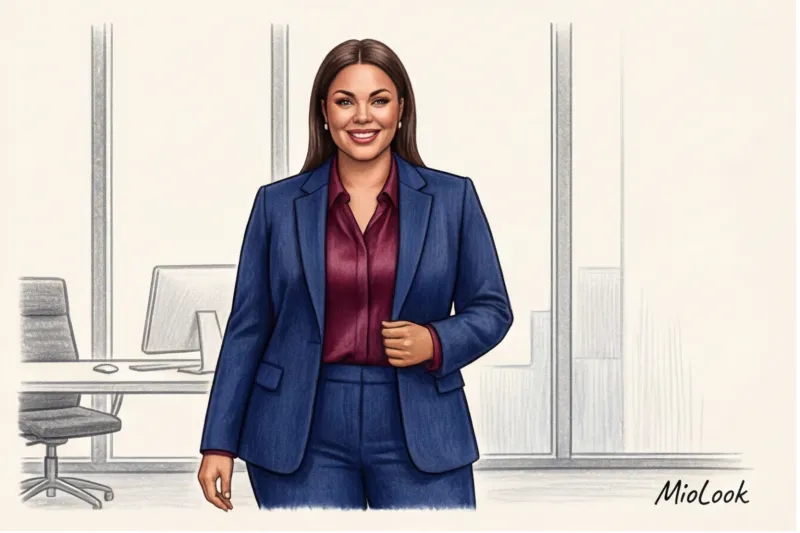
Wear a dark, monochrome base layer (for example, black straight-leg trousers and a matte black top). Layer a long, unbuttoned jacket or a crisp vest in a bright color (rich red, cobalt blue, fuchsia) over the top. The unbuttoned sides of the bright top layer create a narrow, dark "corridor" within. This instantly elongates your height and completely conceals any bulk around the waist and hips. Bonus: if you move the visual line of the contrasting top 5-7 cm above your actual waistline, your legs will appear 10% longer.
Danger Zones: How NOT to Combine Colors in Plus Size
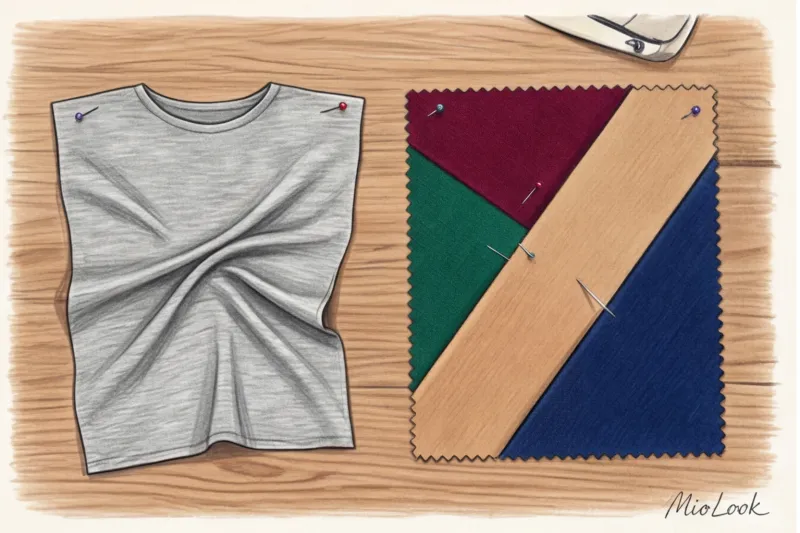
I'll be honest with you: color blocking doesn't forgive carelessness. It's math, and an error in the formula will backfire. There are situations when color blocking is absolutely contraindicated.
- Horizontal 50/50 cut: The worst thing you can do to your figure is wear a contrasting white top and black skirt, dividing your height exactly in half at the waist. This harsh horizontal line "cuts" you, makes you look squat, and visually widens your hips. If you're using horizontal color blocking, the ratio should be 1/3 to 2/3 (for example, a cropped top tucked in and high-waisted pants).
- The insidiousness of cheap fabrics: Color blocking requires architectural detail. Thin viscose jersey from a mass-market store for €30 that clings to every fold of the body will ruin the illusion. The color line will ripple across the stomach, creating a sloppy and cheap look. Choose thick suiting wool, structured cotton (from 180 g/m²), or gabardine.
- Clown effect: More than three large blocks of color in a single look break the silhouette into tiny pieces. The eye doesn't know what to focus on, and the figure appears wider than it actually is.
Let's compare the numbers: a structured two-tone jacket in a dense fabric from Massimo Dutti will cost you around €150-€180. A cheap, shapeless color-block acrylic cardigan at H&M costs €30-€40. The former will visually drop a size and last five years, while the latter will add 10 kilograms and become covered in pilling after the second wash. Saving money works against you here.
Micro-color blocking: using shoes and accessories
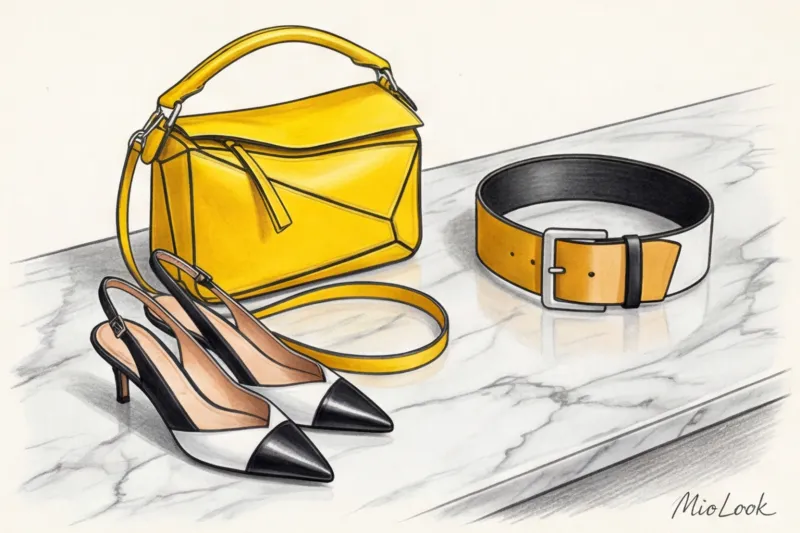
If you're still afraid to wear contrasting dresses, start directing attention through details. This is a great way to introduce bright accessories to complete the look , without disturbing your comfort zone.
Wear two-tone pointed-toe shoes (for example, beige slingbacks with a black or burgundy contrasting toe). The pointed toe itself elongates the leg even without a heel, and the contrasting color creates the right dynamic. Another great option is geometric, rigid crossbody bags. The diagonal strap perfectly breaks up the monolithic volume of the chest and stomach.
Organize your smart wardrobe
Upload photos of your items to MioLook, and the algorithm will suggest perfect color-blocking combinations from what you already own.
Get access — €0.99 onceA stylist's checklist: putting together a color-block capsule in a mass-market store
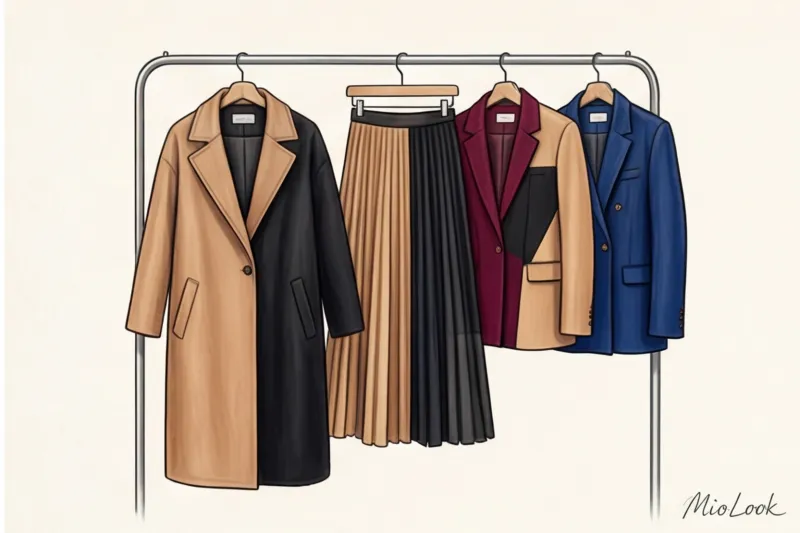
You don't need to buy out half a shopping mall to implement this tool. A smart wardrobe is a compact wardrobe. Here are the brands I recommend in Europe for budgets under €200 per item.
- COS and &Other Stories: These are ideal brands for architectural tailoring. Their patterns are often built on straight lines and heavy cotton. Look for split-color shirt dresses here (budget around €100–€150).
- Massimo Dutti: We're looking for a thick top layer here. We're looking for a long, contrasting wool suit vest (€120–€160) that will create that perfect vertical edge over a basic black top.
- Zara (selective): Premium lines (Studio or Zara Woman) offer excellent wide-leg, straight-leg trousers with contrasting stripes (from €50). The side hem on these trousers works on the same principle as side panels on a dress—it infinitely elongates the legs.
Don't buy too much at once. Start with one perfect piece that will fit you perfectly. Remember the golden rule: a piece should earn its place in your closet. If it doesn't flatter you, but only disguises you, it doesn't belong there.
Conclusion: Your New Silhouette
Color isn't just a way to lift your spirits. In the right hands, it's a precise, mathematically calibrated tool that can transform your body's geometry in a matter of seconds. Color blocking allows us to forego exhausting diets just to "fit into a dress," and instead makes the dress itself work to our natural features.
Stop hiding behind bland, dark robes. Take stock of your wardrobe today: break out your monochrome basics and try breaking them up with a contrasting, long jacket or an open shirt. You'll immediately see completely new, put-together proportions in the mirror.