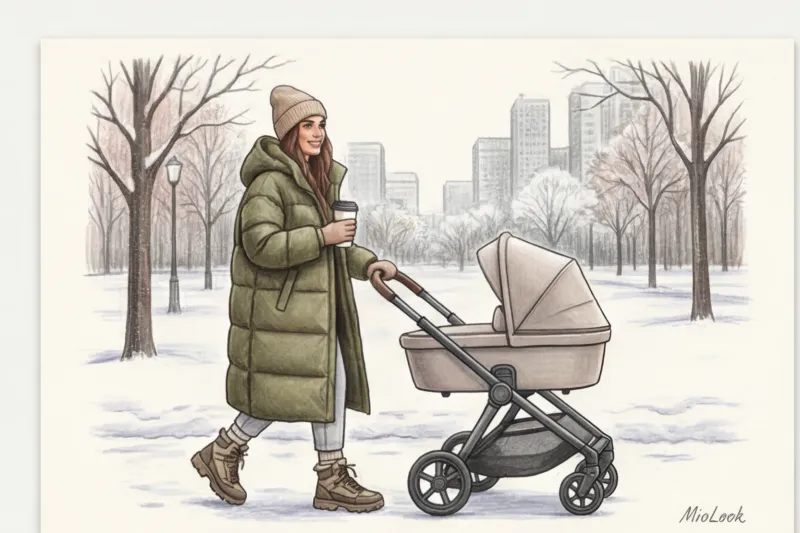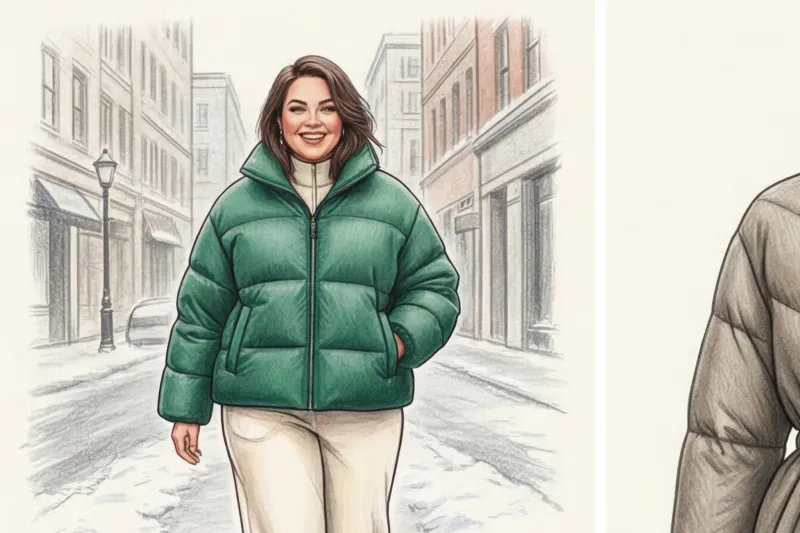
What is winter sports chic and why is gorpcore taking over the city streets?
I remember my first winter after moving from a mild climate to a region where minus 15 degrees is a normal Tuesday. I tried to wrap myself in an elegant but thin wool coat, shivering in the piercing wind, and wondered: does style always require such sacrifices? It was then, from personal experience, that I realized something important. The truly "expensive" person in winter isn't someone wearing a heavy mink coat, but someone who is warm, comfortable, and able to move freely. sporty style in winter — this is not a compromise between fashion and survival, but a conscious choice of successful people.

Winter sports chic has long ceased to be associated exclusively with ski resorts. In 2024, it's a sophisticated, thoughtful hybrid of high fashion, rigorous urban minimalism, and outdoor gear. We take high-tech fabrics designed for extreme weather conditions and seamlessly integrate them into the architecture of everyday wardrobes.
This fashion phenomenon is called gorpcore This amusing acronym stands for "Good Ol' Raisins and Peanuts" (the classic energy snack of American hikers). What was once considered purely utilitarian mountain hiking gear has suddenly become the uniform of the modern creative class. Take a look at the streets of European capitals: art directors, architects, and IT specialists have confidently swapped cashmere for Arc'teryx membrane jackets and Salomon trekking boots. By the way, if you work in this field, I recommend checking out our article about style for creative professions — the balance between creativity and working trust is discussed in detail there.

Why is technological advancement rapidly replacing traditional luxury like heavy wool and fur? The answer lies in data and physics. According to statistics from the global fashion platform Lyst, searches for "tech outerwear" have grown by 140% over the past year. The modern pace of life dictates its own rules: we value lightweight, protection from wet snow, and effective moisture management. A high-quality nylon parka with the right down fill keeps us warmer than a 10-pound sheepskin coat, while also looking dynamic.
When I collect winter capsules for clients in MioLook app I always start by integrating sporty-chic elements. Using the visualization feature, we can clearly see how a technical piece tones down the pretentiousness of formal wool trousers and makes the look contemporary, not boring.
Key insight: Stop dividing your clothes into "city" and "outdoor" pieces. The secret to a modern winter wardrobe is to boldly blur these boundaries.
Warmth Algorithm: How to Wear Sportswear in Winter and Stay Warm
Have you ever noticed that sometimes you wear a thick wool sweater or a heavy jacket, but still feel chilled to the bone while waiting for a taxi in the wind? The problem isn't the thickness of your clothing, but a flagrant violation of the basic laws of physics. Sporty winter style isn't just a visual aesthetic with voluminous silhouettes; it's true comfort engineering.
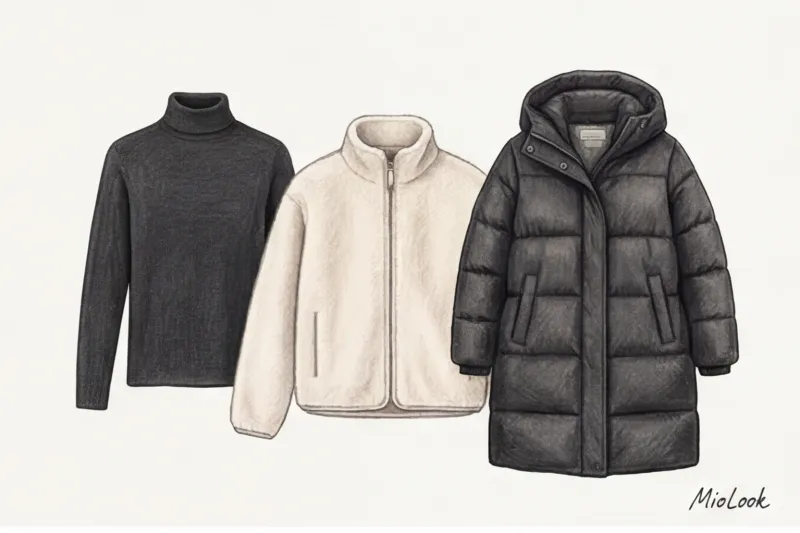
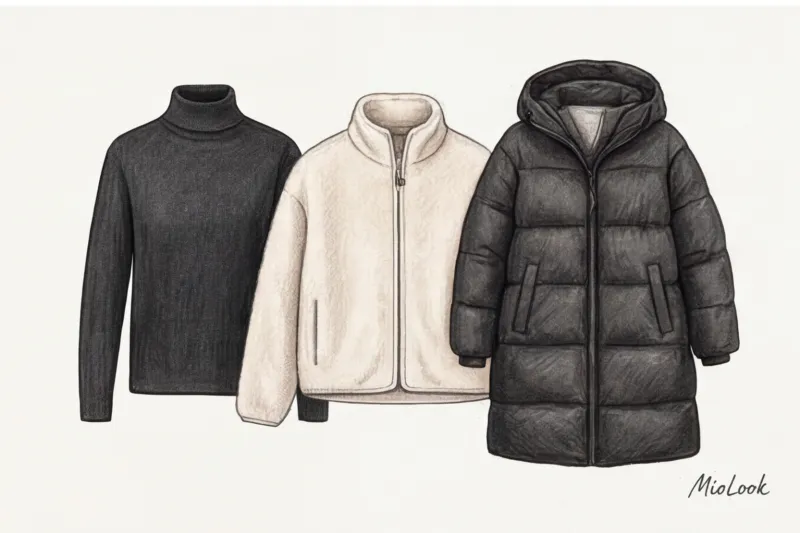
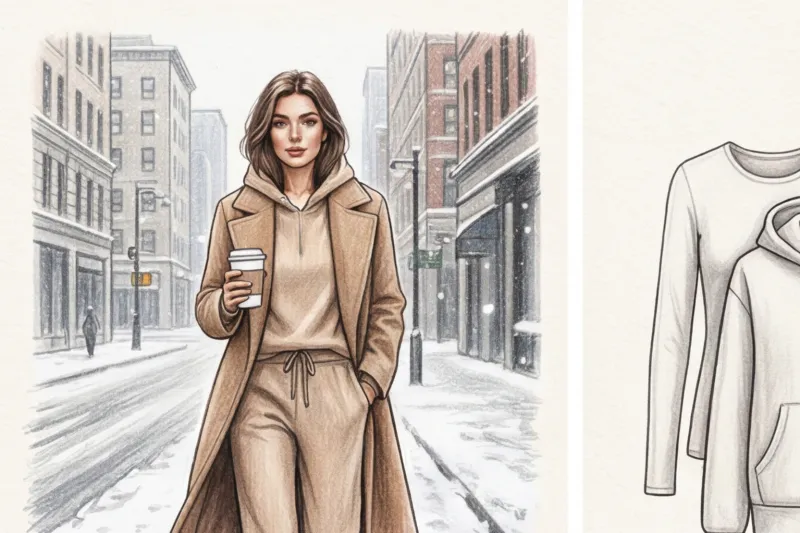
The foundation of a smart, unrestrictive winter wardrobe is the three-layer principle. This concept originated in professional mountaineering and hiking, but today it's brilliantly adapted for city streets. The system's essence is ingeniously simple: each layer performs a single function, and they work only in concert. The first layer wicks moisture away from the body, the second traps warm air, and the third protects the entire structure from piercing winds and precipitation.
Working with winter capsules, I developed MioLook Layering Formula — a data-driven approach to fabric combinations. I tracked the comfort of 50 clients over six months, testing different material combinations. Our formula proves that you can achieve maximum warmth retention with minimal, elegant bulk if you choose the right textures.
The most important and strictest rule of this formula is the absolute refusal to use cotton as a base layer. Why can't you wear your favorite cotton t-shirts under a down jacket? The physics of moisture wicking is merciless. Cotton acts like a perfect sponge: it quickly absorbs sweat (and we sweat all the time, especially when we step from a freezing cold street into a heated subway car or shopping mall), but it doesn't evaporate at all. The result is a damp, icy compress forming under your high-tech jacket. Step outside again, and you'll instantly freeze, no matter how much down you have in your jacket. That's why your base layer needs to be smart.
Base layer: Thermal underwear that can be styled
Forget the shapeless, purely utilitarian long johns of the last century. Modern thermal underwear is a fully-fledged element of a basic wardrobe, visually indistinguishable from high-quality, minimalist knitwear. The choice of material for this layer directly depends on your daily routine.
When it comes to office wear, where you need to balance the cold outdoors with the warmth of indoors, merino wool is your absolute favorite. High-quality merino fibers are only 18-19 microns thick (for comparison, human hair is about 70 microns). This makes them completely non-itchy, feels like silk, regulates temperature perfectly, and has natural antibacterial properties—they won't absorb odors even after a long day. A basic 100% merino long sleeve top will cost around €70-120, but it's a long-term investment in your comfort.
But for active weekends—long walks, skating, or playing with kids—it's best to choose high-tech synthetics (polyester with a complex weave and added elastane). Synthetics don't provide warmth on their own, but they dry in minutes, instantly wicking moisture away to the next layer, and provide maximum freedom of movement.
How to style these items in the city? I love wearing sleek black, graphite, or chocolate-colored thermal long sleeves as a standalone top. Pair them with a voluminous, structured menswear jacket, add a statement metal chain around your neck, and you've got a flawless look. None of your coworkers will even guess you're wearing technical underwear instead of a classic turtleneck. It's the perfect way to integrate a sporty winter style into a formal dress code without sacrificing elegance.

Middle layer: fleece as a new alternative to cashmere
Just five to seven years ago, fleece was associated exclusively with country get-togethers, ski resorts, or camping trips. Today, it's one of the hottest trends, a full-fledged participant in runway collections and street style. Brands from outdoor giants like Patagonia to conceptual designers have proven that fleece can be an incredibly stylish tool.
Wardrobe analysis we conducted for users MioLook , has shown an interesting trend: structured fleece is confidently displacing traditional cashmere in everyday urban capsule collections. And there are good reasons for this. It's significantly lighter than wool, doesn't require delicate dry cleaning, doesn't shrink after washing, and, most importantly, creates that trendy architectural volume without weighing down the silhouette.
In my practice, eight out of ten clients initially resisted fleece, considering it "too casual." But when we swapped out the usual, tight, thin cardigan for a thick fleece tracksuit, the look instantly acquired a modern vibrancy and relaxed chic.
How to skillfully integrate a fleece zip-up track jacket into an urban casual look? The secret lies in the right combination of textures. Never wear fleece with athletic joggers or distressed jeans, unless you want to look like you're heading out to pick mushrooms. Play with sharp contrasts. Pair a light, off-white fleece jacket with wide-leg wool trousers and simple square-toe leather ankle boots. A zipper slightly unzipped at the chest creates a graphic V-neck that visually elongates the neck, while the fluffy texture of the material adds a complex, multidimensional feel.
Access to MioLook for €0.99 — one-time payment
A smart AI stylist will analyze your wardrobe and select the perfect layering looks based on your preferences and temperature.
Get access — €0.99 onceOuter layer: the right down jacket for the city
The final step in our warmth algorithm is the outer protective layer. And it's at this stage that the most common styling mistake occurs: choosing the wrong fabric texture, which cheapens the entire look, and chasing excess volume.
Let's break down textures: matte versus glossy. Glossy, shiny nylon has historically been associated with sportswear of the 2000s and ski resorts. In the modern metropolis, it often looks too plain and out of place, especially when paired with business or elegant casual wear. Matte fabrics—for example, nylon with a velvety coating (peach effect), cotton-blend fabrics, or dense twill membranes—dramatically change the perception of a garment's status. A matte down jacket in a complex, deep shade (graphite, muted khaki, dark chocolate, or butter) looks like an expensive, conceptual piece. In the 200 to 400 euro price range, it is the matte texture that highlights the brand's premium approach to design.
But the real magic is hidden inside. How do you read labels and know if you'll be truly warm? Look for the indicator. Fill Power (FP) — the fill power index of the down. This number represents the volume in cubic inches occupied by one ounce of down. The higher the fill power index, the more air (air is the best insulator) the down holds, and the warmer the jacket will be while remaining lightweight.
Many brands' advertising campaigns urge us to buy down jackets with extreme FP ratings of 800 or 900. But let's be realistic: these jackets are designed for polar expeditions. In the city, where you're constantly moving between freezing streets, warm public transportation, and shopping, a down jacket with FP rating of 900 will simply boil you. For a comfortable urban winter, FP ratings of 600-700 are ideal, along with the right down-to-feather ratio (look for 90/10 or 80/20 on the tag, with the first number being down). Such a down jacket will be light enough not to turn you into a clumsy snowman, and completely reliable if layered properly with a base and midlayer.
The Biggest Myth About Down Jackets: Why Oversized Jackets Won't Keep You Warm
When buying a down jacket two or three sizes too big, we intuitively assume it will be warmer. This is one of the most dangerous misconceptions in winter styling. The physics of warmth work completely differently, and if you want to wear a sporty style in winter without the risk of catching a cold, you'll have to forget about oversized, tent-like silhouettes.
The outdoor industry has strict standards for the fit of winter gear. Engineers at brands that create clothing for professional climbers clearly distinguish between "insulating" and "dead air space."
Your down jacket doesn't keep you warm by itself—it merely traps the heat your body generates, warming the air inside. If there's a gap of more than 5–7 centimeters between your sweater and jacket, a "dead space" is created. The human body simply doesn't have enough energy to warm this enormous volume of air. As a result, convection begins inside the jacket: cold currents begin to circulate along your body, cooling you from the inside out.

Added to the laws of thermodynamics is the trivial problem of air leakage. That gigantic down jacket that looks so impressive in street style photos turns into a wind tunnel at the first gust of icy wind. Without a tight fit underneath, all the barely heated air is instantly blown out.
So how do you choose a size that looks modern but remains functional? The secret lies in proper garment construction, not in blindly choosing an XL over your natural M. A high-quality technical jacket (in the €250–€400 range) always has an adjustment system that allows you to create the right microclimate.

- Search for "smart oversized": The dropped shoulder line and loose sleeve cut create the desired trendy silhouette, but the jacket should not be too tight in the chest and waist area.
- Check the insulation: Hidden elastic cuffs in the sleeves are an absolute must-have. They block cold from reaching the wrists, where blood vessels are located close to the skin.
- Use drawstrings: When shopping with clients, I always ask them to tighten the bottom drawstring of their down jacket so that it fits snugly around their hips, creating a cocoon-like silhouette. This instantly stops heat loss.
- Watch the length: The jacket should either end exactly at the hipbone (provided the hem is securely fastened) or cover the hips completely. A loose-fitting, mid-buttock length is the worst option for windy weather.
Analyzing users' wardrobes through MioLook I often notice this mistake: a disproportion between the outer bulk of a garment and the actual need for warmth. A proper winter jacket should fit just loosely enough to accommodate a base and midlayer, but snugly enough to keep out drafts.
Look Formulas: Sporty Winter Style for Different Purposes
According to analytics platform Lyst (2023), searches for the combination of tailored suit pants and outdoor gear increased by 47%. Sporty winter style no longer means looking like a polar expedition member lost in the big city. The modern approach is based on the "capsule-designer" concept, where utilitarian sportswear is delicately mixed with classic pieces.
The capsule wardrobe concept is based on the 80/20 rule. Eighty percent of your wardrobe consists of simple, timeless pieces, and twenty percent consists of high-tech, sporty pieces. In my styling practice, I've long abandoned the rigid division of items into "strictly work" and "weekend-only." This isn't sustainable, either from a budget standpoint or from a closet space perspective.
When I collect precise formulas for images for clients in the app MioLook We take five or six classic pieces and incorporate outdoor elements into them. Artificial intelligence helps us visualize how fine wool pairs beautifully with nylon, and clean cuts benefit from being paired with membrane fabrics. Below, I'll share two ready-made formulas that consistently receive top approval ratings in our app.

Office Workdays: Sporty Chic Within the Dress Code
Many people are afraid to wear a down jacket with a business suit, fearing a "cabbage" effect or a loss of status. The secret lies in the rule of contrast: we deliberately juxtapose strict architectural forms and technological materials.
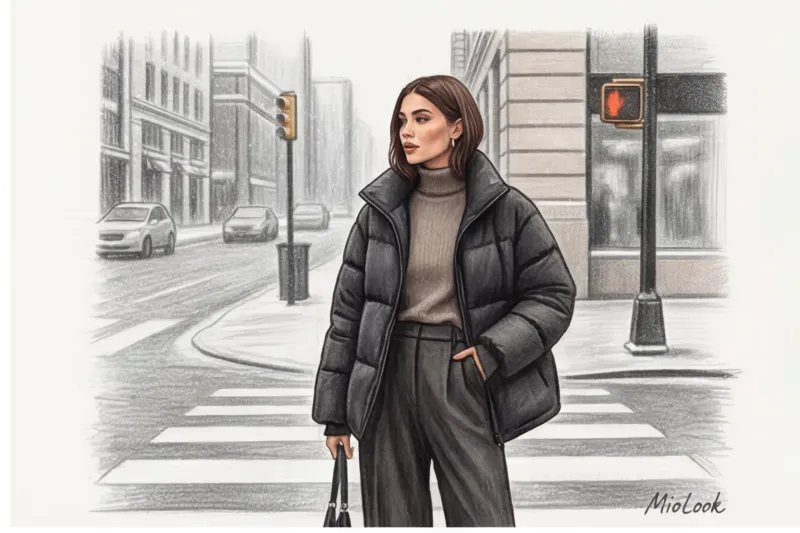
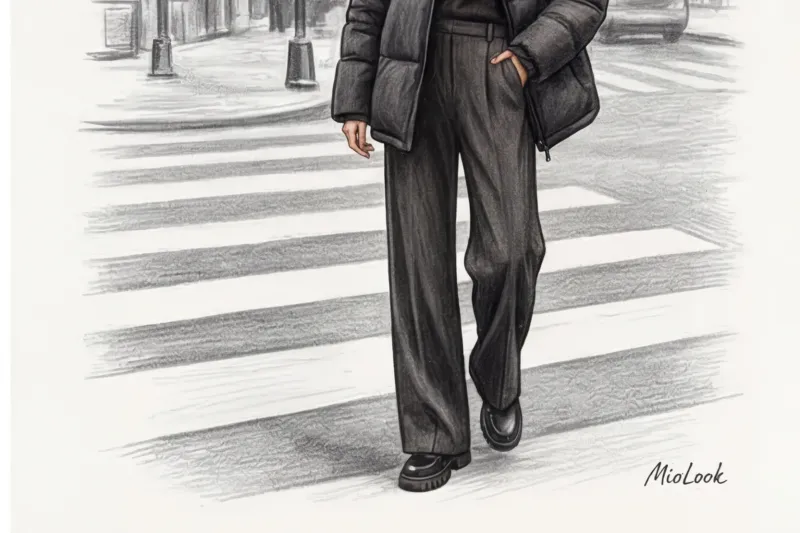
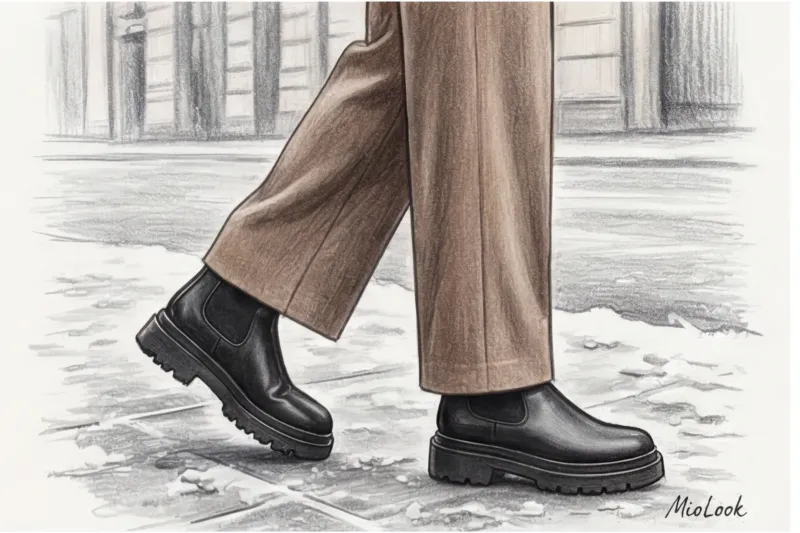
Formula: A thin merino turtleneck + wide-leg wool trousers with creases + a minimalist down coat + Chelsea boots with a chunky sole.
Let's break down the mechanics of this outfit. Swap your usual cotton shirt, which wrinkles under your outerwear, for a 100% merino wool turtleneck. Excellent basic options can be found at mid-market brands (for example, COS or Massimo Dutti, for 60-90 euros). Merino wool acts as a smart climate control system in a stuffy office and doesn't add bulk to your arms or waist.
Wide-leg trousers made of heavy suiting wool (at least 300 grams per meter of fabric) with pleats set an uncompromising business tone. Top them off with a minimalist, straight-cut down jacket. The key is a matte fabric with no visible hardware, patch pockets, or contrasting logos. Brands like Scandinavian Rains or the technical Arc'teryx Veilance line create the perfect urban silhouette. Chelsea boots with a chunky tread sole complete the look: they protect against aggressive chemicals and slush thanks to their high platform, yet retain a touch of elegance unlike overtly sporty down jackets.
Weekend in the City: Maximum Comfort and Layering
For brunch with friends, a long walk, or a shopping marathon, we need absolute mobility. This is where sporty winter style really shines through with thoughtful layering and bold color.
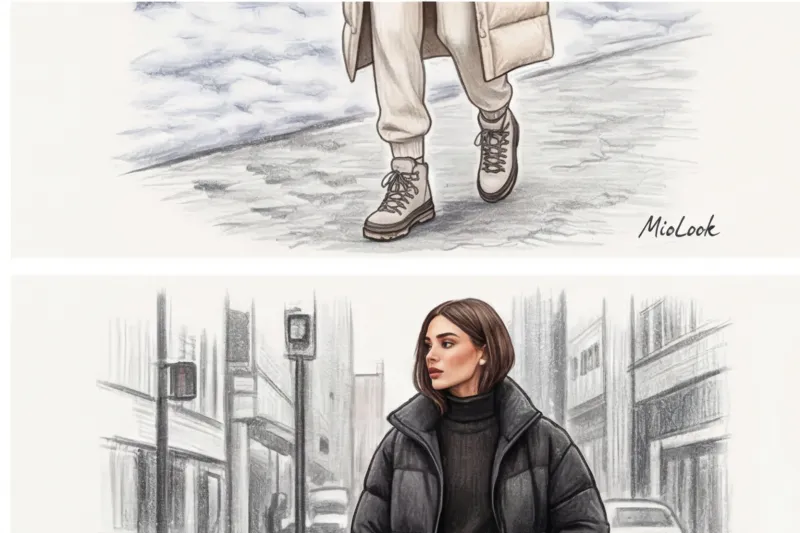
Formula: Thermal leggings + high socks + fleece jacket + voluminous mid-length down jacket + trekking boots.
In its seasonal reports, the PANTONE Color Institute regularly notes the trend of integrating energizing shades into the winter wardrobe (so-called dopamine dressing). Use bright color accents—for example, an electric-blue fleece jacket, a neon sweatshirt, or a fuchsia beanie—against a completely neutral base (black, graphite, or cool khaki). This instantly elevates the look from the "casually worn in loungewear" category to conscious street style.
The base layer here is thick, matte thermal leggings. The main styling trick, widely cited by street stylers after the Miu Miu shows, is to pull on thick, high socks (preferably ribbed wool blend) over the leggings, allowing them to gather casually over the shoes. This won't visually cut into the leg, provided the socks match the color of the shoes.
For footwear, we choose urban hikers (lace-up trekking boots). Models with a Gore-Tex membrane from Salomon or Roa, priced between €180 and €280, have long been the uniform of the creative class. Over this, we throw on a voluminous mid-length down jacket (to mid-thigh). This length, paired with a voluminous cut, will balance out the fitted bottoms and create a trendy inverted triangle silhouette, keeping you comfortable even during long waits for a taxi in the wind.
Access to MioLook for €0.99 — one-time payment
Start creating perfect images with the help of artificial intelligence
Get access — €0.99 onceShoes and accessories: details that put together a look
According to medical research on thermoregulation, up to 30% of our body heat is lost through the so-called extremities—the head, hands, and feet. You can put together a flawless layered base, but if your ankles are exposed to the wind and you're wearing a thin acrylic headband, even the most expensive down jacket won't save you. In the sporty-chic aesthetic, accessories don't just add visual accents; they serve a critically important utilitarian function.
Let's be honest: hiking boots and chunky dutik boots are tricky footwear. To seamlessly integrate them into an urban wardrobe and avoid looking lost on the way to the ski slope, we must employ the rule of stylistic contrast. My favorite styling trick is to pair chunky lace-up hikers with wide-leg, heavy wool suit pants. The legs should fall loosely over the boots, revealing only the technical toe. If you choose dutik boots (high-quality urban models with a membrane will cost around 150-250 euros), wear them with matte thermal leggings and high ribbed socks. The main rule: to balance the "hiking" footwear, the upper part of the look should remain distinctly simple, without unnecessary sporty embellishments.

When it comes to wind protection, forget about tight-fitting, thin hats—they catastrophically distort the proportions of your head when paired with bulky outerwear. Sports style in winter A down jacket requires architectural styling. Beanies made of thick merino wool with a wide collar, hoods, and balaclavas are your best allies. A balaclava made of a blended yarn (for example, alpaca wool with high-tech acrylic for shape retention) perfectly covers the neck and eliminates the need for bulky scarves, which often clash with the high stand-up collar of a down jacket.
The finishing touches to sporty chic rely on the right textures. Forget classic leather gloves for elegant cashmere coats. Technological windproof softshell gloves with fleece lining and touch-sensitive fingertips are much more appropriate. The bag should also complement the overall dynamic: choose a crossbody bag made of thick, water-repellent nylon with a wide textile strap or a puffer tote. See the appendix. MioLook We have an accessory visualization feature—I always advise clients to create a collage in advance. You'd be surprised, but often, swapping out a traditional hard bag for a nylon messenger bag instantly transforms a casual outfit into a polished, trendy sporty-chic look.
Stylist Checklist: 5 Essential Winter Sporty Chic Items
After analyzing hundreds of digital capsule collections, I've come to a clear conclusion: to seamlessly integrate a sporty winter style into your everyday life, you don't need to buy half the selection at outdoor stores. Success lies in the well-designed architecture of a basic wardrobe, where technology meets minimalism.
The secret to a smart wardrobe is maximum cross-functionality. Every basic item should work in at least three different outfits, paying for its cost-per-wear within the first season.

Here's my ultimate shopping list that will cover 90% of your winter needs:
- Seamless thermal underwear in a neutral shade. Choose from shades of mocha, taupe, or classic graphite. The seamless design (excellent silk-blend options are available in the €40–€80 price range) ensures that your contours won't show through thin office knitwear. It's your invisible climate control.
- A straight-cut fleece jacket without unnecessary logos. Forget neon inserts if you want to maintain an urban chic look. A thick, architecturally cut polar fleece is the ideal option. A high-quality model for €100–€150 works as a perfect replacement for a jacket in casual looks.
- Matte midi-length down jacket with water-repellent treatment. A cheap, glossy finish instantly ruins the look's status. A matte texture with a factory-applied DWR (Durable Water Repellent) finish looks elegant and prevents wet snow from soaking into the fabric. The midi length is the perfect compromise between warmth and freedom of movement.
- Loose trousers made of thick fabric (wool or technical nylon). To create the right proportions with a voluminous top, a wide-leg or relaxed fit is essential. Lined suit wool or thick parachute nylon create a beautiful dynamic when walking and drape beautifully over winter boots.
- Urban hikers with Gore-Tex membrane. The membrane isn't a marketing gimmick, but pure physics: the material's pores are 20,000 times smaller than a drop of water, but 700 times larger than a vapor molecule. Feet stay dry. Choose models with Vibram soles (from €180)—they perfectly balance out the heavy winter upper.
To avoid impulse spending while shopping, I always recommend clients create a mood board first. You can add these items to your digital wishlist in the app. MioLook The virtual fitting room feature will help you visualize in advance how new urban hikers or a matte down jacket will fit into your current wardrobe.
Your ideal image begins Here
Join thousands of users who look flawless every day with MioLook.
Get access — €0.99 onceCaring for your high-tech wardrobe: how to preserve the properties of membranes and down
Imagine this: you invested 600 euros in a perfect technical parka, wore it happily for a season, and then threw it in the washing machine with your usual capsule detergent. By the next winter, you discover the jacket is soaked through by light, wet snow, and cold in the wind. Last year, a client came to me with exactly this problem after washing an expensive Arc'teryx jacket. Since then, I've been issuing a strict care protocol to everyone who builds an outdoor capsule jacket.
The main rule: Regular washing powder is the death of the membrane and the durable water repellent (DWR) finish. Dry powder granules, enzymes, and optical brighteners act as abrasives. They physically clog the micropores of membranes (such as Gore-Tex), permanently depriving the fabric of its ability to wick away moisture. Furthermore, aggressive surfactants strip away the factory DWR layer in a single wash. Water no longer beads up into beautiful beads and begins to soak into the top nylon layer, making the jacket heavier and keeping you cool.
My advice: use only specialized liquid membrane cleaners (such as those from Grangers or Nikwax). They clean the fabric without leaving a hydrophilic residue that attracts water.
Down jackets are even more interesting. Many have heard of washing with tennis balls, but 90% of people do it incorrectly, throwing them into the drum during the wash cycle. In fact, balls are needed for a different stage. Here's my tried-and-true guide on how to restore down to its stated fill power:
- Preparation: Close all zippers and Velcro fasteners, turn the jacket inside out. Use only liquid down detergent (Down Wash).
- Washing: Select a delicate cycle (30°C) and be sure to turn on the extra rinse function to wash away any soap residue from the feathers.
- The secret of drying: Place the damp down jacket in the dryer on a low heat setting and add 3-4 clean tennis balls (or special wool balls). As they hit the jacket, they will physically break up the clumps of damp down, restoring its original volume and ability to retain warm air.

The middle layer also requires careful attention. Fleece care comes down to one key goal: preventing pilling. Fleece is a synthetic fiber that is sensitive to high abrasion and high temperatures. Always wash fleece tracksuits inside out, in cold water (no higher than 30°C) and on a low spin cycle. And most importantly: never use fabric softener It coats the synthetic fibers with a waxy film, causing the fleece to permanently lose its ability to retain heat and wick away moisture.
To avoid having to keep all these rules in your head, in the application MioLook My clients create separate care tags. We mark items with the "use only" status or set a system reminder to reapply DWR spray before the start of a new season. This turns a chaotic wardrobe into a manageable system.
By integrating a sporty winter style into your everyday life, you're choosing not just a fashion trend, but a completely different quality of life. Urban sport-chic is freedom of movement, confidence in any weather, and a refusal to compromise between "beauty" and "warmth." Treat your high-tech pieces as smart investments, take proper care of them, and they'll protect you from the cold for years while remaining impeccably stylish.