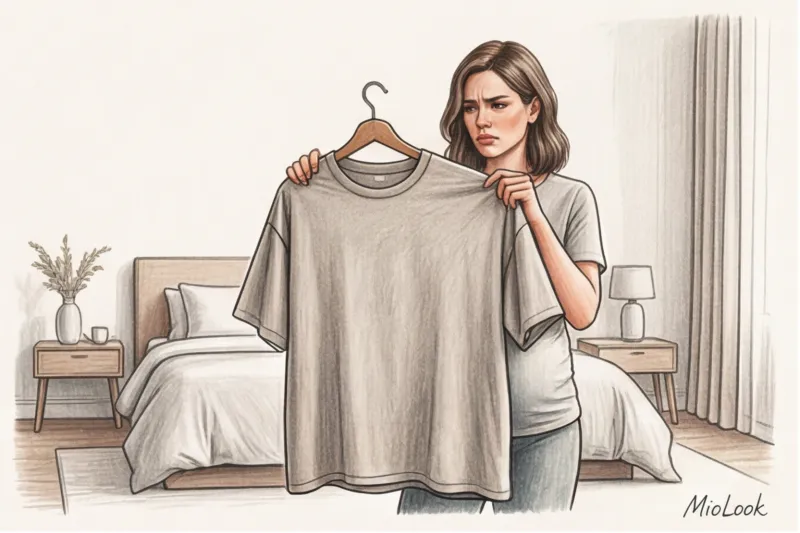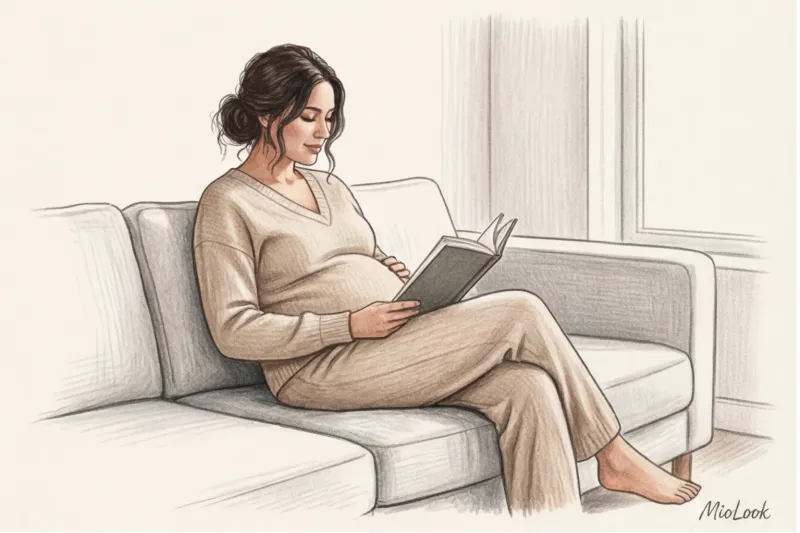
One of my clients once burst into tears in front of the mirror in her eighth month of pregnancy. The reason? She was wearing her husband's stretched-out gray T-shirt with a tea stain on her stomach and a pair of old sweatpants. "I feel like a huge, shapeless cloud, not a woman," she told me during an online consultation. Sound familiar? Statistics show that during the final months of pregnancy and the first months of maternity leave, a woman spends up to 90% of her time at home. And what she wears during these hours literally shapes her self-esteem and energy levels.
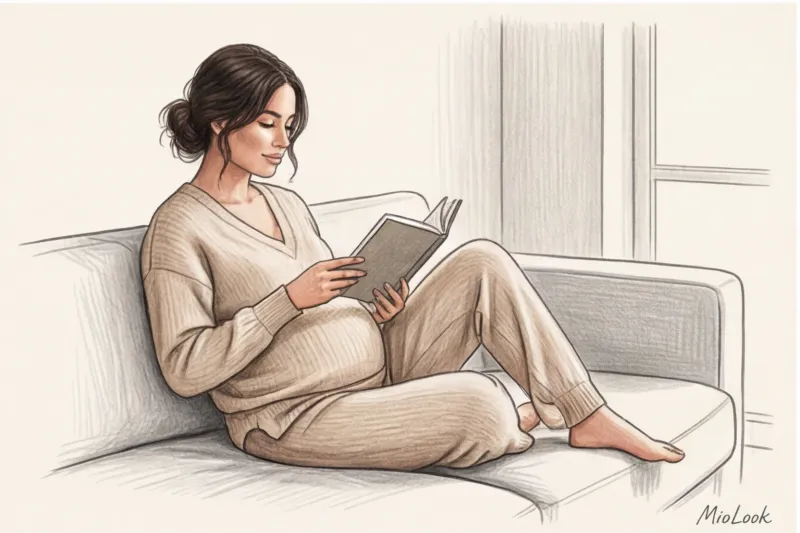
Maternity loungewear isn't just rags you "don't mind getting dirty with spit-up." It's your armor. We've covered the basic principles of creating cozy and aesthetically pleasing looks in our the complete guide to stylish loungewear In this article, we'll apply a data-driven approach to maternity wardrobe planning. Forget the bad advice of "just buy three sizes too big." We'll use math, smart fabrics, and capsule logic to save your budget and protect your nervous system.
Maternity Loungewear: Why Are Old T-Shirts a Wasted Resource?
When your body changes daily and hormonal fluctuations test your resilience, your wardrobe should be a source of support, not a source of stress. Wearing clothes around the house that should have been thrown out long ago sends a daily signal to your brain: "I'm not a priority right now."
A study by Northwestern University (2012) has scientifically proven the phenomenon Enclothed Cognition (embodied cognition) – our behavior, confidence, and even cognitive abilities are directly dependent on the symbolic meaning of the clothes we wear. During the most vulnerable period of a woman's life, this law is 200% effective. By putting on a beautiful modal suit instead of a washed-out sweatshirt, you physically straighten your back. This is the best prevention of postpartum blues.
"High-quality clothes for your home while on maternity leave aren't a frivolous expense for four months. They're a direct investment in your mental health and the resilience your baby so desperately needs."
In my practice, replacing a "poor" home kit with a well-designed capsule has transformed my clients' moods in a single day. If you're interested in the profound connection between what you wear and how you feel, I recommend reading this article. "The Psychology of Your Wardrobe: Why Old T-Shirts Are Stealing Your Energy".
The biggest styling mistake: the 'two sizes too big' myth
The biggest misconception I hear from expectant mothers is, "Why spend money on special clothing? I'll just buy some plus-size T-shirts from the men's department." This is a disservice to your figure. Men's clothing, or simply larger sizes, have a completely different shoulder and armhole structure. Trying to hide your belly, you're visually adding 10 kilograms to your shoulders and chest.
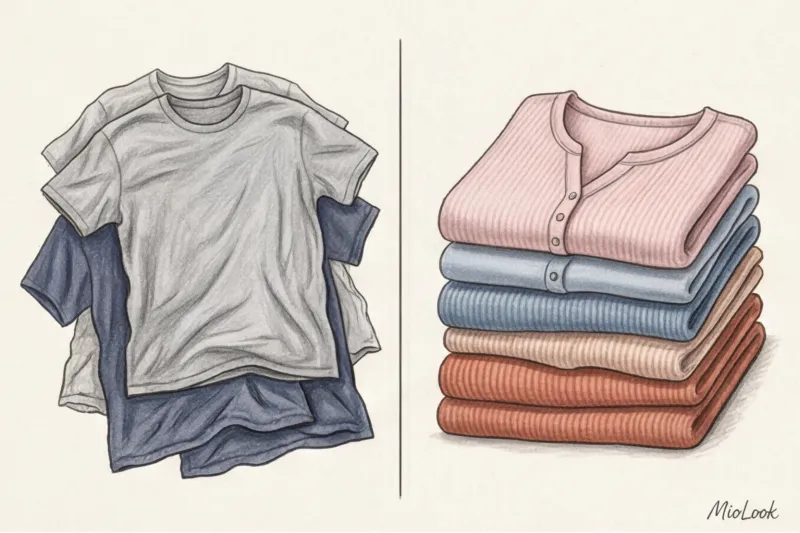
It's important to understand the difference between a proper oversize (a thoughtful cut that preserves the fragility of your wrists and shoulders) and an "oversized" garment that makes you look like a rectangle. Furthermore, buying clothes labeled "maternity" is often a waste of money. My counterintuitive advice: Buy nursing-first clothes Loose fit. It will perfectly accommodate your belly in the 9th month, and after giving birth, it will last you another 1.5 to 2 years.
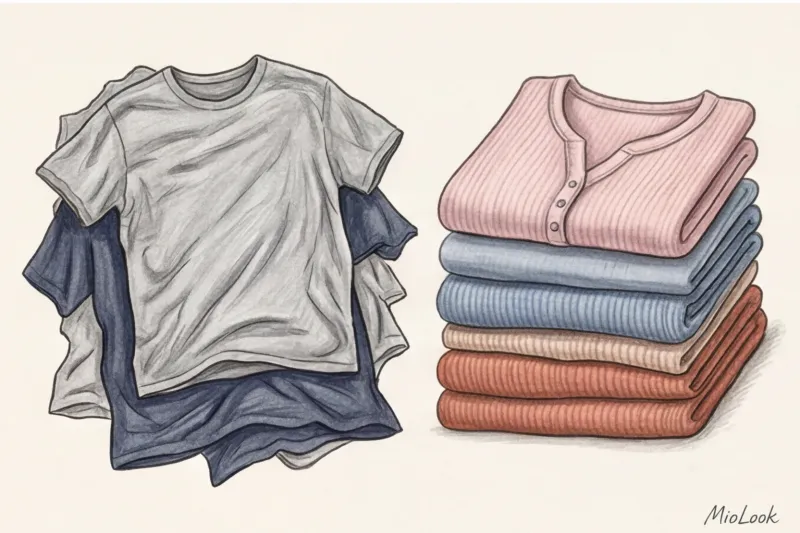
Let's count Cost Per Wear (CPW) — the cost of one outfit. A cheap, mass-market nightgown for €15 will lose its shape and become covered in pills after five washes (€3 per wear). But you'll wear a high-quality, basic nursing outfit for €80 for at least 600 days (the last months of pregnancy and lactation). Total: €0.13 per day! The math proves: one premium home set is more cost-effective than a stack of cheap knitwear.
Your perfect look starts here
Join thousands of users who look flawless every day with the smart MioLook algorithm.
Get access — €0.99 onceSmart 2-in-1 Capsule: A Home Wardrobe for Pregnant and Nursing Women
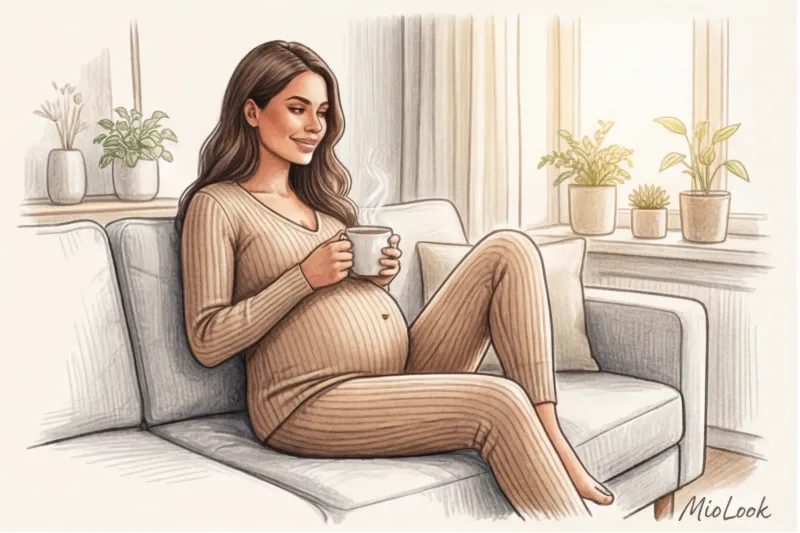
A home capsule follows the same rules as a city capsule: everything must be combined blindly. If you're not familiar with this approach, check out our The Capsule Wardrobe: A Complete Guide The foundation of a maternity capsule is the principle of layering: a cami top with a secret for breastfeeding, a soft cardigan, and trousers. This allows for immediate adaptation to the temperature fluctuations that are inevitable during hormonal changes.
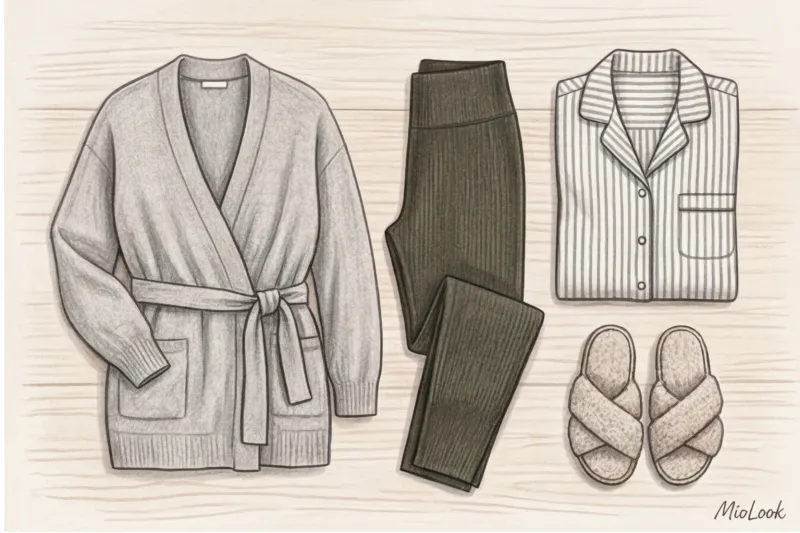
Pay special attention to color. Gray melange fabric is the worst enemy of any home wardrobe. Any stains from water, milk, or baby food immediately show up on it, and the color itself often gives a sallow complexion when sleep-deprived. Choose sophisticated, refined shades: deep emerald, warm chocolate, dusty rose, terracotta, or sapphire. They conceal minor imperfections and look expensive.
High-IQ Fabrics: What Will Protect You From Temperature Changes?
Hot flashes during pregnancy and night sweats during lactation are a harsh reality. I've personally tested various fabrics for thermoregulation and can confidently say: regular heavy cotton is a loser. It absorbs moisture, but takes a long time to dry, which can leave you waking up in a cold, damp T-shirt.
- Modal and Micromodal: The perfect choice. This next-generation viscose fiber flows incredibly softly over the body and absorbs 50% more moisture than cotton.
- Bamboo fiber: According to research by textile institutes, bamboo is several times more hygroscopic than synthetic fibers. It has a slight cooling effect.
- Viscose Ecovero: An eco-friendly and breathable material that doesn't roll up as quickly as cheap knitwear.
The forbidden list: stiff acrylic, cheap fleece, and sub-premium polyester. They create a greenhouse effect, impairing heat exchange. An important limitation of my method: if you are prone to severe allergies, choose only 100% organic cotton with a minimum weight of 180 g/m², even if it has slightly worse moisture-wicking properties.
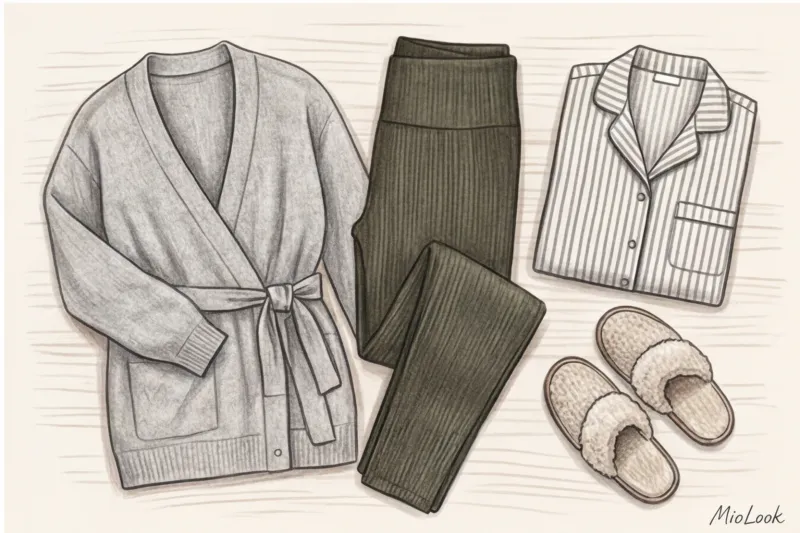
Styles that work for you
Clothes should adapt to you, not you to them. An analysis of cuts from the perspective of changing body proportions (which we wrote about in detail in the article How to choose clothes according to your body type ) shows that rigid belt structures should be excluded completely.
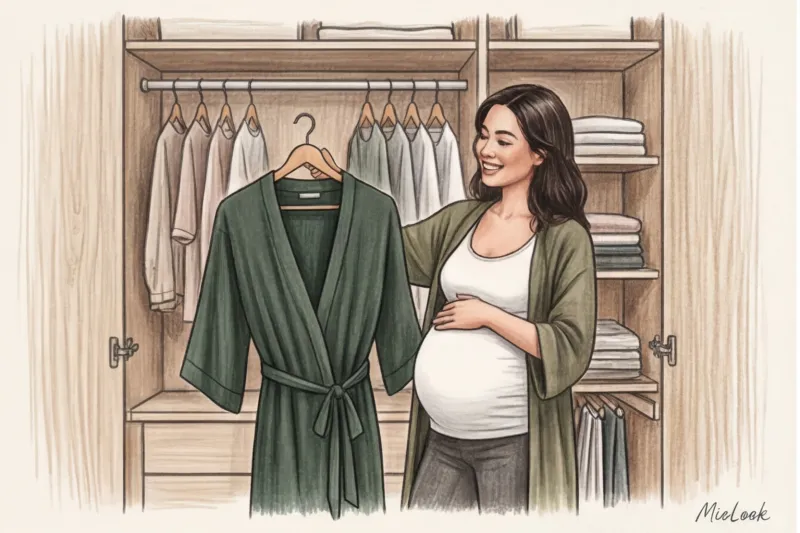
My favorites for the maternity capsule:
- Kimonos and wrap dresses: A brilliant invention. You can adjust the width millimeter by millimeter throughout any month of your pregnancy. After giving birth, the deep V-neck will provide the easiest access for nursing.
- Ribbed trousers with a high elastic waist: The ribbed texture offers incredible stretch. They can be pulled over your belly (like a belly band) or pulled down under it as it sags before labor.
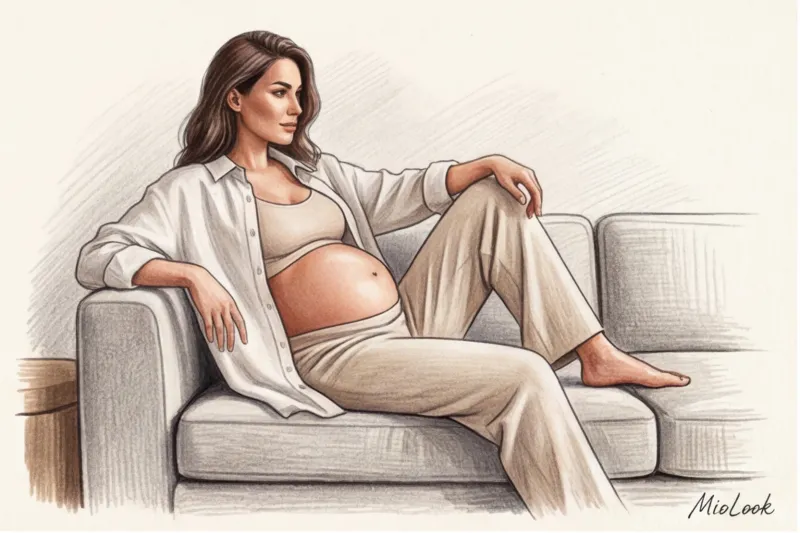
- Men's button-down shirts: An elegant alternative to elongated sweatshirts. Wear them unbuttoned over a nursing top—the vertical lines create a slimming silhouette.
Checklist: 5 Essential Items for a Stylish and Comfortable Maternity Leave
Enough theory, let's get practical. Here's a specific shopping plan I create for my pregnant clients, with a budget ranging from €150 to €300. This five-item list will cover 95% of your household needs.
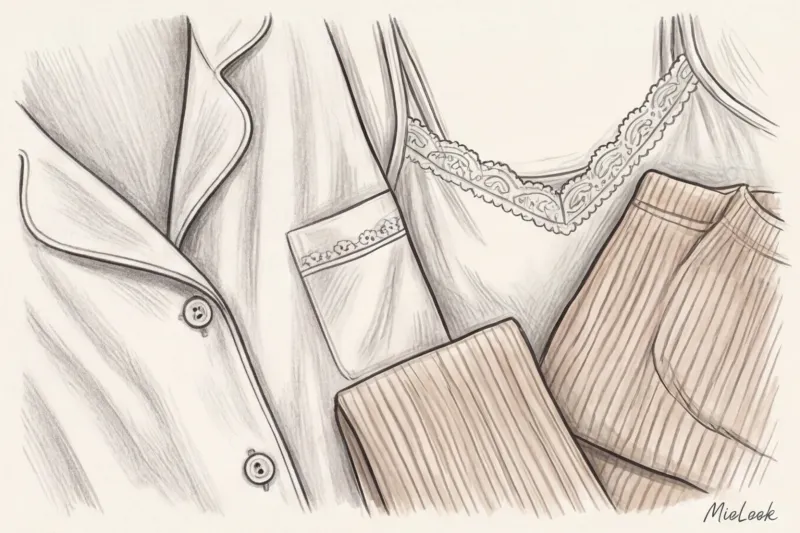
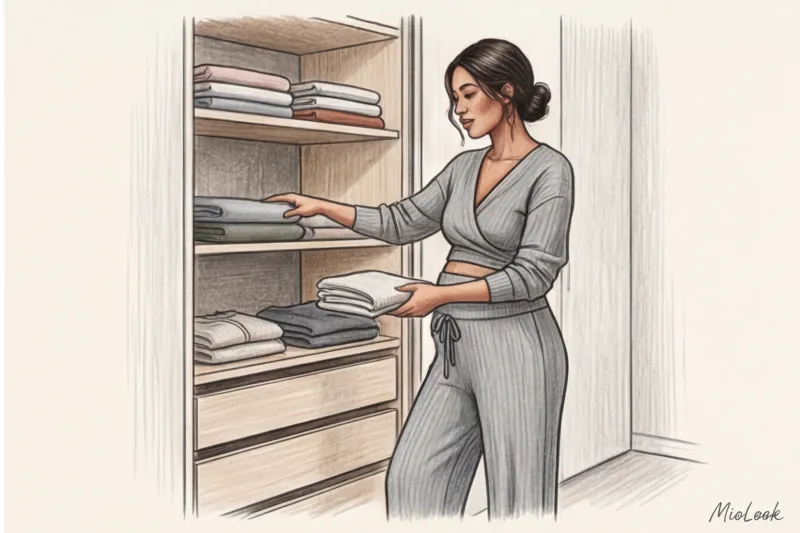
- Ribbed two-piece suit: A top with a secret for breastfeeding and loose-fitting palazzo pants (approximate price €50–90 from brands like Oysho or local eco-labels).
- Long shirt: Made from softened linen (in summer) or thick flannel cotton (in winter). An excellent second layer.
- Midi wrap dress: Made from flowing modal. Choose a length that falls below the knee—it visually elongates your height and looks more put-together than shorter shirts.
- Seamless bra tops (3-4 pieces): Avoid hard underwires. Look for bustier tops in basic colors (black, mocha, powder) with detachable cups.
- Aesthetic house shoes: No more worn-out dog slippers. Invest in simple leather mules with a soft sole or stylish sheepskin slides (from €40). They instantly bring your look together.
Ready to get started?
Try the MioLook plan for free—no commitments required. Upload your capsule and get ready-made look formulas.
Get access — €0.99 onceHow the MioLook app helps you manage your home wardrobe
Young mothers often face decision fatigue — decision fatigue. When you've only slept three hours a night, you literally don't have the neural resources to think, "What should I wear with this cardigan?" This is where technology comes into play.
I recommend digitizing your home capsule. In the app MioLook You can create a separate album called "Home Aesthetics" (or "Maternity Leave"). Just take a photo of your 5-7 basic items, and the AI algorithm will automatically suggest ready-made combinations. Wake up, open the app, choose a generated look—and you'll look like a professional has been working on your style. AI suggestions will help you reimagine familiar items, for example, pairing your husband's shirt with your new ribbed top.
Your comfort is the foundation of the family: a stylist's resume
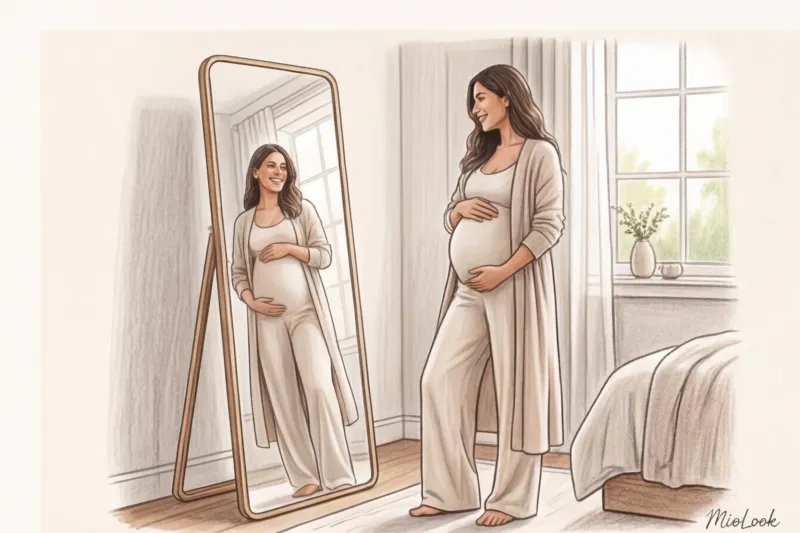
Of course, nice loungewear won't solve your baby's colic or your sleepless nights. But it can become your personal armor, a source of micro-joy in Groundhog Day. When you pass by the mirror and see a stylish, well-groomed woman, not a tired shadow in stretched sweatpants, your cortisol levels drop.
Conduct an audit of your home shelves today. Remove all the items you wear around the house and ruthlessly recycle the "parasites" (those with stains, holes, and sprained knees). Keep only what you wouldn't be embarrassed to wear to a delivery guy or a friend who dropped by unexpectedly.
Invest in what you'll be wearing for the most important part of your life. Your maternity leave isn't a rough patch to be "suffered" in old clothes. This is a time when you deserve the utmost care, beauty, and comfort. Put on your oxygen mask (and a pretty wrap dress) first.