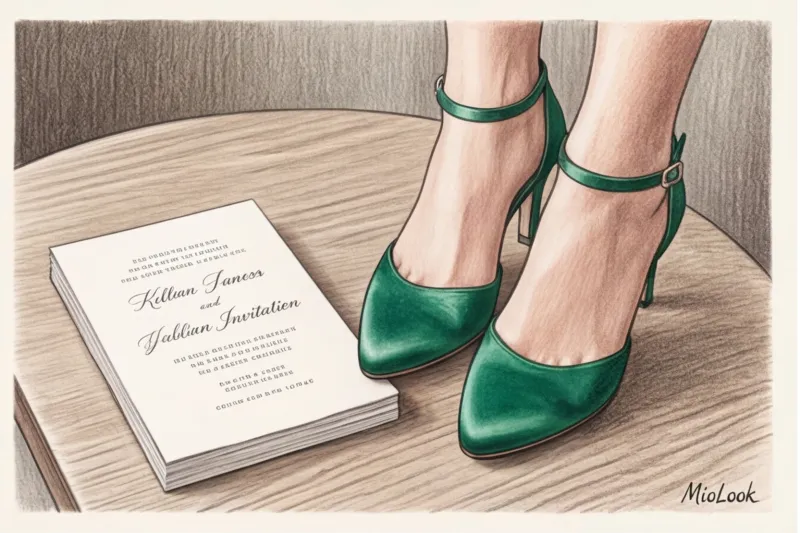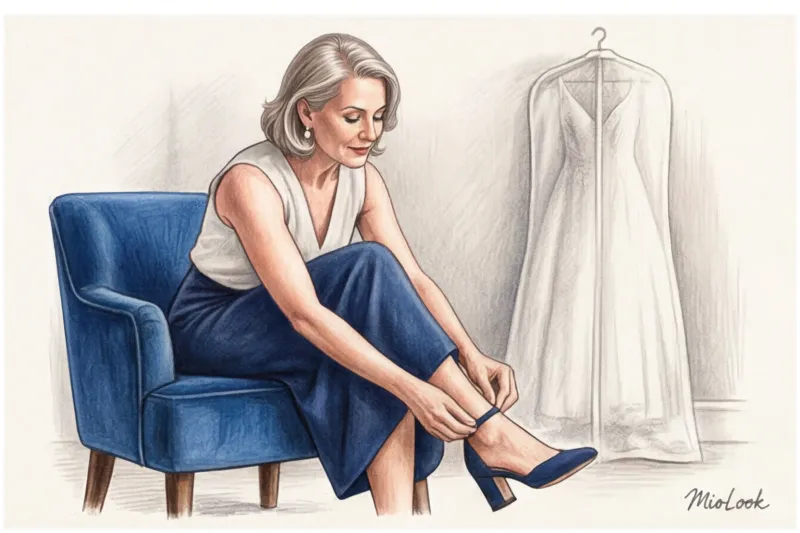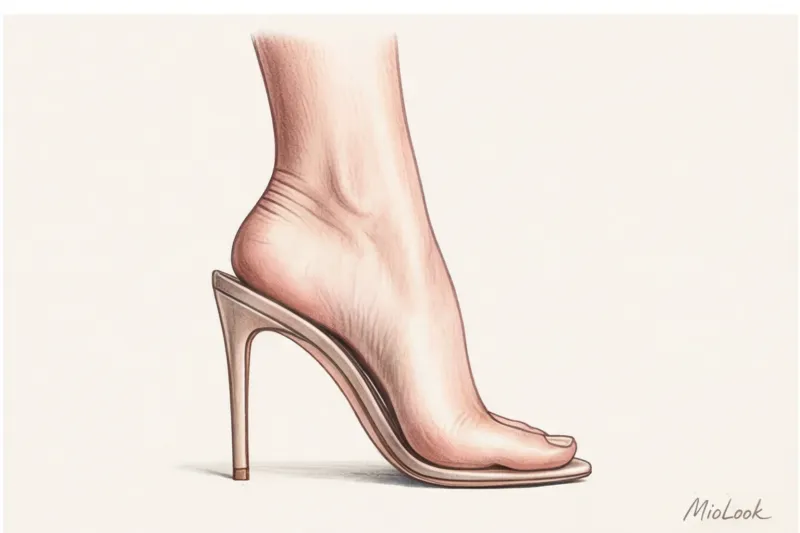
Last season, a client came to me in tears. She'd bought stunning €800 sandals for her Lake Como wedding, but had spent the lavish reception barefoot. Those seemingly perfect shoes had turned her life into torture in just two hours. The problem wasn't the heel height or the brand, but the catastrophically incorrect angle of the last.
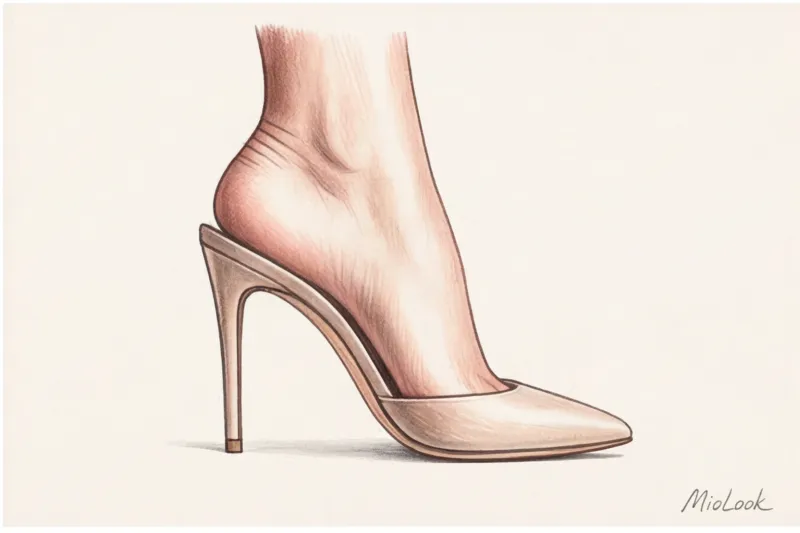
When it comes to events that last between 8 and 12 hours, find comfortable high-heeled shoes It's not a matter of luck. It's a matter of understanding basic biomechanics and material properties. Your face in photos always reflects how comfortable your feet are. By the evening, after dancing and long hours on your feet, your feet physiologically increase in size by 0.5–1 size. If your shoes can't adapt to these changes, your holiday is hopelessly ruined.
We covered the basic rules for styling and matching shoes to your silhouette in more detail in our complete guide: The Perfect Shoes for an Evening Dress: Stylist Tips In this article, we'll go further and examine the architecture of comfort from the perspective of orthopedics, textile quality, and the laws of physics.
The Anatomy of Comfort: What Makes Comfortable Heels Truly Comfortable
Let's get one thing straight: the price of shoes isn't synonymous with their comfort. Many luxury brands create shoes with a so-called "runway last." Their purpose is to look stunning on the model's foot for exactly 15 minutes during the fashion show. A real-life last is built according to entirely different rules.
According to the American Podiatric Medical Association (APMA) in 2023, shifting the center of gravity in a shoe just 1 centimeter forward increases the impact force on the toes by 22%. That's why the arch support is crucial in proper shoes. It should absorb some of the weight, supporting the arch of the foot, rather than leaving you suspended in mid-air, resting solely on the balls of your feet.
Toe box width is another critical factor. A narrow, pointed toe looks elegant, but if it tapers too early, to the natural crease of the toes, it immediately cuts off circulation.
The "center of gravity" rule and the inclination of the shoe
The most common mistake mass-market manufacturers make is placing the heel toward the back of the shoe. Physics is unforgiving: the heel should be positioned directly in the center of your heel (under the heel bone). If it's positioned too far back, you'll constantly lose your balance and compensate by tensing your calf muscles.
"The ideal pitch shouldn't be extreme. Orthopedists agree that the maximum heel height for wearing for more than six hours without harming health is 7–8.5 cm. Anything higher requires a hidden platform in the toe box to compensate for the pitch," notes the biomechanics doctor.
Sole Flexibility: Why a Rigid Platform is the Enemy of Dance
For proms and weddings, proper gait biomechanics are crucial. When dancing or walking, your foot should roll from heel to toe. A sole that's too thick and hard, made of a single piece of plastic, blocks this movement. As a result, your knees and lower back take the brunt of the impact.
Right in the store, try bending the toe of the shoe slightly upward. If the sole resists like a piece of plywood, you won't be able to dance in them. Look for models with leather soles or special flexible inserts.
Access to MioLook for €0.99 — one-time payment
A smart AI stylist will select the perfect look for your special occasion and suggest the best shoes to complement your outfit.
Get access — €0.99 onceMaterials Matter: How Fabric Dictates Comfort
As a textile specialist, I often see girls fall in love with so-called "Cinderella slippers" made of clear vinyl or PVC. These are the worst choice for a 10-hour event. Vinyl doesn't breathe or stretch. After just two hours, a greenhouse effect develops inside, the foot slips, and the hard plastic edge digs into the heated skin.
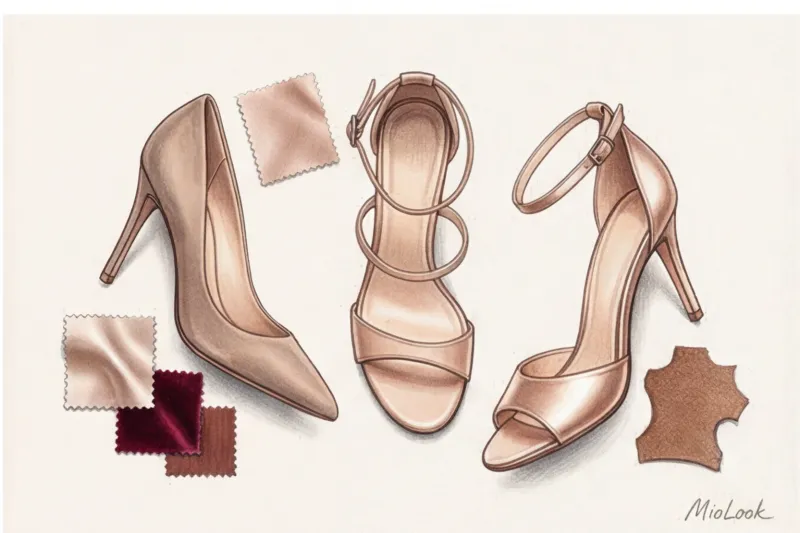
If you are looking for uncompromising comfort, your choice is genuine nappa leather or high-quality suede. These materials become flexible under the heat of your body and mold to the contours of your foot within an hour. Satin is a great evening option, but remember that it doesn't stretch, so the fit must be perfect from the start.
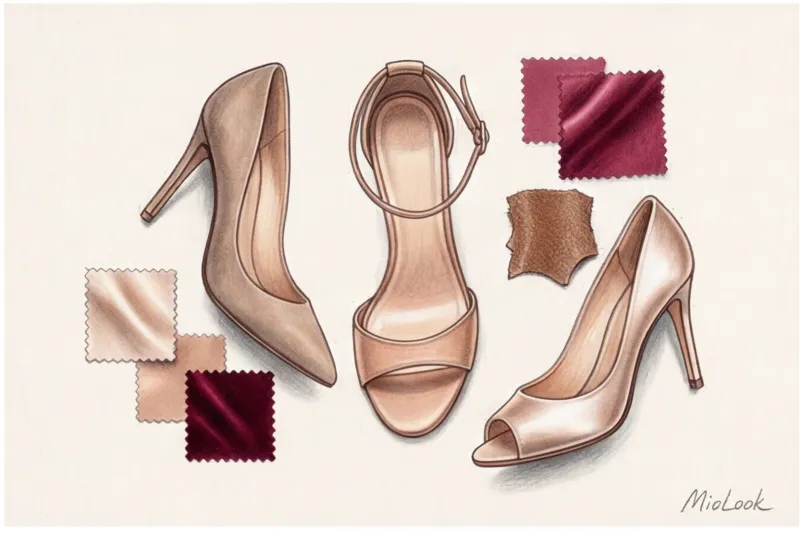
- Interior decoration: Never ignore the lining. Premium shoes are often lined with pigskin leather—it's incredibly soft and wicks away moisture. A cheap synthetic lining will cause your foot to slide forward with every step.
- Visual weight: The material of your shoes should match the fabric of your dress. A lightweight chiffon prom dress would pair with weightless, thin leather sandals, while a heavy satin wedding dress might feature velvet or heavy satin.
Wedding vs. Prom: Choosing Shoes for the Location
The venue dictates heel shape more than any trend. At one summer wedding, a bridesmaid wore elegant kitten heels. The outdoor ceremony took place on a lush lawn. With every step, her shoes sank 5 centimeters into the ground. As a result, her shoes were ruined, and she found herself walking on tiptoe like a tightrope walker.
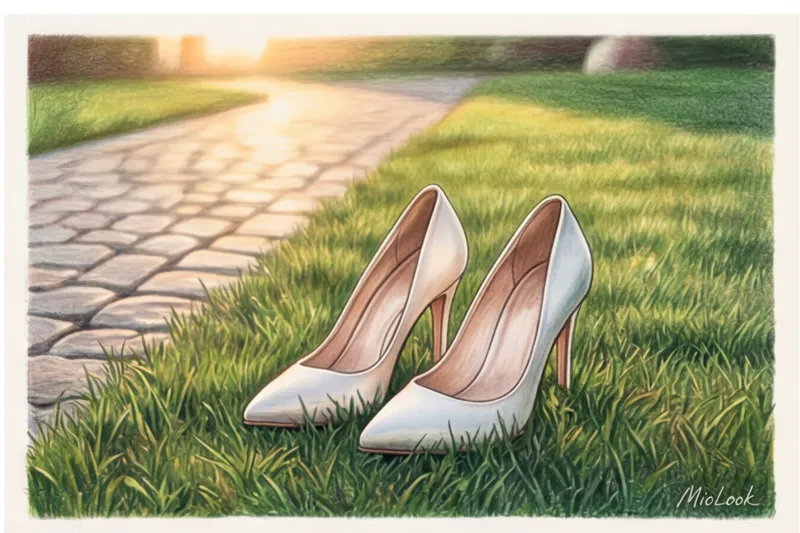
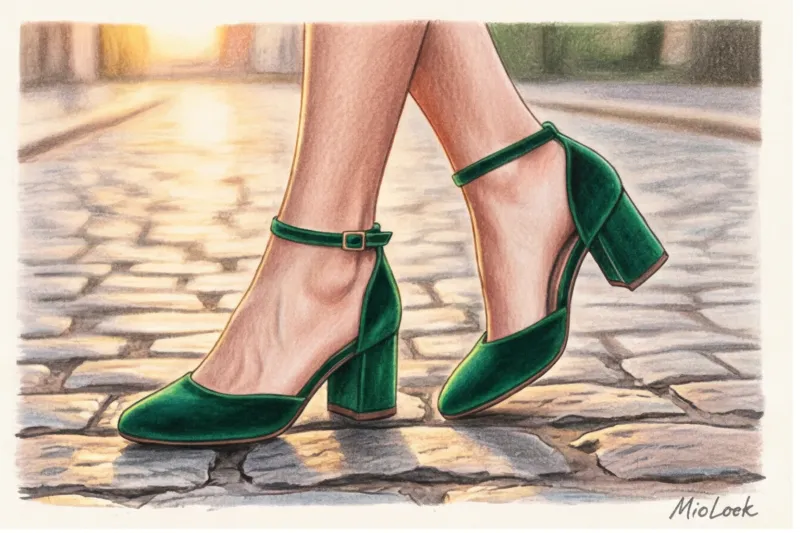
If you're walking on grass or old cobblestones, a thin stiletto heel will give in within the first half hour. In such cases, transparent heel stoppers are a lifesaver—a brilliant invention that increases the surface area of support, and I highly recommend keeping them in your bag.
Don't forget about the temperature, either. Wearing closed-toe patent leather pumps to your July prom is guaranteed to cause swelling. For hot weather, choose sandals with minimal straps that don't constrict blood vessels, or open-toe styles (slingbacks).
The main myth: "A thick heel is always more comfortable than a stiletto."
This is the most common misconception, and one I've been fighting for years. Research on muscle fatigue shows a counterintuitive result: a wide block heel doesn't always mean comfort. Yes, it does provide a larger support surface. But there's a catch.
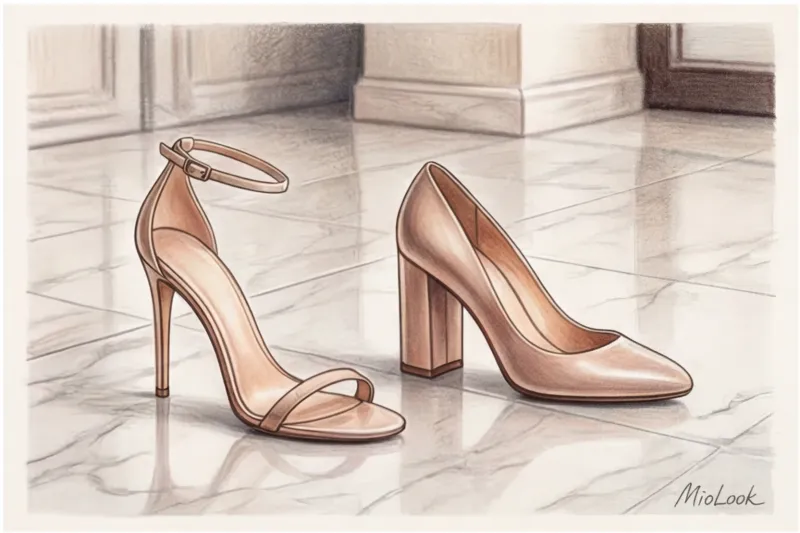
If a wide heel is made of heavy wood or molded plastic, the shoe becomes bulky. You have to lift additional weight with every step. Furthermore, due to its width, such a heel often extends beyond the natural heel line, causing you to "slap" across the floor. As a result, the calf muscles become strained much more quickly than in lightweight shoes with a centered heel.
The perfect compromise: Flare heels. They are slender at the base, like a stiletto, maintaining a graceful silhouette, and widen toward the bottom, providing a stable base. However, it's worth noting: these geometric shapes can clash with flowing, lingerie-style slip dresses.
Your perfect look starts here
Join thousands of users who look flawless every day and build their wardrobe wisely.
Get access — €0.99 onceBoutique Test Drive: 5 Steps to Checking Out Comfortable Heels
Over 12 years of working as a stylist, I've developed my own algorithm for testing shoes. Don't trust the first impression of "they don't seem to pinch anywhere." Take this test drive.
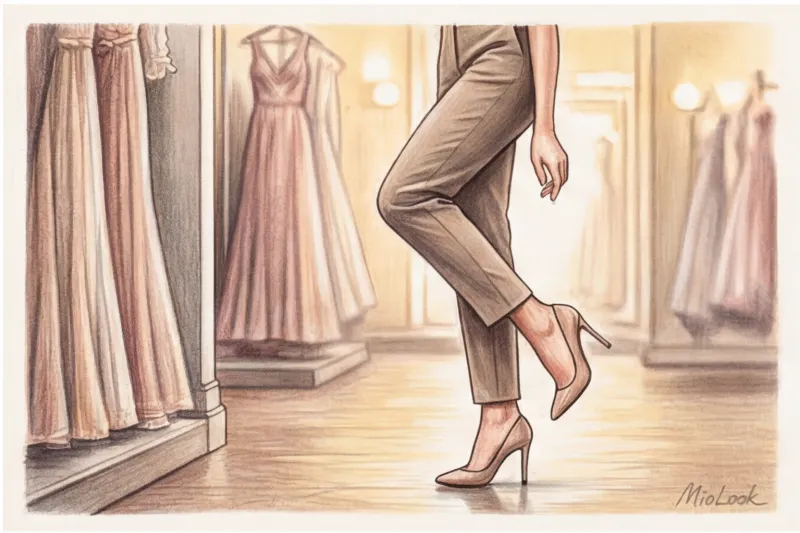
- Test 1: "The Rocking Shoe". Place an empty shoe on a level boutique counter and give it a gentle push. A properly balanced shoe should come to a stop quickly. If the shoe continues to wobble, the last is off balance. This will result in twisted ankles.
- Test 2: Evening fitting rule. Never buy evening shoes in the morning. Arrive at the store after 5:00 PM, when your feet are already slightly swollen and have acquired that "banquet" volume.
- Test 3: Stand on tiptoes. After putting on your shoes, try rising up on your toes until your heels are lifted off the top. If there isn't at least 1–1.5 cm of space between your heels and the shoe, the heel is too high. You won't be able to bear weight properly while walking, and your knees will remain bent.
- Test 4: Step back. Take a few confident steps backwards. If your heel slips out of the shoe, the last is not right.
- Test 5: Checking the edging. Run your finger along the inside edge of the shoe's cutout. High-quality shoes use a "French edge"—the edge of the leather is folded inward and stitched. If you feel a rough, raw edge or a drop of glue, that spot is guaranteed to rub your skin raw.
An eco-friendly checklist: how to break in evening shoes without damaging them
Popular online advice like "fill your shoes with bags of water and freeze them" is barbaric to delicate materials. Ice destroys the structure of natural leather, and harsh alcohol-based stretchers leave permanent stains on light-colored suede and satin.
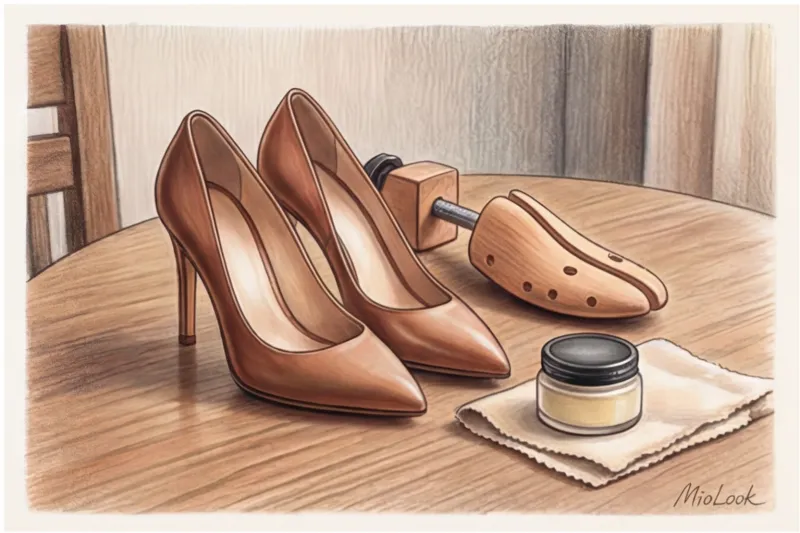
If your shoes are a little tight (which is normal for new leather), use professional methods:
- Shoe stretchers. Buy adjustable cedar wooden shoe trees. They gently adjust the shoe's shape without distorting the silhouette.
- Foam sprays. Apply specialized stretching foam only to the inside of the shoe in areas of greatest pressure.
- The 10-minute home rule. Start breaking in your shoes two to three weeks before the event. Wear them with thick cotton socks and walk around the house for exactly 10 minutes a day. This is enough time for the skin to begin adapting to body heat, but not enough to cause blisters.
Backup Plan: How to Change Your Shoes Without Ruining Your Look
Even the most comfortable heels have their limits. There comes a point when you want to dance to the party's finale without even bothering with your stilettos. And herein lies the main stylistic pitfall.
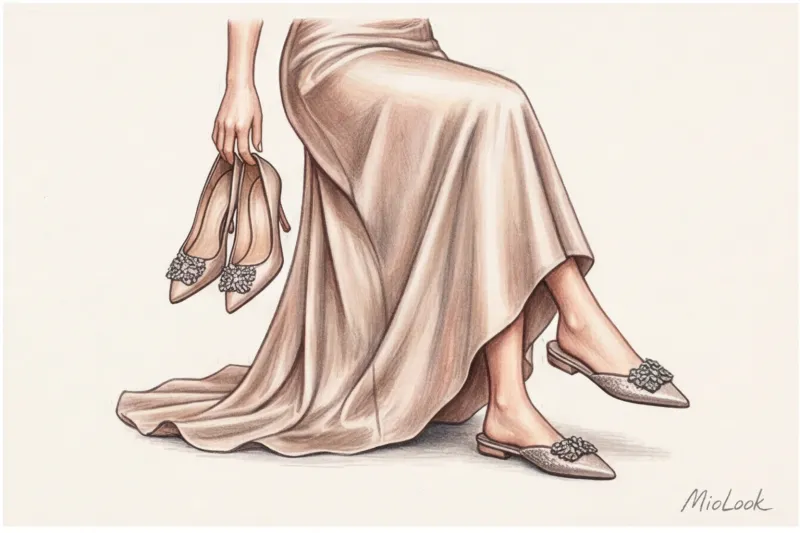
If your dress was originally designed for an 8-centimeter heel, switching to regular round ballet flats will ruin the entire geometric shape of your look. The hem will fall to the floor, causing you to step on it, and the visual proportions will become heavier. A round toe with a flat sole will cut off your height.
To maintain the harmony of the silhouette, use the right alternatives:
- Mules or ballet flats with a pointed toe. The pointed toe peeking out from under the long hem optically elongates the leg and maintains the evening mood.
- Slingbacks with micro heels. Replace your stiletto heel with a sleek 2-3 cm heel. This will be enough to keep your hems from getting tangled under your feet and give your feet a rest.
Another professional life hack is a convertible dress with a detachable skirt or an asymmetrical cut (shorter in the front, longer in the back). This will make changing shoes as seamless as possible for your look. If you're unsure how a particular pair of shoes will look with a dress, upload both options to MioLook wardrobe — the app will help you visually compare proportions before you leave the house.
Ready to get started?
Try a free plan—no commitments. Store photos of your shoes and dresses in one place and create perfect combinations.
Get access — €0.99 onceChoosing shoes for an important occasion is always a balancing act between aesthetics and self-care. Remember, true luxury lies not in the heel height or the logo on the sole, but in your ability to confidently, easily, and enjoyably experience the evening from the first minute to the last.