What are the Kibbe body types and why don't the standard 'apples' and 'pears' work anymore?
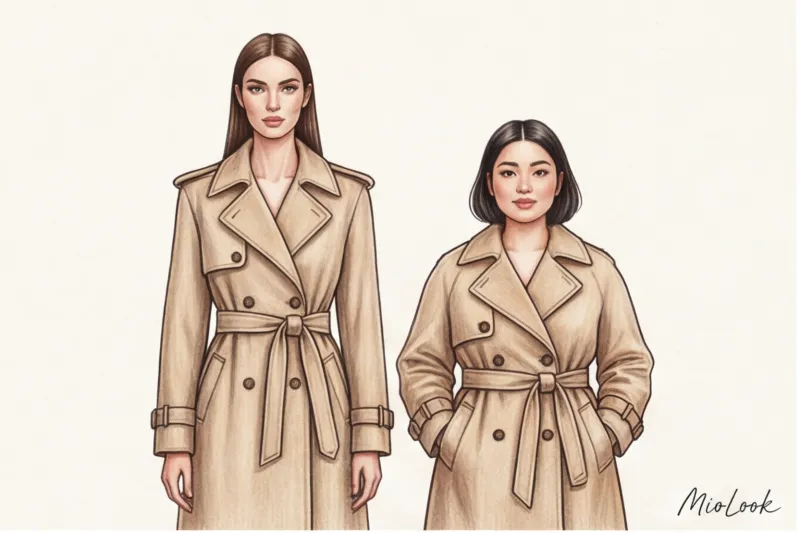
Have you ever noticed how the same structured coat/jacket looks like a street style star on your friend, but makes you look like a rectangular pedestal, even though you're both a size 10? It's not magic, not a "bad" figure, and certainly not excess weight. It's just different bone structure. This is where the difference in size comes into play. Kibbie types — a system that will forever change the way you approach your wardrobe.
In my practice (and over 14 years as a stylist, I've sorted through hundreds of closets), we always begin our first meeting with clients with one important ritual. We permanently forget about their "problem areas" and learn to view the body as an architectural project. Why is the notorious "fruit system" hopelessly outdated? Because it's built on insecurities and concealment. It forces women to constantly hide, tighten, and visually "saw" their proportions, trying to fit into an imposed hourglass figure. "Apple-shaped" women are told to hide their stomachs, "pears" to camouflage their hips. This exhausting approach stems from a flaw, not a strength.
The body isn't a collection of imperfections to be frantically draped. It's your personal architectural framework (bones) and façade (soft tissues). If you have Gothic architecture with sharp lines, there's no point in trying to embellish it with soft Baroque.
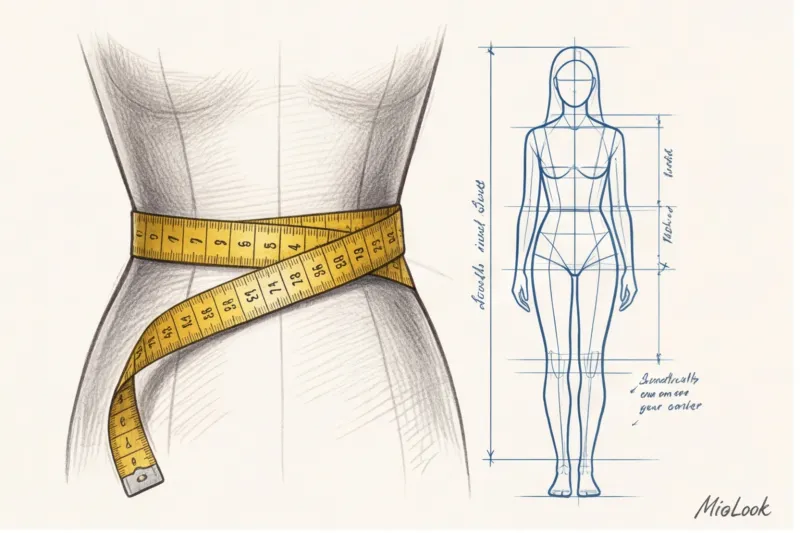
In 1987, New York stylist David Kibbee published the book "Metamorphosis," which proposed a fundamentally different approach. The essence of David Kibbee's theory lies not in simple measurements with a tape measure, but in a comprehensive analysis of your natural geometry: your bone structure (height, shoulder width and shape, limb length, hand and foot size, facial geometry) and the distribution of soft tissues over this framework.
The whole system is based on how two energies interact in your body:
- Yin scale — this is femininity in its classic, visual sense: softness, roundness, delicacy of bones, sloping shoulders, plump lips and cheeks, a defined waist.
- Yang scale — this is masculine energy translated into the language of female physiology: sharpness, length, clear geometry, high cheekbones, broad or angular shoulders, an elongated silhouette.
Each of us is a unique cocktail of these extremes. If you have a strong Yang (broad shoulders, sharp features), trying to dress in small flowers and soft, flowing ruffles (Yin) will create visual dissonance. Your face will appear coarser and your body larger. Conversely, a petite woman with rounded curves will be lost in a stiff, masculine-cut jacket. The rule of similarity works everywhere: just as we carefully study How to choose a perfume to suit your style To ensure that the scent doesn't clash with your look, you need to select the texture and density of the fabric strictly according to your bone structure.
You'd be surprised, but knowing your Kibbe type can save you up to 50% of your shopping budget. My clients often admit that once you've defined your lines, clothes no longer hang with the tags in your closet for years. You know that frustrating feeling when a dress on the mannequin looks like it could cost $200, the color is yours, the fabric is gorgeous, but when you put it on, the magic disappears? This happens when the cut lines clash with your body shape. Knowing your architecture, you stop buying random trends. Instead of five ill-fitting blouses, you invest in two perfect ones. You can scan the rails in the store in 10 seconds and understand which silhouettes and even accessories for office style will fit you perfectly, simply because they follow your natural geometry.
The Biggest Myth of the Kibbe System: Why You Don't Need to Change Your Taste
The most common complaint I hear from new clients is: "I passed the Kibbe type test and came up with a Romantic. But I can't stand retro, ruffles, and fifties style! Am I really going to have to wear floral dresses for the rest of my life?" This is a colossal misconception and the main reason why many modern women are disappointed with this ingenious tool.
In 1987, when David Kibbee published his iconic book, Metamorphosis, he used the images of Hollywood divas of the last century as easily understood archetypes. This has led to confusion: many stylists still take these examples too literally and impose them on their clients. Let me reassure you—you don't need to change your taste or lifestyle at all.
The secret lies in separating the two concepts forever: body lines And stylistic aesthetics.
The Kibbe system dictates only the physics of things The weight and density of the fabric, the scale of the prints, the geometry of the cut, the depth of the darts, and the overall silhouette. But the style aesthetic (minimalism, grunge, old money, sporty chic) is your personal mood. You can channel absolutely any aesthetic, filtering it through the prism of your natural features.
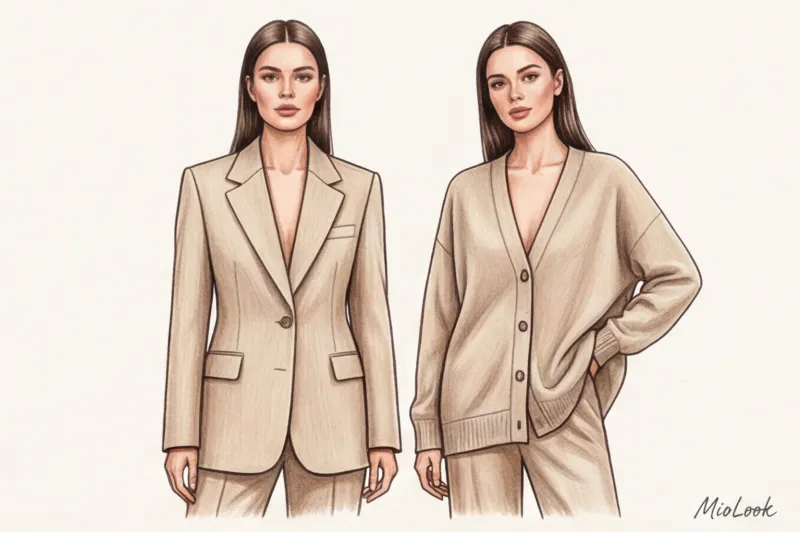
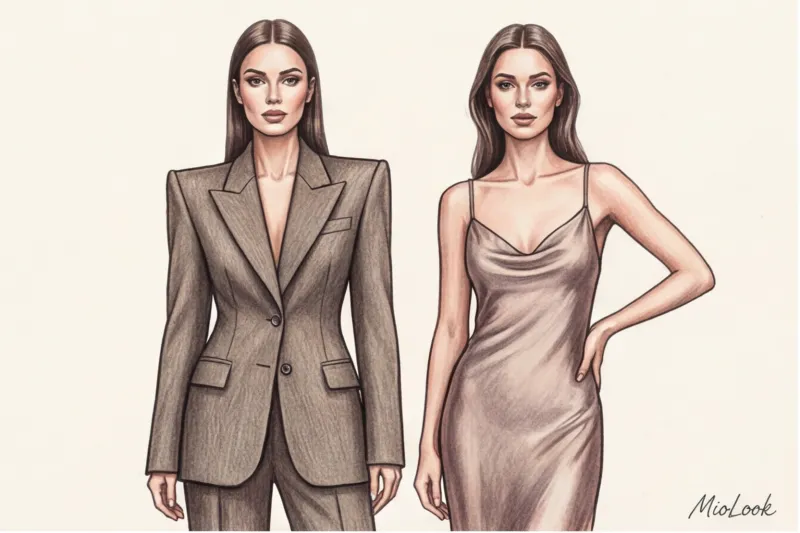
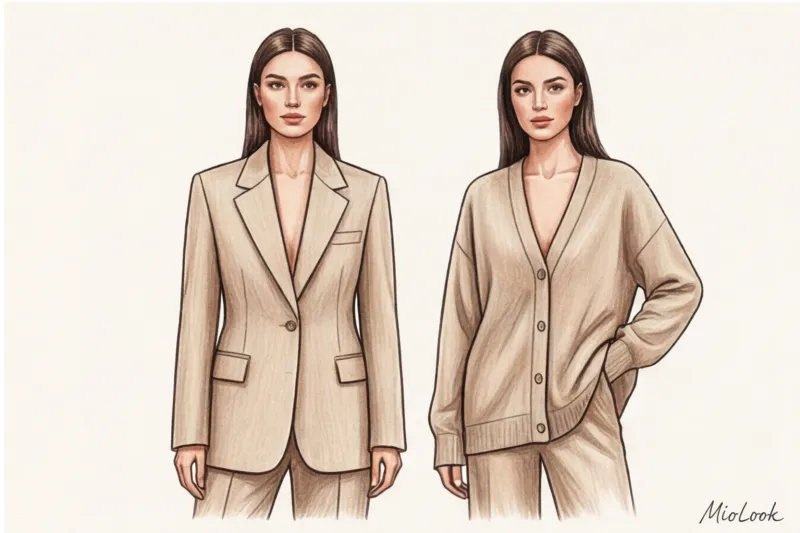
Let's look at some practical examples. How can a Romantic wear a formal business attire when the office dress code demands poise? You don't need a stiff men's jacket made of thick tweed—it will make a delicate figure look like a little girl trying on her dad's clothes. Strictness and status can be conveyed through soft lines: choose a jacket made of heavy crepe that drapes well, accentuate the waist (for example, with a peplum or a neat belt), and swap out the crisp cotton shirt for a silk blouse with a soft collar. The aesthetic is preserved—it's absolute office power dressing, but tailored to your soft contours.
Now, let's reverse the situation: the Dramatic type wants relaxed, casual weekend wear. If a woman with a distinctly Yang personality type wears a loose, loose, chunky knit sweater and soft, jersey joggers, her sculpted face will suddenly appear tired and her figure will appear bulky. The secret to the perfect relaxed look for the Dramatic type lies in elongated, shapely pieces. Swap out loose, oversized clothing for a sleek, thick long-sleeve top, and instead of soft sweatpants, choose long, wide-leg jeans made of heavy denim that fall in straight lines. The feeling of comfort will remain the same, but the lines will work for you, not against you.
True freedom of self-expression means you don't have to give up on current trends. Love the popular utilitarian cargo style? Great. A Natural might choose matte trousers made of thick cotton with voluminous patch pockets, while a Classic might opt for a simple style in a smooth suiting fabric with symmetrical, subtle embellishments. Knowing your body type gives you a unique filter, allowing you to adapt fashion to your body type without losing your individuality.
Access to MioLook for €0.99 — one-time payment
A smart AI stylist will select the perfect look based on your unique proportions and preferences.
Get access — €0.99 once5 Basic Families: The Anatomy of Style and Kibbe Types
When David Kibbee first introduced his concept of metamorphosis in 1987, fashion critics were baffled. Why divide women into some Yin and Yang axes when the industry had been successfully selling a clear system of "apples," "pears," and "hourglasses" for decades? The answer is simple: the fruit system taught us hide , and the Kibbe system teaches continue.
The Yin-Yang scale has nothing to do with esotericism in its style. It's pure physics and geometry. Yang — this is ice and metal: sharpness, length, sharp angles, framework and tension. Yin — is water: softness, roundness, delicacy, the absence of rigid form. Most of us are not at absolute poles, but are a unique cocktail of these two energies. That's why, when creating digital capsules for clients through MioLook smart wardrobe I always start by identifying the leading dominant - this instantly eliminates 80% of unsuitable styles at the planning stage.
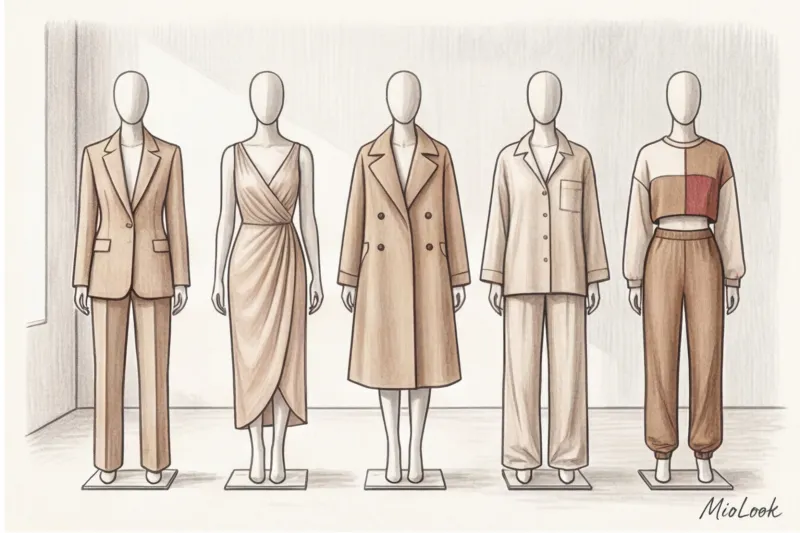
Kibby identified five clear, basic families (Dramatic, Romantic, Classic, Natural, Gamine), each occupying its own specific place on the scale. Let's break down their architecture in detail so you understand not just "what to wear," but Why the fabric behaves exactly like that on you.
Dramatics (Extreme Yang): sculptural and powerful
Dramatic is pure, concentrated Yang energy. Imagine a modern skyscraper: tall, narrow, with sharp edges. If you tried to drape it with lightweight chiffon, the fabric would look cheap and out of place, because form demands corresponding content.
- Physical markers: tall stature (usually 168 cm and above), sharp angles in the bone structure (pronounced cheekbones, sharp shoulders), narrow chest and long limbs.
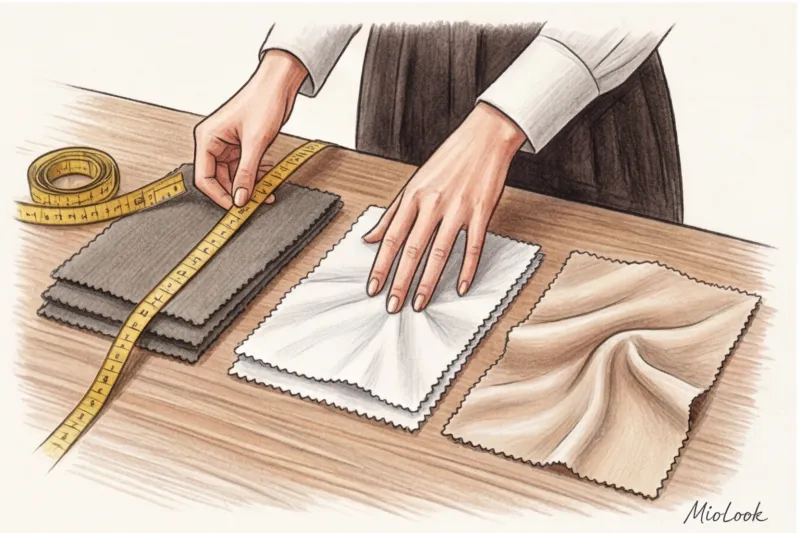
- Ideal fabrics: Dense, smooth, and shape-holding. Your superpowers are heavy wool, stiff cotton, taffeta, thick silk, leather, and gabardine. The fabric should have its own weight and "frame."
- Cut: Asymmetry, strict geometry, elongated silhouettes. Deep V-necklines, peak lapels, straight lines.
For Dramatics, the "monolith" rule applies. The fewer visual breaks in an outfit, the more expensive it appears. In a recent review of power dressing aesthetics, Vogue analysts noted Anthony Vaccarello's collections for Saint Laurent—a perfect illustration of how the extreme Yang is revealed through a maxi coat with exaggerated, sharp shoulders.
If you're a Dramatic, your most important investment is an impeccably tailored jacket or coat. While a rigid uniform might overwhelm other women, it makes you look classy and elegant.
Romantics (Extreme Yin): sensuality and softness
At the opposite end of the spectrum is pure Yin—Romantics. Their geometry is built on circles and smooth curves. The biggest mistake a Romantic can make is trying to squeeze their delicate, rounded figure into a rigid, office-style box made of thick fabric. The effect will be counterproductive: clothes will hang stiffly, visually adding bulk where there isn't any.
- Physical markers: Delicate, slightly shortened bone structure, sloping shoulders, rounded shapes (even with low weight the body remains soft), a clearly defined waist.
- Ideal fabrics: Light, flowing, soft. Silk, chiffon, velvet, angora, fine cashmere, soft, flowing knits. The fabric should embrace the body, not dictate its course.
- Cut: draping, mandatory emphasis on the waist, soft edges, rounded necklines, bias cut.
An honest confession from experience: Romantics have it incredibly hard in the era of the global trend for oversized men. Stiff, oversized hoodies turn them into "nightstands." My advice for adapting to the trends: choose soft oversize. Let it be a voluminous yet weightless mink cardigan with an off-shoulder design, casually tucked into a silk midi skirt that reveals slender ankles.
Naturals (Soft Yang): freedom and dynamics
Naturals are a softened Yang. If the Dramatic is a sharp triangle, then the Natural is a square with rounded corners. Their beauty is built on freedom, openness, and a slight casualness. This is the type that makes a wrinkled linen shirt for 40 euros look like luxurious, relaxed chic from the resorts of Como, while on the Classic, it would seem simply sloppy.
- Physical markers: blunt angles, broader bone structure, shoulders may be straight and slightly square, and there is often a natural athleticism.
- Ideal fabrics: Textured, matte, natural surfaces. Linen, heavy cotton, suede, bouclé, chunky knit, corduroy. The more texture, the better. Perfectly smooth and shiny fabrics (like satin) often look out of place on them.
- Cut: A relaxed silhouette, layering, and the absence of rigid structures and strict collars. Clothing should allow for movement.
According to trend forecasting agency WGSN (2024), the macro trend for "Elevated Comfort" shows no signs of abating. For Naturals, this is a golden age. Your base: deconstructed jackets without stiff shoulder pads, wide, flowing lyocell trousers, and chunky, chunky knit sweaters.
Blended: Symmetry and Balance
Classics are the epicenter of the Kibbe scale. Perfect symmetry and an absolutely even distribution of Yin and Yang. And herein lies the main catch: pure Classics are vanishingly rare in nature. Most of us are skewed in one direction or another.
If you're lucky enough to be in this family, your worst enemy is extremes. Too much rigidity will make you look stern, too many frills will make you look comical, and too much casual will make you invisible.
- Physical markers: Perfect symmetry, even proportions. No facial or body features stand out (no overly long arms, overly broad shoulders, or overly curvy hips).
- Ideal fabrics: medium weight, smooth, matte or with a slight satin sheen. The fabric should be neither too stiff (like the Dramatic) nor too soft (like the Romantic). High-quality wool blends, silk crepe, and fine gabardine.
- Cut: Conciseness, symmetry, and moderation in everything. Your secret weapon is a perfect fit (tailoring).
One of the most important lessons I impart to my Classic clients is that it's vital to find a good tailor. A $50 mass-market garment, perfectly tailored to your darts and shoulder line for an extra $30, will look better on you than a sloppy designer original for $1,000. In your case, geometry is everything.
Gamines (Combination): Contrast and Energy
If the Classic is a smooth blending of Yin and Yang into a homogeneous mass (like coffee with milk), then the Gamine is a clash of opposites. Petite stature and delicate size (Yin) collide with sharp shoulders, an angular jaw, or large, expressive eyes (Yang). This creates a staccato—an energetic, slightly daring rhythm.
- Physical markers: Petiteness (usually up to 165 cm) combined with sharp (Yang) and soft (Yin) facial and body features. This is the geometry of contrasts.
- Ideal fabrics: Shape-holding, textured, and preferably matte. The fabric should be thick enough to hold the line, but not so heavy that it weighs down your short stature. Stiff cotton, denim, ribbed fabric, and fine leather.
- Cut: broken silhouette, shortened lines (cropped), color blocking, contrasting details.
Gamins are literally drowning in the long, monolithic silhouettes of Dramatics. I once had a Gamin client come to me complaining that she looked "like an orphan in her dad's raincoat" in a fashionable maxi coat. We simply swapped it for a structured, cropped, mid-thigh peacoat, added a contrasting scarf, and her look instantly came together, revealing her personality and character.
Your golden rule when styling: always break up the line. If you're wearing a suit, have the top and bottom in different shades. Use contrasting collars, rolled-up sleeves, and cropped trousers that reveal the ankle. Your style should pulse.
How to Determine Your Kibbe Type: A Step-by-Step Test from a Stylist
Did you know that our brain literally edits our reflection in the mirror? According to research in cognitive psychology, we perceive our own proportions with a distortion of up to 20%. We tend to exaggerate our flaws or see ourselves through the prism of our aspirations. A girl with a delicate frame may consider herself "broad" for years simply because she was slightly larger than her peers in school, while a tall woman will slouch, subconsciously trying to appear smaller. This is why most automated online Kibbe body type tests yield erroneous results—when answering questions, we describe our fears and insecurities, not reality. Therefore, the main rule of self-typing is surgical objectivity and a complete disengagement from emotions.
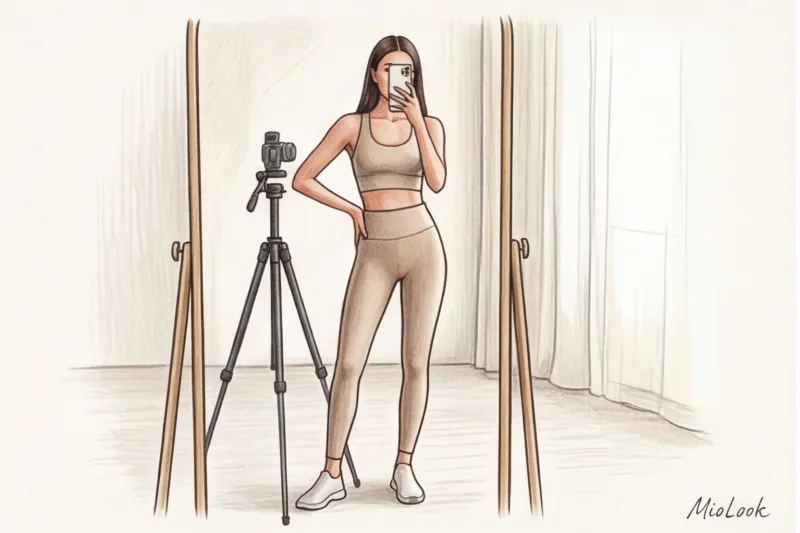
Preparing for the test requires almost laboratory-like conditions. Wear simple, smooth underwear without push-ups or compression pieces, preferably in a color that contrasts with your skin tone so your body contours are clearly visible. No makeup—even a touch of contouring artificially alters the architecture of your cheekbones and nose, confusing you. Hair should be slicked back or pulled back into a tight ponytail. Stand in a well-lit room, ideally with diffused daylight from a window to avoid harsh shadows that can distort your proportions.
A critical point: why can't you just take a selfie in the mirror? The lens of any modern smartphone is a wide-angle lens, which inevitably distorts perspective. Shoot from a slightly higher angle and you'll end up with a huge head and shortened legs; shoot from below and you'll look like a giant with massive hips. The rule of objective shooting: Mount your phone on a tripod or ask someone to take your photo. The camera should be positioned exactly at chest level, the lens perpendicular to the floor, and the distance from you exactly 2-3 meters. Only with these settings will the lines of your body remain accurate.
Step 1. Analysis of bone structure. Look at the resulting photo and completely disregard weight. Imagine your skeleton as the frame of a building. Assess your actual height (do you appear taller, shorter, or true to your actual height?). Study your shoulders: are they sharp and square, sloping, or wide and tapered? Notice the length of your arms and legs relative to your torso—are they elongated or shortened? Evaluate the size of your hands and feet: are they long and narrow, wide, or quite petite?
Step 2. Flesh distribution analysis. Now let's look at the soft tissues—the chest, waist, and hips. The goal is to understand how your skin and muscles fit this framework. Does the flesh appear firm, toned, and sinewy even with excess weight (a clear manifestation of Yang)? Or does it always remain soft, rounded, and slightly loose, even if you weigh 45 kg (a Yin influence)? Analyze how the volume is distributed as you gain weight: does it gather strictly at the lower hips and chest, leaving a defined waist, or does it spread evenly across the entire body from the shoulders to the knees?
Step 3. Facial features analysis. The face also needs to be divided into bones and tissues. Examine the chin and jaw: is it geometric, wide, pointed, or delicately rounded? The shape of the nose and cheekbones: do they protrude with sharp edges or remain soft and slightly flattened? Finally, evaluate the lips and eyes. Thin, straight lips and narrow, close-set eyes will add points to the Yang column, while full lips and large, wide-open, saucer-like eyes are pure Yin.
Once you've determined your basic geometry, don't rush to the store right away. Record your Yin and Yang dominants, and then enter this data into your profile using MioLook smart wardrobe feature This will help the app's algorithm more accurately select combinations and generate images based not only on the color palette but also on your natural architectural lines.
Access to MioLook for €0.99 — one-time payment
Start creating perfect images with the help of artificial intelligence
Get access — €0.99 onceCapsule Wardrobe Through the Kibbe Lens: Practical Application
For a long time, glossy magazines have been feeding us the idea of a "universal essential." The familiar lists of "10 things every woman should have" cost my clients thousands of wasted euros or dollars. In 2023, I conducted a revealing experiment with one of my clients: I put together a capsule wardrobe of exactly 15 items for her, based solely on Kibbe types and her unique body lines (she turned out to be a striking Gamine). The result? These 15 elements combined to create 32 perfect looks that didn't require much thought in the morning. The secret wasn't in the palette, but in the fact that all the pieces had the same shape and cut.
Let's explore this principle using the example of the "holy trinity" of everyday wardrobe: a white shirt, jeans, and a jacket. Each type has its own unique foundation.
Take a white shirt. If you're a Dramatic with a dominant Yang (sharp bone structure), your ideal style is a crisp, crisp cotton or poplin, with a strict, masculine cut and a pointed collar that holds its shape securely. This piece will accentuate your natural sculpted figure. But put the same shirt on a Romantic (pure Yin), and it will instantly transform a delicate, feminine figure into a shapeless square, adding visual heaviness. A basic "white shirt" for a Romantic is a flowing silk blouse, soft draping, an accent at the waist, and perhaps a delicate bow at the neck.
The same goes for jeans and jackets. Naturals (Soft Yang) look great in relaxed, straight-leg or wide-leg jeans made of textured, slightly distressed denim. But the Classic type needs absolute symmetry: smooth jeans in a uniform sapphire or graphite color, without the slightest fraying. As for jackets, for a Gamin, it should be cropped, maintaining a clear shape, with contrasting details. Put on a trendy, long, oversized jacket (perfect for Naturals), and the Gamin will look like he's been plucked from his mom's closet.
The choice of accessories and footwear also strictly follows the Yin or Yang principle, as it is the details that complete the overall look. If your appearance is dominated by Yang (sharpness, height, pronounced angles), choose bags with rigid geometric shapes (briefcases, baguettes with sharp edges), shoes with a distinct pointed toe, and large, simple jewelry made of smooth metal. If Yin (softness, petiteness, and roundness) predominates, your aesthetic is hobo bags or soft, duffel-style clutches without a rigid frame, shoes with almond-shaped toes, as well as thin, graceful chains and vintage elements. A geometric, rigid bag in the hands of a Romantic will look out of place, like a random piece of furniture.
Keeping all these nuances of textures and lines in mind can be difficult, especially during sales. To avoid impulse purchases that end up as dead weight, I always recommend digitizing your closet. A great way to do this is to upload items to MioLook This smart wardrobe management app lets you instantly see how a new item will fit into your wardrobe. Before you spend $150 on a trendy jacket, you can visually check whether its rigid "yang" lines complement your soft "yin" sweaters. This saves not only money but also precious time during daily dressing.
Common Mistakes When Working with Lines: What to Avoid
According to fashion platform analytics for 2023, approximately 60% of women who begin studying stylistic typologies become disillusioned with them within a month. The reason is simple: the theory begins to feel like a strict set of taboos. Over the years, I've identified three main pitfalls that women fall into when working with lines independently.
Mistake 1: Resisting natural abilities
The most destructive pattern is trying to cheat your genetics. I often see women with a luxurious model height of 178 cm slouching and wearing completely flat shoes in an attempt to appear petite. Conversely, women with a delicate height of 155 cm artificially elongate themselves with heavy platforms in everyday looks. Resisting your type always backfires. A tall woman (Dramatic or Vibrant Natural) in a short, childish babydoll dress looks not fragile, but bulky. Embrace your architecture: tallness conveys presence and scale, while petiteness conveys dynamism and energy.
Mistake 2: Ignoring the weight and texture of the fabric
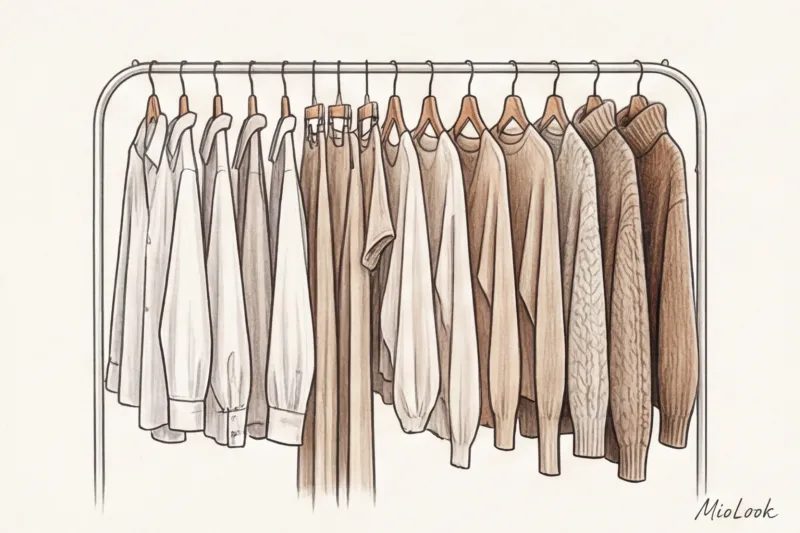
The right cut in the wrong fabric will ruin a look faster than a three-size mistake. The body's contours dictate not only the silhouette but also how the material should interact with the skin. Imagine a perfectly tailored bias-cut slip dress. If you sew it for the Romantic girl from stiff, crisp linen, it will be stiff and visually add 10 kilograms. And flowing, thin chiffon will look too plain on the Dramatic girl, as this texture is unable to maintain the necessary sculpting and sharpness.
Mistake 3: Reading the 1980s Testaments Literally
David Kibbee's book "Metamorphosis" was published in 1987. Following the outdated recommendations of that era too closely is a surefire way to look like the heroine of a retro soap opera. When the original text advises wearing "stiff shoulder pads" for Yang-types, today it translates as "opt for modern, architectural cuts" (like sculpted jackets from COS or The Frankie Shop) rather than sewing massive foam padding onto blouses.
Pro tip: Kibby is a navigator, not a prison warden. Don't fall victim to the system and always leave room for experimentation. If you're a Romantic but adore strict minimalism, simply adapt it. Choose a simple suit, but in soft wool crepe, and add a touch of casualness to your hairstyle.
To painlessly test new silhouettes and textures, I recommend collecting mood boards and images through smart wardrobe feature in MioLook This allows you to visually evaluate how a particular item will form the basis of your style before you spend $150-$300 on it at the store.
Your perfect look starts here
Join thousands of users who look flawless every day with MioLook.
Get access — €0.99 onceSummary and checklist: how to become friends with your natural geometry
Open your closet right now. I'll bet you a cup of good coffee that your favorite pieces—the ones you wear until they're worn out and get the most compliments for—intuitively align with your natural Kibbe line. Conversely, that expensive designer blouse that's been hanging forlornly on a hanger for two seasons probably just clashes with your geometry. Knowing your Yin or Yang dominant line frees you from illusions and saves you thousands of dollars we usually spend on impulse purchases.
The main principle that I try to convey to every woman is extremely simple: the lines of clothing should echo the architecture of your body By trying to reshape ourselves to fit a fleeting trend, we only highlight physiological disharmony. If your bone structure is dominated by sharp geometry and elongation (Yang), soft, shapeless drapes will make your figure appear heavy and bulky. If you're made of smooth curves (Yin), a rigid, architectural cut will turn you into a "man in a case."
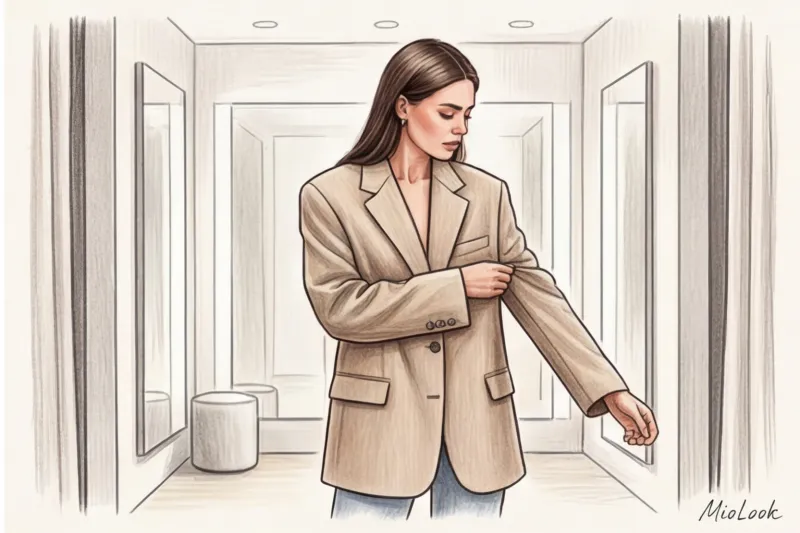
According to research agency Mintel (2024), up to 40% of online returns are due to an ill-fitting garment. But in reality, it fits perfectly as the designer intended—it just didn't fit the right body shape. To make line theory work for you every day, I've prepared a practical algorithm.
Fitting Room Checklist: 3 Markers of the Perfect Item
The next time you go shopping or decide to sort through your current wardrobe, run each potential update through these three steps:
- Fits snugly across the shoulders. This is the foundation of any silhouette. If you're a Dramatic or Gamin, defined, tailored shoulders are essential—they'll pull the look together. Natural types, on the other hand, should opt for dropped armholes or soft raglan sleeves to allow for freedom of movement. Romantics should look for delicate gathers (like subtle puffs), while Classics should look for a perfectly symmetrical fit, right at the hip.
- Weight and density of the fabric. Fabric dictates how a garment moves with you. Pick up a garment: does it hold its shape naturally, like heavyweight 14-ounce denim or gabardine? This is an excellent choice for pure Yang energy. Does the fabric flow, glide, and drape easily (heavy silk, fine viscose, cupra)? This is Yin energy.
- Freedom of fit (air in the silhouette). There should always be the right amount of space between the body and the clothing. For Naturals, this "air" is expressed in a relaxed oversize fit. For Classics, it's a semi-fitted look, where the fabric only delicately defines the contours. For Dramatics, a narrow, elongated line without excess bulk at the sides is important, and Romantics need a strong accent at the waist, otherwise any straight shirt will visually add 5-7 kilograms.
Your task for today: Take three items out of your closet that irritate you. Put them on and check them against this checklist. You'll instantly see where the technical glitches are—an awkward shoulder line, a fabric that's too stiff, or a volume dissonance.
Remember the most important thing: the Kibbe personality type system is a compass, not a high-security prison. Don't become a hostage to typology, losing your personal taste in it.
You don't need to use a microscope to calculate lapel width or abandon your beloved grunge aesthetic just because the test came up with a "Romantic" result. Any style can be translated into the language of your body. Love biker style, but have a delicate Yin figure? Simply choose a cropped biker jacket made of the most flexible, thin leather (like nappa), with rounded hardware and a fitted cut—and the look will be perfect.
Developing a personal style is a fun process of testing hypotheses. To practice your eye and assemble flawless capsule wardrobes without breaking the bank, I recommend my clients digitize their closets using an app. MioLook By creating looks on your smartphone screen, you'll clearly see how your natural lines interact with different textures and proportions, avoiding accidental purchases. Study your geometry, experiment with shapes, and remember: the perfect outfit is one that doesn't try to change you, but allows you to be yourself.
Guide Chapters
The Perfect Kibbie Wedding Dresses for Every Body Type
Is choosing your dream dress turning into disappointment in the fitting room? Learn how David Kibbee's system helps you find the perfect fit.
How to Wear Oversized Kibbe: Tips for 3 Body Types
Do bulky items fit like a sack? We'll explore how to adapt the trendy oversize style to body types that historically don't suit it.
Fabrics for Kibbie Body Types: A Guide to Choosing
The right fabric matters more than just fit. Learn how texture, density, and weight of a material influence how a garment fits your natural body shape.
Kibbie or body types: what to choose for style?
Forget the classic "apple" and "pear" shapes. We'll explore why the Kibbe system works better for traditional body types and transforms your wardrobe.
Kibby's Perfect Bags: A Guide to Choosing Accessories
Why does the same item look stylish on your friend but completely unflattering on you? Learn how to choose accessories based on your body shape using the Kibbe system.
How to Choose a Coat by Kibbie: An Outerwear Guide
There's no one-size-fits-all formula: what makes one woman look statuesque may make another look fat. Learn how to choose the perfect outerwear for your bone structure.
Kibbie Body Types for Plus Size: Style for Plus Size
Excess weight doesn't change your bone structure. We'll use real-life examples to help you determine your plus-size Kibbe body type and choose the perfect wardrobe.
Makeup for Kibbe Face Types: Emphasizing Yin and Yang
Proper makeup is an architectural work of facial lines. Learn how Kibbe's bone structure determines your ideal makeup application technique.
Kibbe Hairstyles: How to Choose the Perfect Haircut
Choosing a haircut based on your face shape is hopelessly outdated. Learn how David Kibbee's body type system can help you find a hairstyle that flatters your body shape.
The Gamine Kibbie Type: Style, Contrasts, and Cut Architecture
Gamine is about cutting, not the image of a perpetual teenager. We'll explore how petite women can create luxurious and classy looks.
Kibbe's Classic Body Type: Clothing and Secrets of Elegance
The Classic body type isn't about boring office attire. Learn how to dress stylishly for the Dramatic and Soft Classic body types while maintaining proportion.
Natural Kibbie Type: Wardrobe and Relaxed Chic
Forget shapeless boho and linen bags. We'll show you how to create a modern wardrobe for the natural person with a quietly luxurious aesthetic.
Kibbe's Romantic Body Type: Clothing for a Feminine Figure
Why are rigid trends and oversized styles unsuitable for women with curvaceous figures? We'll explore how Romantics should dress to look stunning.
Dramatic Kibbie Body Type: Clothes and Basic Wardrobe
A modern adaptation of the Kibbe system for Dramatic and Soft Dramatic types. Learn how to create a stylish basic wardrobe and enhance your figure.
The Kibbe Test: Determine Your Body Type Based on Your Body Lines
Standard questionnaires are often wrong. Learn how professional appearance diagnostic methods work to accurately determine your type.