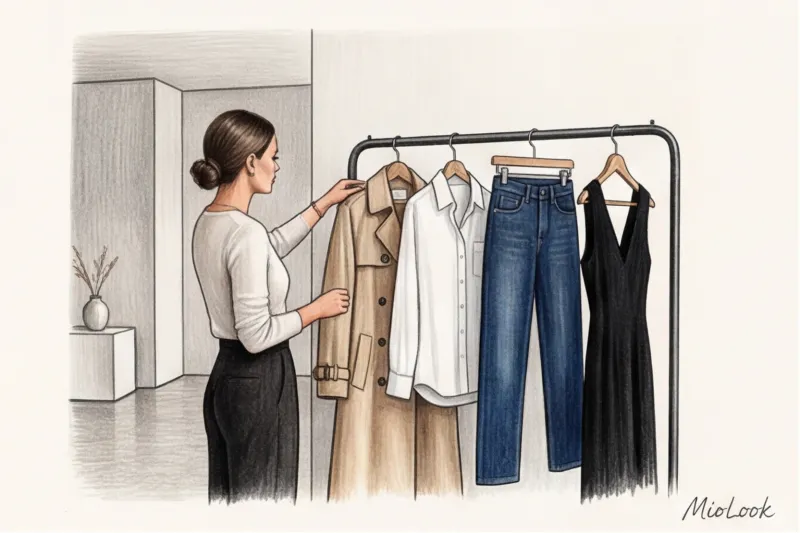
The Evolution of Utility: How Wardrobe Basics and Their History Shape Modern Style
Have you ever noticed the paradox: we often buy the latest catwalk trends out of pure emotion, but end up wearing the same seemingly simple and predictable pieces 80% of the time? If you take a closer look at your wardrobe staples, the story behind their creation quickly explains this phenomenon: they've all survived in the industry thanks to their uncompromising functionality.
No truly iconic item was created for beauty's sake. Military uniforms, rugged workwear, and sports gear became the foundation of the modern capsule wardrobe for one simple reason: they solved practical human problems. A beige trench coat protected from the piercing wind and dirt, heavy denim withstood the rigors of mining, and loose sweatshirts didn't restrict athletes' movements. These garments have mathematically precise ergonomics: the right armhole depth for freedom of movement, durable fabrics, and pockets that can actually fit a phone, not just a lucky coin.
"If a garment lives in wardrobes for over a hundred years, it means its cut solved a real physical problem, and didn't just satisfy the designer's aesthetic whim"—this is the rule I repeat at every personal consultation.
According to a major McKinsey report (2024), interest in utilitarian items continues to grow: over 65% of consumers are now purposefully seeking durable clothing with clear functionality, tired of fast fashion. In my practice, I see confirmation of these figures every day. When my clients and I analyze their closets using the tracking function in MioLook app , statistics are relentless: the historical database is always at the absolute top in terms of frequency of use.
That's why it's important to apply a strict but fair mathematical approach to such purchases—the Cost Per Wear concept. It's the best filter for impulse purchases. Compare this: if you buy a statement neon blouse for €70 and wear it twice a season, each outfit costs you €35. But if you invest in a quality oxford shirt for €180 and integrate it into dozens of looks—worn alone or layered— creating stylish layering — and wear it 60 times a year, the price per outfit drops to €3. By investing in centuries-old pieces, you're paying not just for the fabric, but for guaranteed versatility, which saves you time in front of the mirror every day.
Beige trench coat: from the trenches of World War I to the offices of IT corporations
In 1888, British entrepreneur Thomas Burberry did something that forever changed the course of fashion history: he patented gabardine. Until then, protective outerwear was made of rubberized fabric—heavy, non-breathable, and reeking of rubber. The invention of dense, diagonally woven cotton with a water-repellent finish was a true technological revolution of its time.
If Burberry had known that a century and a half later his invention would become the unofficial uniform of creative directors and IT corporation employees, he would undoubtedly have been surprised. After all, the trench coat (from the English trench coat The trench coat was created solely to ensure the survival of British officers in the harsh trenches of the First World War.
Let's dissect the classic trench coat. Every detail is a hymn to uncompromising utility:
- Epaulets on the shoulders: They were used to secure the belts of the shoulder straps, heavy binoculars and gas masks.
- D-rings: They were located on the belt and were intended for hanging grenades, army flasks or tablets with maps.
- Storm flap: It was located on the back and right shoulder, acting as an architectural mini-umbrella. Raindrops rolled down it without penetrating the seams when the soldier held the rifle.
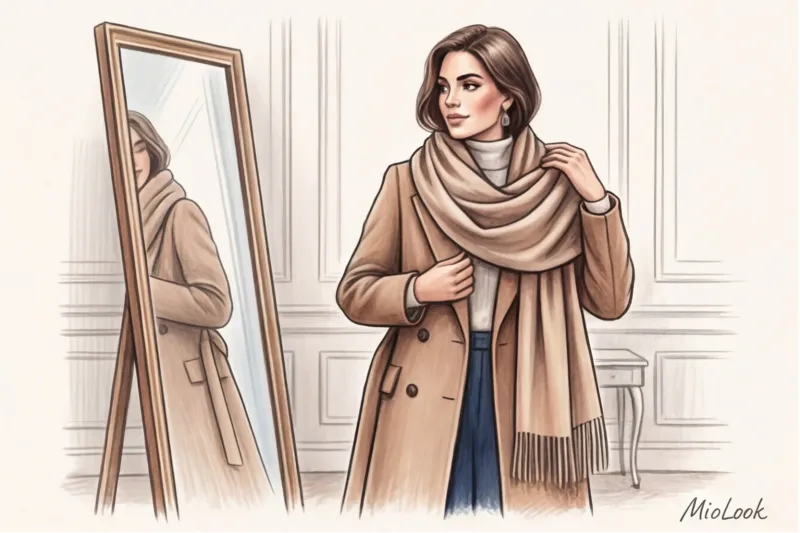
But how did this austere military attire transform into a symbol of refined French chic and elegance? The cultural shift came about thanks to cinema. When Catherine Deneuve appeared in a beige trench coat in The Umbrellas of Cherbourg, and Jane Birkin began wearing it unbuttoned with a wicker basket on the streets of Paris, the perception of the garment changed dramatically. From the trenches, it migrated into the wardrobes of fashionistas, proving the most important rule of style: emphatically masculine, rugged garments paradoxically enhance feminine fragility.
"The secret to a trench coat's longevity is that it works like a blank canvas. It's understated enough to pull an outfit together, but neutral enough to not steal the show." This is the message I always try to convey to my clients during wardrobe reviews.
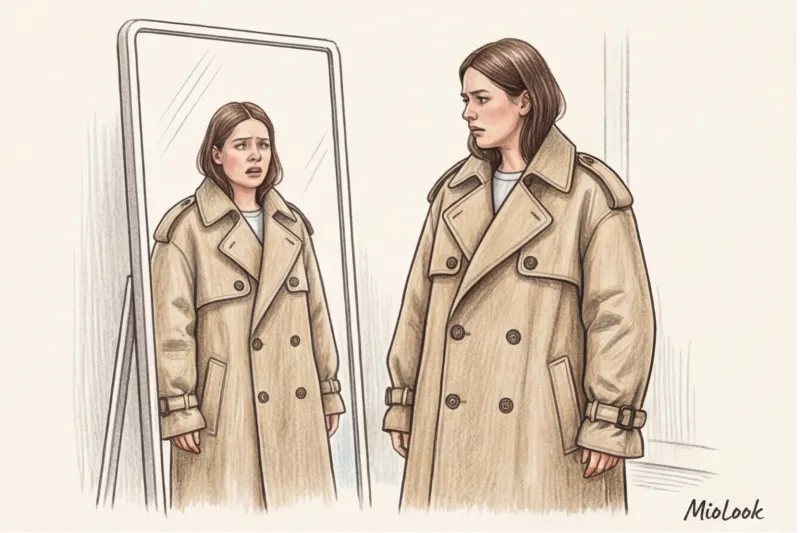
However, historical cuts can sometimes play tricks on us. I had a telling case: a female executive bought an authentic, fitted trench coat from a legendary brand (paying around €2,300), but it hung in her closet for two years. She complained, "I feel constrained in it, like a police inspector from an old detective story." The problem was the outdated, rigid silhouette. Once we replaced it with a looser fit and added relaxed, modern pieces, the trench coat began to repay every penny invested in it.
What to wear with a trench coat today: look formulas
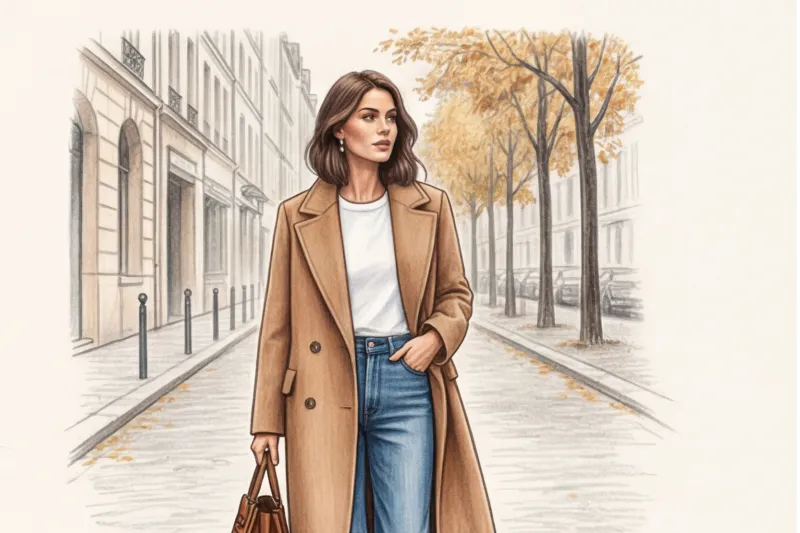
To make a historical base look relevant in 2024, use the principle of stylistic contrast. Pair the right, structured gabardine with unexpected textures.
- Sport chic: The most sought-after combination for the fast-paced city. Pair a trench coat with an oversized hoodie (the hood must extend over the coat collar), chunky joggers, and chunky sneakers. The architectural trench coat instantly brings relaxed knitwear together, transforming it from "couch wear" into polished street style.
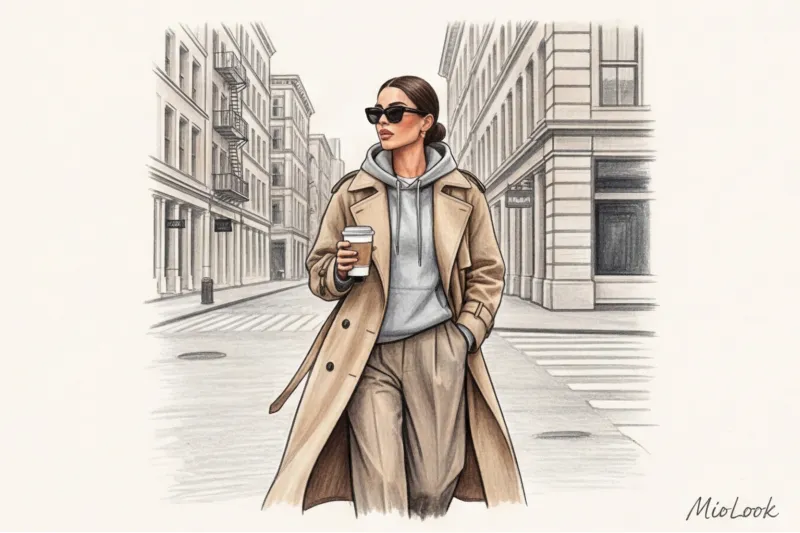
- Business smart casual: Wear a trench coat over a relaxed pantsuit. Important: the suit shouldn't be too tight or too skimpy. Opt for wide, pleated trousers and a straight, menswear-inspired jacket. The trench coat should be worn open, and the belt can be casually tied in a knot at the back to create a vertical, elongating silhouette.
When choosing length and volume, focus on your proportions. Oversized versus classic is always a choice between trend and conservatism. For petite women (up to 160 cm tall), a hyper-oversized maxi length can be dangerous—it visually reduces height and makes the figure heavier. Your ideal compromise is a midi length (just below the knee) and a semi-fitted silhouette with a defined shoulder line. However, for tall women and plus-size figures, the voluminous maxi silhouette is ideal. It easily accommodates any layered look, whether a chunky knit sweater or a heavy tweed jacket.
The main rule of modern fit: there should always be some air between you and the trench coat. To reinforce these principles in practice, I recommend putting together 3-4 outfits in front of a mirror and photographing them. Download these looks via wardrobe visualization feature in MioLook — this way, you'll always have a ready-made cheat sheet on your smartphone, which will save you in those morning moments when it seems like you have absolutely nothing to wear.
Access to MioLook for €0.99 — one-time payment
A smart AI stylist will select the perfect look based on your wardrobe and suggest how to wear your favorite trench coat every day.
Get access — €0.99 onceThe White Shirt: How the Masculine Element Gave Women Freedom
Until the late 19th century, maintaining impeccable whiteness without modern washing machines and bleaches was a luxury. The term "white collar" arose not as a metaphor, but as a literal marker of class superiority. A man in a crystal-clear shirt conveyed a simple message to society: "I don't do heavy physical labor, and I have a staff of servants to wash and starch me daily." For women, this wardrobe item remained off-limits.
If we're interested in wardrobe basics, the history of the white shirt is perhaps the most illustrative example of how clothing changes social roles. The first crack in the gender dress code appeared in the roaring 1920s. Flapper girls, inspired by Coco Chanel, began cutting their hair short and altering men's shirts to fit themselves. This was a direct challenge to patriarchal society—an act of defiance and emancipation.
A real revolution occurred in the 1970s, when women began to occupy corporate leadership positions en masse. The office environment of the time was aggressively male-dominated. To play by the rules of big business, women needed visual armor. Thus, the white men's shirt became a key element. power dressing - the style of "clothing for power".
"By taking away men's monopoly on the formal white shirt, women were taking back some of their social and financial power. The shirt allowed them to appear professional and authoritative, without being objectified," notes Valerie Steele, director of the Fashion Institute of New York Museum.
Recently, a top manager at an IT company came to me for a consultation. She had purchased several expensive silk blouses with soft bows, but complained that at board meetings, her colleagues subconsciously perceived her image as too "compliant." We removed the flowing silk and introduced a single, crisp, white poplin shirt in a men's cut. The paradigm shift was immediate: the stiff collar visually elongated her neck, her shoulders became more defined, and her posture became confident.
Secrets to Styling a White Shirt in 2024
Forget the fitted, darted office blouses of the early 2010s—today, such a cut looks hopelessly outdated and, worse, restricts movement. Modern styling is built on architectural cuts and the "boyfriend shirt" concept. There should be air between the fabric and the body.
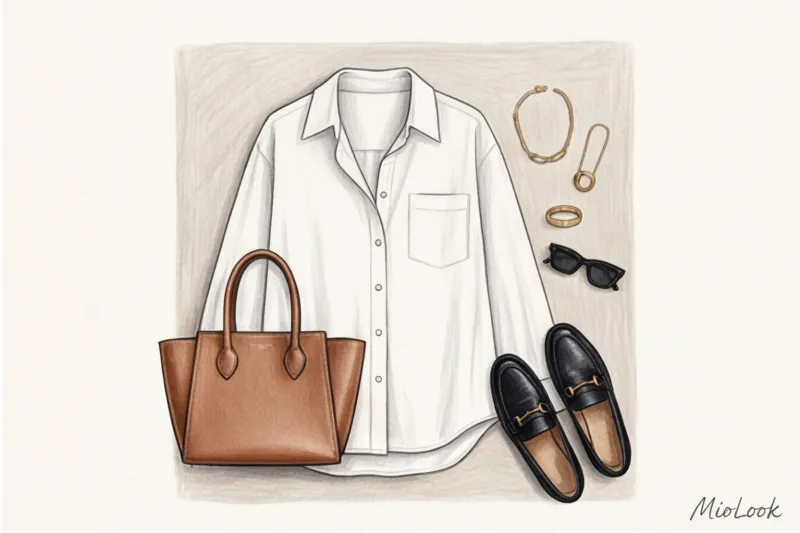
The loose fit opens up amazing layering opportunities that elevate any boring look:
- English Preppy: We put on a shirt under a voluminous knitted vest, leaving the collar, cuffs and hem casually hanging out.
- Warm minimalism: Wearing a shirt unbuttoned 2-3 buttons over a thin wool turtleneck is a great option for the colder months.
- Summer casualness: We use the shirt instead of a light jacket, throwing it over a basic tank top and straight jeans.
The most common question I get from my clients is, "How do I choose a shirt that doesn't require half an hour of ironing?" There's a catch. Non-iron shirts are often impregnated with formaldehyde resins, which can irritate the skin and prevent the body from breathing. Instead, look for 2-ply cotton—it's dense, holds its shape well, and looks expensive. A good technological compromise is to add 2-5% elastane or lyocell (Tencel) to the cotton. This fabric wrinkles less and drapes beautifully.
A quality basic shirt made from the right cotton will cost you between €80 and €150—it's an investment worth every penny. And if you think a white shirt is boring, try digitizing it. Add a photo of the shirt to the app. MioLook , and the "smart wardrobe" algorithm will instantly generate dozens of unexpected outfits for you using items already hanging in your closet.
The Little Black Dress (LBD): A Timeless Uniform
Would you willingly wear a maid's or widow's uniform? That's exactly how the question would have sounded to a woman in the early 20th century if she were asked to wear a black dress outside of mourning. Until 1926, black was strictly taboo in society wardrobes—associated either with servants or with Queen Victoria's protracted grief over Prince Albert. But then Gabrielle Chanel pulled off one of the most brilliant marketing subversions in fashion history: she transformed a grim marker of social status into the absolute epitome of elegance.
October 1, 1926, on the pages of the American publication Vogue A laconic sketch of a Chanel crepe de Chine dress appeared. Journalists made a bold but surprisingly accurate prophecy, noting that this wardrobe staple and its history would change the rules of the game forever.
"This black dress will become a kind of uniform for all women of good taste. It's the Ford of fashion," wrote Vogue, comparing Chanel's creation to a Ford Model T.
The comparison to Henry Ford's approach to automobile manufacturing was no accident. Just as the Ford Model T made the car an affordable means of transportation (which, incidentally, was produced exclusively in black to reduce production costs), so the LBD (Little Black Dress) became the first truly democratic garment. It erased class boundaries: thanks to the simplicity of its cut and versatility of color, it was impossible to immediately tell whether you were wearing a wealthy aristocrat or a modest typist with good taste.
How to adapt the LBD to modern realities
These days, when people come to me for a wardrobe overhaul, I often see the same mistake: clients carefully hoard those stiff sheath dresses from the 2000s, which are physically impossible to wear for more than a couple of hours. They require perfect posture and special underwear. I always tell them frankly: forget about tightly fitted silhouettes that restrict your steps.
Ergonomics and texture are king right now. A sensible basic investment (for example, in the €100–€250 range) is a thick, shapeable knit, a simple A-line silhouette, or a flowing slip dress made of heavy silk or viscose. These things work for you, not against your anatomy.
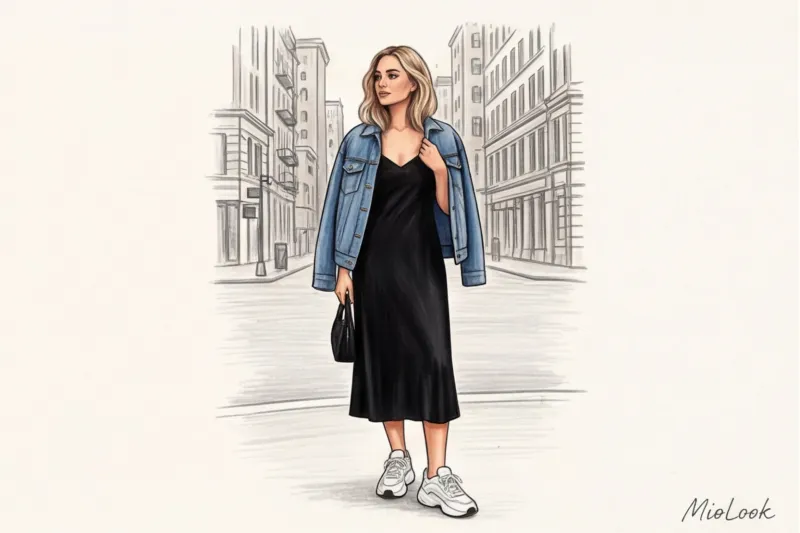
The secret to the modern LBD is stylistic contrast—the ability to take the edge off the formality. daytime scenario We build a look on a clash of textures: we throw a thick, voluminous, chunky-knit cardigan or a formal men's jacket over a silk slip, and on our feet we put on chunky lace-up boots or minimalist sneakers.
Evening scenario It requires only minimal manipulation: changing shoes to pumps or open-toe mules, adding statement accessories—for example, chunky geometric earrings or an architectural clutch. To avoid reinventing the wheel every morning, I recommend putting together 3-4 styling options in front of the mirror and saving them in MioLook The intelligent assistant will remember your kits and suggest the right formula in just a couple of clicks.
Access to MioLook for €0.99 — one-time payment
Start creating perfect images with the help of artificial intelligence
Get access — €0.99 onceJeans: From Gold Mines to Boardrooms
Look at photos of top executives at any IT conference: there's a 99% chance they're standing on stage wearing denim. Yet just a century and a half ago, this fabric was a strict marker of exceptionally hard physical labor. The history of this iconic garment dates back to 1873, when entrepreneur Levi Strauss and tailor Jacob Davis patented a brilliant utilitarian solution: copper rivets for reinforcing pockets on work pants.
The first jeans were made from stiff tent canvas (and later from twill) exclusively for gold prospectors, stevedores, and miners. These were heavy-duty work clothes designed to withstand the weight of heavy nuggets and metal tools stuffed into the pockets. There was no question of aesthetics or comfort—they were focused on function, a garment built to last.
"Jeans represent fashion democracy," Giorgio Armani once aptly observed. But to break into the world's catwalks and become truly democratic, they required a cultural revolution.
A powerful paradigm shift occurred in the 1950s. When icons of the era, Marlon Brando and James Dean, appeared on screen wearing simple white T-shirts and distressed jeans, denim instantly became a symbol of youthful rebellion against conservative post-war society. What had previously been associated with drudgery became a manifesto of freedom. It was this sociocultural shift that launched the gradual legitimization of denim in high fashion.
But the most striking transformation is happening right now. In Silicon Valley, denim has become a marker of "new luxury." It's an unspoken statement: "My intellect and wealth are so significant that I no longer need to prove my status with a formal three-piece suit." Today, a pair of premium Japanese selvedge denim in the €300-€400 price range, paired with basic knitwear, is a modern uniform that opens doors to any boardroom.
Denim in a modern expert wardrobe
From my styling experience, I've learned one hard and fast rule: not every pair of jeans is appropriate for the workplace. Ripped boyfriend jeans or heavily embellished styles are great for the weekend, but they completely ruin your professional image.
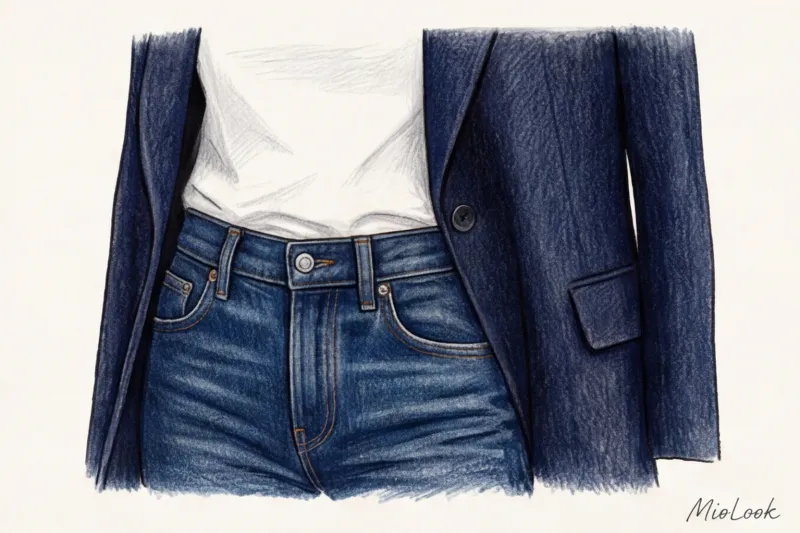
If you're planning to skillfully integrate denim into business smart casual, filter your jeans through three criteria:
- Color: solid dark denim (deep indigo, graphite or rich black) without gradients or tie-dye effect.
- Cut: Straight or slightly loose, architectural (straight or relaxed). Avoid outdated skinnies that hug the calves.
- Texture: smooth, even fabric and a complete absence of frayed edges, rips, or contrasting seams on the pockets.
This minimalist style works just as flawlessly as a pair of classic trousers. And the key to elevating denim's status lies in the stylistic contrast of materials. Rough, dense cotton denim always calls for a refined, visually "expensive" pairing. I highly recommend pairing jeans with smooth, thick silk (like a pussy-bow blouse), flowing cashmere, or the structured wool of a blazer. Add a high-quality leather belt with a minimalist buckle—and this play on textures will instantly elevate your outfit to a premium level.
If you often have doubts about how appropriate your jeans look with a particular jacket or shirt, digitize your closet in the app MioLook Smart wardrobe algorithms will analyze your essentials and automatically curate dozens of safe, stylish, and classy office combinations, taking the hassle out of getting ready in the morning.
Tweed Jacket: Ditch the Corsets for Comfort
Imagine a dense, itchy wool fabric created exclusively for Scottish landowners and harsh weather conditions. Until the 1920s, using harsh English tweed in a woman's wardrobe was considered sartorial folly. Women continued to suffocate in rigid structures and get tangled in complex layers of fabric until Gabrielle Chanel quietly revolutionized it.
Observing her lover, the Duke of Westminster, she began wearing his sport coats for hunting and fishing. Chanel realized the key: borrowing men's English tweed to create a soft women's suit was the only way to give women true freedom. She abandoned the rigid, form-fitting foundation, offering a silhouette that finally allowed for easy driving, raising one's arms, and simply living comfortably without sacrificing elegance.
The creator of the iconic jacket didn't just redesign the men's jacket; she completely transformed the ergonomics of the garment. For the first time, truly functional pockets appeared on women's clothing—not for decorative purposes, but to allow for comfortable placement of hands. The armholes were cut anatomically high and narrow, allowing for incredible mobility (try moving your arms freely in a regular factory jacket, and you'll see the difference).
"Luxury must be comfortable, otherwise it is not luxury" - this principle forever changed the approach to the design of basic things.
But herein lies the most intriguing tailoring secret. Often, when buying similar items from the mass market, we find that the dense fabric bulges. If you turn a classic jacket from a French house inside out, you'll discover a heavy brass chain at the very bottom of the lining. What's it for? It's an ingenious balancer. It's these chain-like weights that guarantee a perfect fit: they pull the edges down, ensuring the garment lies flat against your figure, doesn't ride up when you walk, and maintains its impeccable cut regardless of your movements.
We wear tweed without a retro touch
Today, this historical piece is one of the best investments in personal style. A quality piece (even modern, high-tech models in the €150–€300 range) can elevate even the simplest everyday look. But it's very easy to get it wrong.
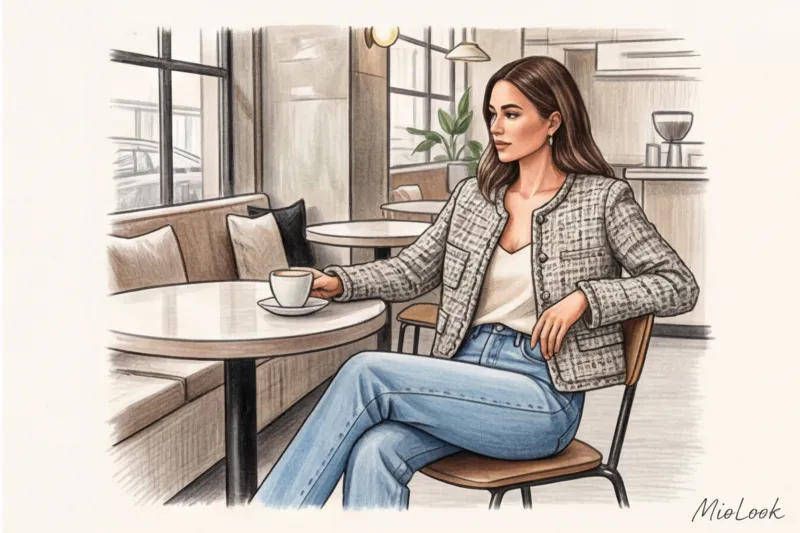
The main rule of styling: never wear a full set (jacket and skirt) unless you want to look overly conservative. A two-piece suit made of loose wool instantly adds years to your appearance and creates the effect of a "strict lady from the past century." Save this trick for royal visits. In today's reality, historical pieces require a fresh, ironic context.
We build looks on a bold mix of textures. Pair rough, textured tweed with bold materials: combine it with smooth leather trousers, flowing silk lingerie-style tops, or the simplest basic tees in thick cotton. Pairing a structured top with vintage straight-leg jeans and sneakers is a modern classic. If you have trouble finding unique pairings for complex pieces, I recommend digitizing your purchases. Upload a photo of the jacket to MioLook app , you can visually test dozens of combination algorithms and find those non-trivial formulas, avoiding boring solutions in front of a mirror.
Your ideal image
it begins Here
Join thousands of users who look flawless every day with MioLook.
Get access — €0.99 onceThe Vintage Trap: Why "Authentic" Items Often Ruin Your Wardrobe
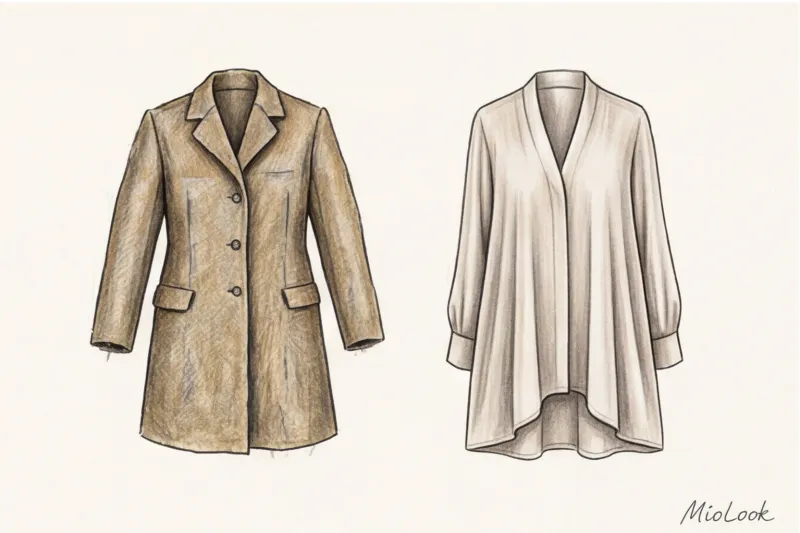
The fashion industry is currently experiencing a veritable cult of resale: influencers are passionately chasing down archival collections, proudly paying €200 to €500 in vintage boutiques for original pieces from decades past. It sounds incredibly romantic, but let's look at it from a practical perspective. I've seen hundreds of women buy expensive vintage pieces, only to have them hang in the back of their closets for years due to simple physical discomfort. The harsh truth is that an original vintage Levi's 501 from the 1970s or an authentic army gabardine trench coat are stiff, heavy, and completely unsuitable for life in 2024.
It's important to understand that historical clothing was originally designed for harsh conditions, physical labor, or military service, not for a relaxed brunch. You won't be able to sit for long at your desk in 100% unwashed denim jeans without feeling a strain on your stomach, and the weight of a genuine "trench coat" with a thick lining will begin to strain your shoulders after just half an hour of brisk walking.
We often confuse the concept of "wardrobe basics and their history" with the need to wear exact museum replicas. In snobbish fashion circles, it's common to criticize any artificial additives to natural materials, but the evolution of fabrics didn't just happen. I want to debunk this myth once and for all: adding 2% elastane to denim or Tencel fibers to a crisp cotton shirt isn't a way for brands to "cheapen" production, but a direct concern for ergonomics.
According to the Textile Exchange analytical report (2023), integrating technological fibers into classic materials allows them to adapt to modern realities. Our lifestyle is paradoxical: we are more mobile, yet we spend hours sedentary. Innovative blended fabrics offer a slight spring, stretch with our movements, and, importantly, wrinkle less throughout the day.
This leads to my most important, and perhaps most pragmatic, rule as a stylist: buy a piece with a historical visual code (the DNA of the garment), but only in a modern, technologically advanced execution. You need a recognizable silhouette, signature brass hardware, or the right lapel geometry, not 15-ounce fabric that can stand in a corner without your help.
If in doubt, try a simple digital test. Upload your rugged vintage find and its modern, flexible counterpart to the app. MioLook To track how often you wear a piece over a single season, smart statistics will quickly reveal the true picture: 9 times out of 10, numbers trump romance. We always subconsciously gravitate toward clothes that don't require us to physically strive to maintain impeccable style.
Digitizing the classics: how to integrate historical references into a smart wardrobe
A study by a major retail chain revealed a terrifying statistic: the average woman spends 17 minutes each morning choosing clothes. Over the course of an active working career, this adds up to nearly six months of life spent gazing at an open closet. My approach to style is based on viewing fashion through the lens of productivity.
This is where the concept of "wardrobe essentials and their history" ceases to be just a theory and becomes a tool for strict time management. When working with wardrobes, I always implement 80/20 rule: High-quality historical staples should make up exactly 80% of your closet. This fundamental core is designed to take on 100% of the morning routine. The remaining 20% is dedicated to micro-trends, statement shoes, and complex textures to set the mood.
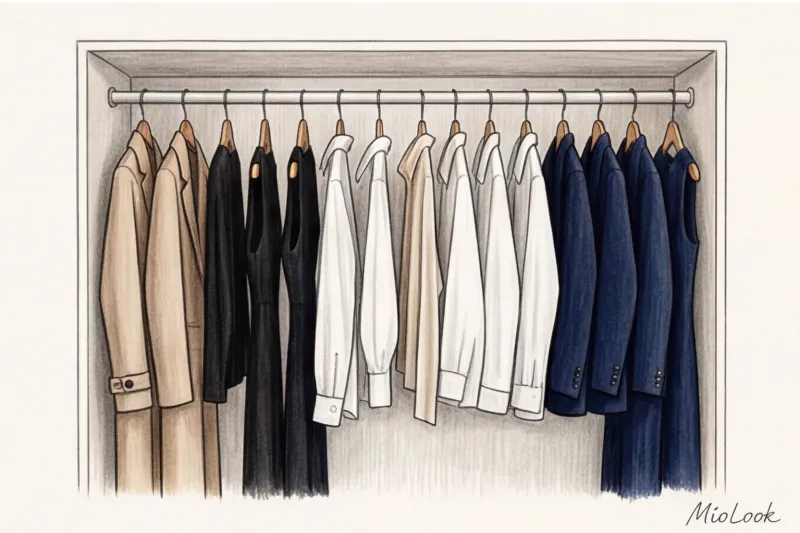
But how can you be sure that investing in the right trench coat or the perfect pair of straight jeans for €150 will actually work? Apply uncompromising integration test Every iconic item should form at least five ready-to-wear combinations with your current clothes. For example, a white men's shirt: tucked into dress pants, worn over a turtleneck, layered over a silk slip dress, paired with basic denim, or layered as a lightweight jacket over a sporty crop top. If you struggle to come up with at least three combinations, the item will sit idle.
To avoid having to keep these patterns in mind, progressive professionals have long since digitalized their style. Using specialized apps to create combination algorithms is an absolute lifesaver. By uploading your items to MioLook smart wardrobe , you essentially delegate the visual routine to algorithms.
Last quarter, I conducted a time audit with a client who works as a brand director. We photographed her classic image database, uploaded it to the app, and set up image generation for the week ahead. The result: morning thinking time dropped from 20 minutes to 3 minutes. Simple math proves that a systematic approach to your database can earn you an extra hour of sleep each workweek.
Checklist: 5 Iconic Investments for Your Personal Brand
Let's conduct a thought experiment. Imagine you have to leave tomorrow for a month-long business trip, complete with tough negotiations with investors, informal evening cocktails, and long walks around the city. And you can only take carry-on luggage. It's in these stressful scenarios that the concept of "wardrobe essentials and their history" proves its absolute genius. These five iconic pieces aren't just clothes, they're your liquid visual capital, working to build your personal brand 24/7.
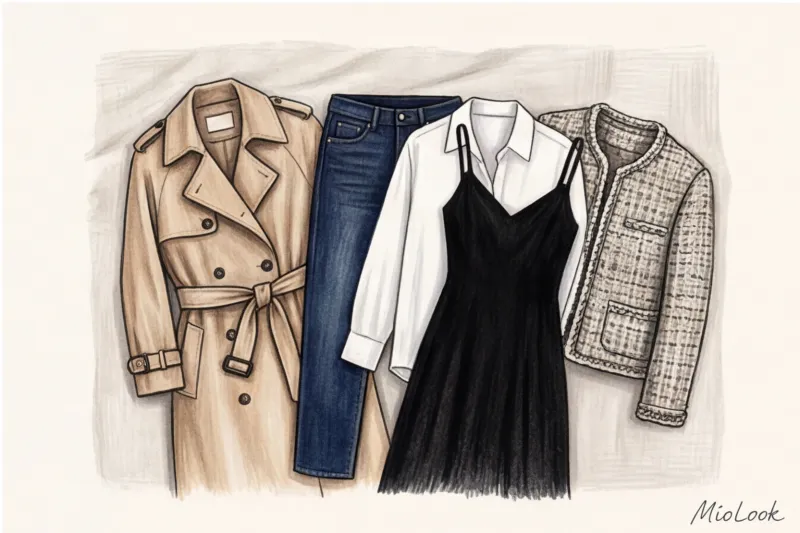
To ensure you don't lose money while shopping, I've put together a strict technical checklist for you. Here's what my clients and I look for in the fitting rooms before taking an item to the checkout:
- Beige trench coat. The main indicator of a luxury item is the hardware and the finish of the back. D-rings on the waistband should be made of heavy, resonant metal, and buttons made of natural horn or dense resin. Pay close attention to the shoulder fit: if you're choosing a raglan sleeve, the fabric shouldn't bunch up under the arms. For oversized styles, the ideal armhole width is one that allows for a voluminous cashmere sweater to fit comfortably under the trench coat without restricting your movement.
- White shirt. The secret lies in the seams and collar. Turn the shirt inside out: the side seams should be closed (French or linen), with no protruding overlock threads. Technologists at production facilities always evaluate stitch count—in premium garments, it's at least 6–7 stitches per centimeter. The collar must maintain its architectural shape even after washing; to achieve this, special stiffeners (bones) should be hidden in its corners.
- Straight jeans. Invest in dense, unruffled denim weighing at least 12 ounces. When trying on the pants, pay close attention to the side seams of the legs—they should hang strictly perpendicular to the floor. If the seam curls even slightly forward or back toward the knee, the fabric was cut with a grain line problem, a problem that will never be resolved. The zipper should be engraved with a reputable manufacturer like YKK, and the copper rivets should adhere tightly to the fabric.
- Tweed jacket. The weakest point of budget tweed is the armhole. The jacket should provide complete freedom of movement: try raising your arms to chest level. If the jacket pulls the entire garment up, the armhole is cut too low (a typical problem with mass-market tweed). High-quality tweed is heavy and falls under its own weight, so the shoulder seams remain perfectly straight, without any bulges or distortions.
- Little black dress (LBD). Assess the texture in natural daylight. The fabric shouldn't reflect light—a cheap, glassy sheen instantly reveals low-quality polyester. If you're choosing an A-line silhouette or a tight slip, check the darts: they should end precisely at the highest point of your bust. Any misalignment will visually distort your body proportions.
Final stylist tip: How to prioritize on a budget.
Last month, I was putting together a basic capsule collection for a freelance client with a strict budget of €500. My approach in such situations is categorical: it's better to buy two exceptional items than five mediocre ones. Don't spread your budget thin.
Start with what's closest to your face and what you wear most often—the perfect white shirt (budget around €80–€120) and the right pair of straight-leg jeans (€100–€150). Invest the rest in quality leather shoes. Save complex, structured pieces like a trench coat or tweed jacket, which in a decent technical design cost €250 and up, for next season. Building a wardrobe is a marathon, not a sprint.
Remember wardrobe math. A €120 shirt worn 100 times a year will only cost you €1.20 per occasion. A trendy €40 blouse worn just once is €40 in the trash. Historically, the base always wins financially.
Your action plan for today: take an honest inventory of your closet and identify your blind spots. To avoid relying on intuition, digitize your wardrobe through MioLook — the algorithm will clearly show you which of these five iconic pieces will give you the greatest number of new combinations with your existing clothes. Invest in history wisely, and it will serve you well for decades.
Guide Chapters
С чем носить жемчуг на шее: от классики до гранжа
Жемчуг больше не ассоциируется исключительно с театральными образами. Узнайте, как интегрировать это украшение в повседневный гардероб и не выглядеть старомодно.
Как носить винтажные вещи: ИИ-гид по базовому гардеробу
Купили уникальный винтажный жакет, но он пылится в шкафу? Узнайте, как сбалансировать пропорции и интегрировать ретро-находки в современный базовый гардероб с помощью ИИ.
Куртка косуха женская: с чем носить и как выбрать
Персональный стилист разрушает стереотипы о «женственной» косухе. Узнайте, как правильно выбрать и стилизовать эту дерзкую куртку, чтобы она стала идеальной базой.
История джинсов кратко: от рабочей формы до подиума
Как грубая рабочая одежда превратилась в главную инвестицию стильного гардероба? Разбираем феномен денима вместе со стилистом.
Белая рубашка женская: с чем носить мужской крой
Почему идеальную белую рубашку для женщин стоит искать в мужском отделе? Разбираем секреты кроя и лучшие способы стилизации базового элемента гардероба.
Классические туфли лодочки с чем носить: советы
Лодочки — это не просто базовая обувь, а точная геометрия стиля. Узнайте секреты стилиста: как правильный вырез туфель может визуально удлинить ноги.
Твидовый жакет с чем носить, чтобы не выглядеть старомодно
Твидовый жакет может добавить 10 лет возраста или стать самым стильным элементом гардероба. Разбираем, как современно носить классику.
Тренчкот женский с чем носить: идеи стильных образов
Узнайте, как военная униформа превратилась в базовую деталь гардероба. Разбираем анатомию классического плаща и подсказываем стильные сочетания.
Капсульный гардероб из базовых вещей: вечная классика
Забудьте о скучных списках из глянца. Персональный стилист делится математическим подходом к созданию идеального гардероба на долгие годы.
Маленькое черное платье: с чем носить и как выбрать
Разбираем мифы о базовом гардеробе и учимся выбирать черное платье, которое не будет годами висеть в шкафу. Практический гид от стилиста по фасонам, тканям и стилизации.