

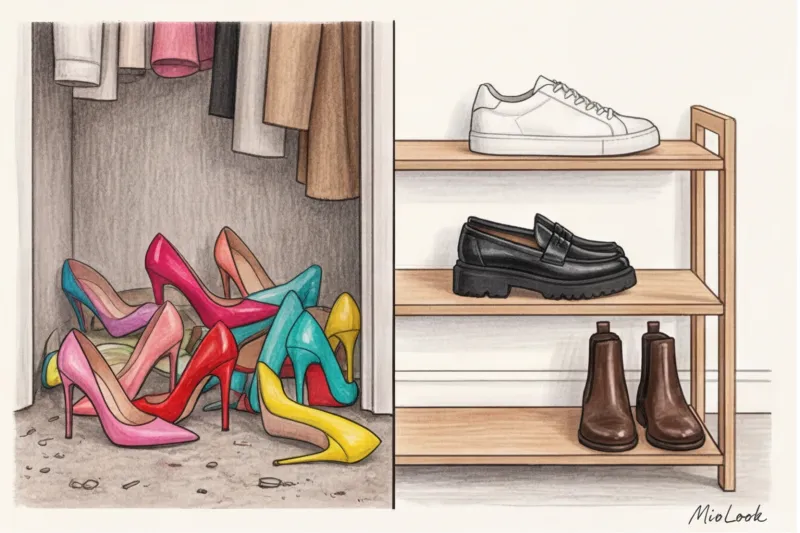
Types of Women's Shoes: Why Old Classifications No Longer Work
Have you ever counted how many pairs of shoes are gathering dust on the top shelves, waiting for "that one" occasion? Over 12 years of working as a personal stylist, I've regularly seen the same scene: a closet overflowing with boxes, and a client sighing in frustration because she has nothing to wear to a meeting. When we begin to digitize our wardrobes, the obvious becomes clear: classic types of women's shoes and the strict rules for combining them that glossy magazines taught us in the 2000s are hopelessly outdated.
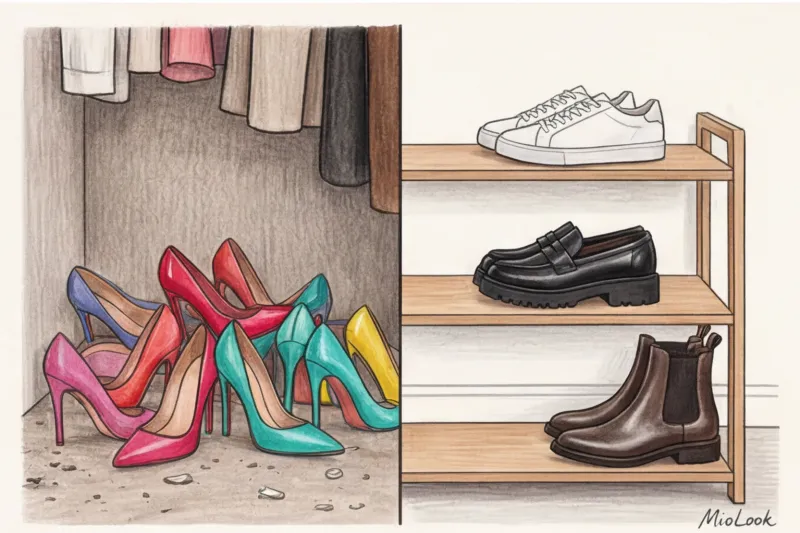
Over the past five years, the industry has undergone a tectonic shift. The trend toward hybridity and uncompromising comfort has forever changed our habits. We are no longer willing to tolerate pain for the sake of visual aesthetics. Manufacturers have realized this: brands are now integrating orthopedic insoles made from memory foam (memory foam) and shock-absorbing athletic soles in clean leather silhouettes.
According to a McKinsey report (2023), sales of classic high-heeled shoes have fallen by a whopping 71%, while demand for premium casual flats is breaking historical records.
That's why the distinction between "strictly business" and "sports" footwear has become meaningless. Today, top managers attend board meetings in minimalist white sneakers and three-piece suits, and we easily mix silky lingerie-style skirts with chunky lace-up boots. The boundaries have blurred, opening up space for smart, functional styling.
As a capsule wardrobe evangelist, I love relying on data rather than intuition. We recently analyzed anonymized user statistics in the app. MioLook To understand what kind of shoes modern women actually wear every day, the results are sobering: 82% of all outings are in just three types of shoes—basic sneakers, loafers, and mid-season Chelsea boots. And those luxurious evening shoes that occupy prime spots in the closet are worn on average 1.5 times a year.
This leads to the main rule of modern shopping: the concept Cost-Per-Wear (CPW) , or price per wear, has become the only true criterion when choosing a new pair. The mathematics of style is extremely simple and ruthless:
- You bought trendy rhinestone ankle boots for 150 euros and wore them twice to parties. Their CPW is 75 euros - it's unreasonably expensive.
- You invested in a pair of high-quality leather loafers for 200 euros and wore them three times a week for eight months (about 100 times). Their CPW is only 2 euros.
You should invest in shoes you live in, not ones you only take pictures of once a season. A smart wardrobe begins with an honest analysis of your real, not imagined, lifestyle.
Basic Shoe Wardrobe: 5 Types of Women's Shoes with Maximum ROI
Let's talk numbers. As a stylist who loves optimization, I always evaluate my wardrobe through the prism of financial terms. ROI (Return on Investment) — return on investment. In the fashion world, we call this Cost-Per-Wear (CPW) , or the cost of one output.
When I first decided to assemble my ideal minimalist capsule wardrobe, I conducted a rigorous closet audit. The numbers were sobering. It turned out that I wore my luxurious fuchsia ankle boots for 350 euros exactly twice (the cost per outfit was 175 euros). Meanwhile, I wore my classic black loafers for 180 euros 120 times per season (1.5 euros per outfit). Feel the difference. It was this mathematical approach that forced me to rethink all existing types of women's shoes and identify those that truly work for you, not just look good on the shelf.
The Pareto principle (80/20) works flawlessly in the shoe closet: just five well-chosen basic pairs can cover 90% of your life situations—from going for your morning coffee to a complex presentation to the board of directors.
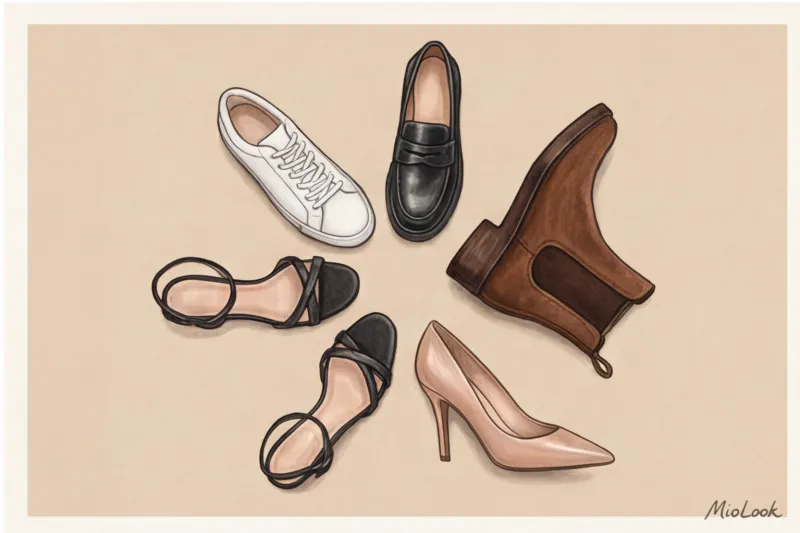
And here I want to once and for all destroy the main stereotype of the glossy magazines of the 2000s. Open any old article on the topic of a basic wardrobe, and the first thing you'll see is... beige stiletto pumps "They visually lengthen the leg and go with everything," magazines told us. Forget it. Unless you work in a strict protocol department or walk the red carpet at the Cannes Film Festival, beige pumps are probably unnecessary. Their ROI in the realities of today's fast-paced lifestyle is close to zero. A truly sustainable foundation looks completely different.
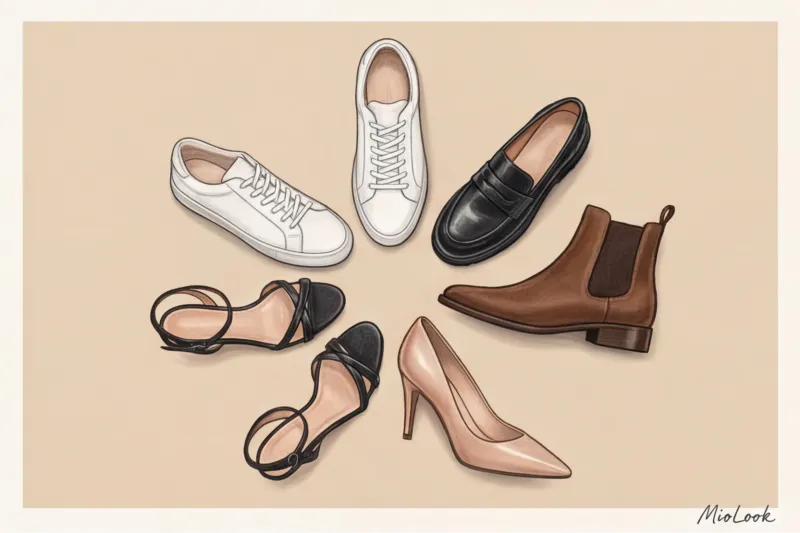
White sneakers: a new classic
The first and most important pair of shoes in a modern wardrobe. But it's crucial to draw a distinction here: running shoes with an active mesh, complex tread, and a cushioned sole (think typical Asics or Hoka models) are considered athletic gear. But simple white sneakers made of smooth matte leather are a fully-fledged casual staple.
The perfect basic sneaker (think silhouettes like Veja Campo, Common Projects, or classic tennis shoes) is free of overt embellishments, massive logos, and contrasting panels. It's this visual purity that allows them to work wonders when it comes to styling:
- With a business suit: They take the arrogance out of a strict three-piece suit, showing that you are a modern professional who values comfort.
- With romance: A silk midi skirt in a lingerie style paired with sneakers stops looking like a date outfit and becomes a great daytime look.
- With denim: Classic straight-leg jeans, a white t-shirt, a structured jacket and white sneakers – a uniform that will never fail.
The only ironclad rule is that sneakers must be spotlessly clean. No "artificial scuffs." My personal life hack: keep regular melamine sponges in the bathroom for cleaning white rubber soles, and use a professional white cream paint with a strong pigment (such as Tarrago) every two weeks. This five-minute routine will extend the life of your favorite pair by at least two seasons.
Loafers and Oxfords: Smart-Casual Essentials
When sneakers seem too casual, and the dress code or mood calls for a more composed look, women's footwear styles historically borrowed from men's wardrobes come into play. To avoid confusion in online stores, let's define the terminology:
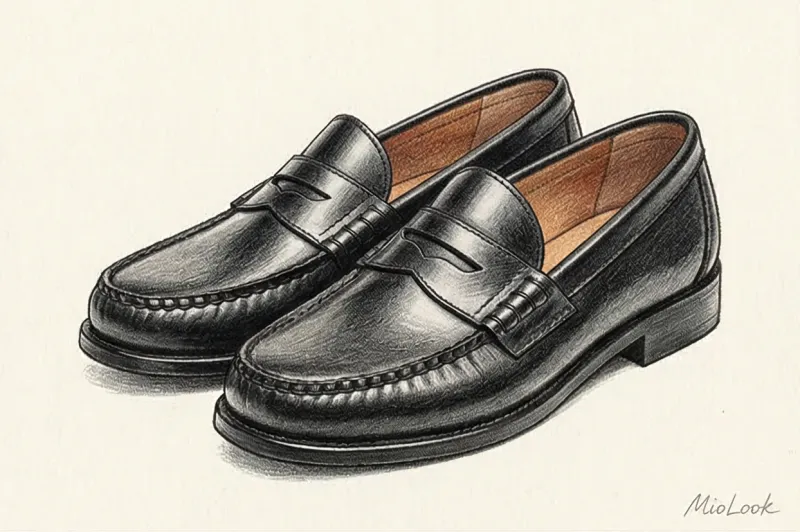
- Loafers: shoes without laces. There are penny loafers (with a distinctive slit on the leather strap where Ivy League students hid a coin), tassel loafers ( tassel loafers ) and modern variations on a massive tractor sole (chunky loafers).
- Oxfords: Closed-laced shoes (with the side panels sewn under the front). The most formal and sophisticated option.
- Derby: Open-laced shoes. Slightly less formal, easier to put on for high-instep feet.
The paradox of style is that it's precisely the rugged, masculine footwear that makes a feminine look more fragile. When you wear formal Oxfords with cropped trousers, revealing a slender ankle, you play on the contrast of volumes. This looks much more interesting and sophisticated than a simple stiletto heel.
To integrate them into your office wardrobe, I always recommend starting with black or deep burgundy polished leather penny loafers. And if you're up for a fashion experiment, try pairing them with high white cotton socks—this instantly adds a fresh, textured touch to the look.
Access to MioLook for €0.99 — one-time payment
A smart AI stylist will select the perfect outfit from your items and suggest what to wear with your new pair of shoes.
Get access — €0.99 onceChelsea boots and chunky boots: a demi-season essential
As the cold weather approaches, our shoe wardrobes transform, but the principle of versatility remains unchanged. And here, the absolute champion in terms of Cost-Per-Wear is Chelsea boots.
This is a truly ingenious invention of the Victorian era. Their creator, shoemaker Joseph Sparks-Hall, came up with the idea of inserting elastic bands along the sides so Queen Victoria could easily put on her riding boots without the hassle of lacing. The lack of unnecessary details, smooth toe, and just-above-the-ankle height make Chelsea boots the most adaptable autumn pair. Today, both classic models with thin Church's-style soles and more rugged platform options are popular.
If your personal style requires more character, consider rough lace-up boots (combat boots, Martins). The secret to skillfully integrating them into an elegant wardrobe is, once again, the rule of contrast. Wear chunky combat boots with flowing floral dresses, flowing skirts, or tailored straight-cut cashmere coats. They instantly ground an overly dressy or overly romantic look, making it suitable for real life.
Important expert warning: When choosing any mid-season boots, the correct shaft height is crucial. This is that subtle detail that can ruin any figure. If you have large calves, absolutely avoid boots whose shaft ends at the widest part of your leg—this will visually "cut" your silhouette horizontally and add extra pounds. The ideal height is either two fingers above the narrowest part of your ankle or full knee-length (like a tube boot). For petite women, I always recommend looking for boots with a snug, sock-like fit to avoid the comical pencil-in-a-glass effect.
A complete glossary: types of women's footwear by season and purpose
One of my clients once spent three evenings trying to find elegant summer office shoes on a major online store. She persistently typed "open-toe shoes" into the search bar. The platform's algorithm, which operates according to strict tagging rules, returned 15,000 results, ranging from beach flip-flops to orthopedic sandals. By the time we spoke on the phone, she was in complete despair about online shopping.
I asked her to enter exactly one word: "slingbacks." And add the filter "kitten heel." Two minutes later, we were placing an order for the perfect pair of smooth leather shoes for 140 euros. This incident perfectly illustrates why knowing the precise terminology isn't just a snobbery for fashion editors, but your most important time management tool.
In the age of e-commerce, the right product name works like a safe key. Online stores use complex filtering systems (faceted search). If you don't speak the same language as the algorithm, you either waste hours browsing irrelevant products or miss out on the best items that simply weren't included in your vague selection.
Various types of women's shoes They have clear historical and design names. The secret to professional online shopping is to set up filters correctly: first, we select a global category (for example, "shoes" or "boots"), then a specific style ("Mary Janes," "monk boots," "Chelsea boots"), then the material ("suede," "smooth leather"), and only finally, we specify the color and size. This algorithm eliminates 95% of visual noise.
Accurate classification is important not only for shopping. When you digitize your wardrobe in MioLook Proper tagging allows the neural network to operate at its full potential. You'll agree that for artificial intelligence (as well as for a stylist), there's a huge difference between abstract "boots" and specific "rough desert boots"—they require completely different styling and proportions.
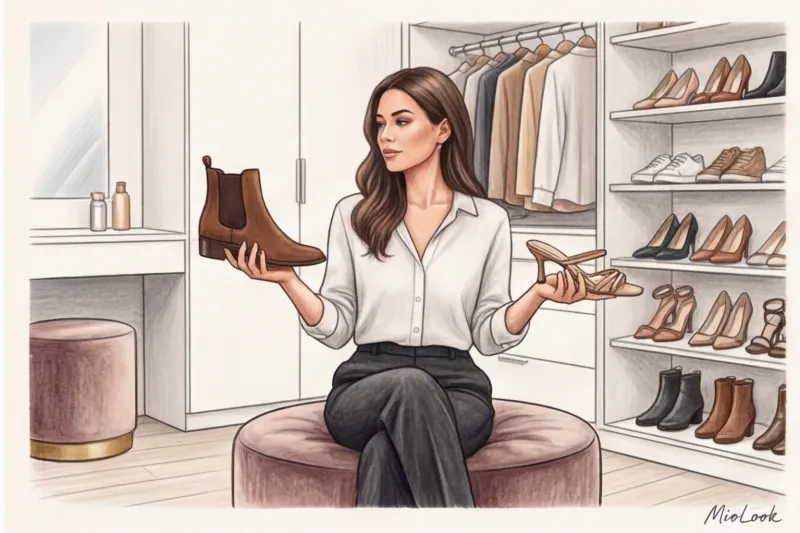
Summer Shoes: From Mules to Espadrilles
Summer footwear often languishes between two extremes: either overtly beachy flip-flops in the city center or closed-toe office pumps in 90-degree heat. Let's explore some terminology to help you find a happy medium.
Let's start with the eternal confusion: mules and clogs Many consider these words synonymous, but structurally they are different types of women's footwear. Mules are elegant, backless shoes, often with a heel (from a micro-stiletto to a stable block) or a thin, flat sole. They can be closed or open-toed, but their DNA is lightness and elegance. Clogs are open-toed shoes with a solid, often wooden or cork, sole, historically descended from peasant shoes. We wear mules with silk slippers and formal palazzo pants, while clogs are the perfect complement to boho style, flared jeans, and linen sundresses.
In the category sandals Today three directions dominate:
- Minimalist (naked shoes) — a legacy of 90s aesthetics. These models feature ultra-thin straps that leave the foot virtually bare. According to WGSN analytics for 2023, they became the best-selling evening shoe.
- Gladiators — sandals or open-toe shoes with multiple straps that wrap around the ankle and calf. These require caution, as they visually shorten the length of the leg.
- Wedges — a one-piece sole that thickens toward the heel. A great alternative to heels for outdoor events (like lawn weddings), where stiletto heels would sink into the ground.
To create the aesthetics of “resort chic in the city” are indispensable espadrilles (textile shoes with jute rope soles, a reference to the iconic Castañer models) and topsiders (Boat shoes are yachting shoes with a white rubber sole and a lace running around the heel.) Both styles are worn barefoot.
When it comes to sandals, anatomical ones rule the roost. Birkenstocks (shoes with orthopedic cork insoles) and trekking sandals Teva-style (with Velcro fastenings and chunky soles). The latter is a prime example of the ugly chic trend, where we deliberately tone down the pomp of a flowy dress with overtly tourist-style footwear.
Demi-season footwear: ankle boots, brogues, monk shoes
The transitional season is the most challenging time for styling. The weather changes three times a day, and the proportions of outerwear require precise work with bottoms. The right types of women's footwear for the transitional season are the foundation of a fall-spring capsule wardrobe.
Term ankle boots Ankle boots encompass footwear that covers the ankle. However, there are critical differences within this category:
- Cossacks (western boots) — ankle boots with a slanted heel and an elongated, often pointed or square toe. This is a genius stylist's tool: wear them with a romantic floral dress, and you'll instantly remove any excess sweetness from your look.
- Sock boots — models made of elastic material that fit snugly around the ankle. These are the only shoes that pair well with wide, cropped trousers (culottes) or midi skirts, as they accentuate the narrowest part of the leg without adding bulk.
- Chukka and deserts — Ankle-length suede boots with two or three pairs of eyelets for laces. The basis for a relaxed casual look.
If you prefer men's style shoes, pay attention to brogues and monks Brogues aren't a style, but a decorative element: any shoe with perforations (holes) is automatically considered brogue. Monk straps, on the other hand, are slip-on shoes with one or two buckled straps serving as closure. In the 150-250 euro price range, you can find stunning polished leather monk straps that will elevate even the most boring office attire.
For a dry and warm autumn, the ideal alternative will be slip-ons (sneakers without laces on a thick rubber sole) and classic moccasins The latter are experiencing a renaissance thanks to the trend for "quiet luxury"—models made of the softest suede (inspired by the iconic Loro Piana Summer Walks) have become the uniform of modern urban minimalists.
Winter footwear: over-the-knee boots, moon boots, ugg boots
A winter shoe wardrobe in our latitudes must solve a complex problem: keeping you warm without turning you into a polar explorer (unless that's your style goal). Forget outdated classifications that divided winter footwear into "fur-lined boots" and "boots."
In the high boot category today, two models rule. Thigh-high boots Over-the-knee boots are boots that reach above the knee. The main rule of modern fashion is that they shouldn't be overly decorated or shiny. Matte leather or suede, flat soles or a sturdy heel—that's how over-the-knee boots look classy. Pipe boots These are models with a straight, wide shaft that doesn't hug the calf. They create a straight, vertical line that's incredibly flattering and allows you to easily tuck in straight jeans or thick leggings.
A separate category is utilitarian winter footwear. We no longer shy away from comfort. Ugg boots (shortened ultra-mini models are especially relevant), moonbutts (moon rovers) and dutiki Padded boots have moved beyond the "for country trips only" category. The secret to styling them in the city is playing with contrasts. We wear chunky moon boots with oversized down jackets, but we pair them with tailored cashmere joggers or thick tights and knit dresses, maintaining a balanced proportion.
An absolute hit of recent seasons, returning to us on a wave of old money aesthetics - jockey boots (equestrian boots). Inspired by equestrian gear (think Hermès classics), these knee-high boots, with a straight shaft, minimal heel, and distinctive straps, have become a symbol of a new elegance. These are the kind of boots that only get better with age: light abrasions on the high-quality leather give them a refined vintage look. They pair flawlessly with tweed jackets, slim trousers (yes, they're legal in this context), and voluminous robe coats.
Understanding these nuances transforms the process of choosing shoes from a chaotic wandering through stores into a targeted, investment-smart approach to developing your style.
Sports and athleisure footwear: the line between indoor and outdoor
On the streets of major business districts, you often see the same style mistake: a gorgeous, loose-fitting pantsuit, accessorized with... professional running shoes made of thin neon mesh. Let's draw a hard line between the gym and the city.
Texture clashes are the main reason why purely training shoes can ruin a casual look. The technical materials of Asics running shoes or the aggressive tread of trail running shoes visually clash with the refined wool, silk, or heavy denim of a suit.
We need it to live lifestyle sneakers This category includes vintage retro silhouettes (for example, flat sneakers with suede inserts), chunky chunky -models and deliberately rude Dad Sneakers Unlike their athletic counterparts, urban sneakers are crafted from a combination of smooth leather, dense nylon, and fuzzy suede. These materials allow them to seamlessly integrate into complex, layered outfits without leaving the impression of having forgotten to change your shoes after a morning run.
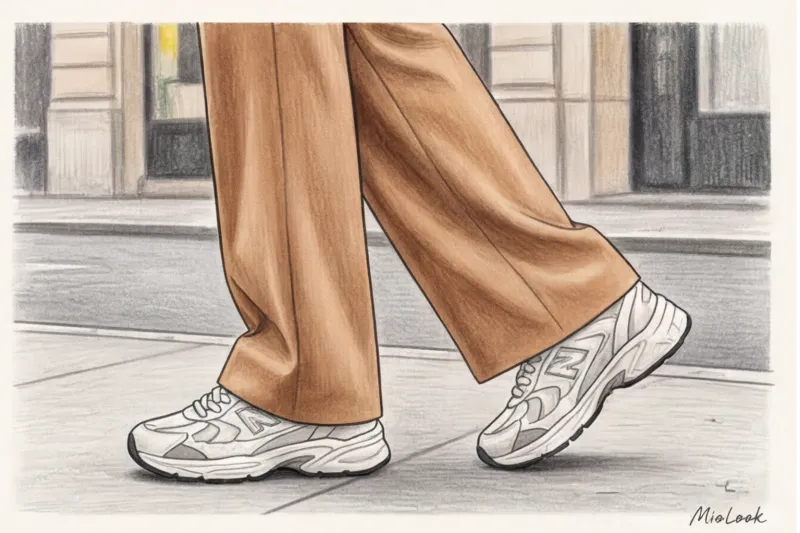
A distinct category that has firmly established itself in the women's wardrobe is high-tops and basketball shoes. While high-top sneakers were once associated exclusively with teenage streetwear, today they're a legitimate tool for playing with contrasts. Try pairing chunky basketball shoes with a feminine midi slip dress or wearing them under wide-leg palazzo pants, allowing only the textured toe to peek out. This instantly takes the edge off any outfit.
Sneaker culture has long ceased to be a niche hobby and has become a form of savvy consumerism. Today, certain types of women's athletic footwear have real investment appeal. Instead of buying fast-fashion knockoffs every season that will look out of place within a month, it's wiser to invest 120-150 euros in iconic essentials: classic Adidas Sambas, versatile New Balance 990s, or minimalist Maison Margiela Replicas. These silhouettes remain relevant for decades. To check which pair will reap the full rewards, I recommend digitizing your basic bottoms. MioLook — a smart algorithm will help you visualize how a specific sneaker model will fit into your current look, even before you buy.
Access to MioLook for €0.99 — one-time payment
Start creating perfect images with the help of artificial intelligence
Get access — €0.99 onceEvening and status shoes: what's worth investing in?
In 2019, a silent revolt erupted on the red carpet of the Cannes Film Festival: A-list stars began ditching their 5-inch stilettos en masse. This marked the official end of an era when elegance was measured solely by instep height and a willingness to tolerate discomfort. Considering modern types of women's shoes For special occasions, we're primarily talking about smart investments where aesthetics work in tandem with ergonomics.
Classic pumps remain a staple, but their geometry has evolved significantly. If you want to visually elongate your legs and accentuate your ankles without sacrificing comfort, consider the silhouette. D'Orsay — models with elegantly cut-out side panels that reveal the arch of the foot. And for those who spend long hours on their feet networking, a real salvation has become Kitten heel — a micro-heel of 3–5 centimeters in height, which is now approved even by the strictest protocols.
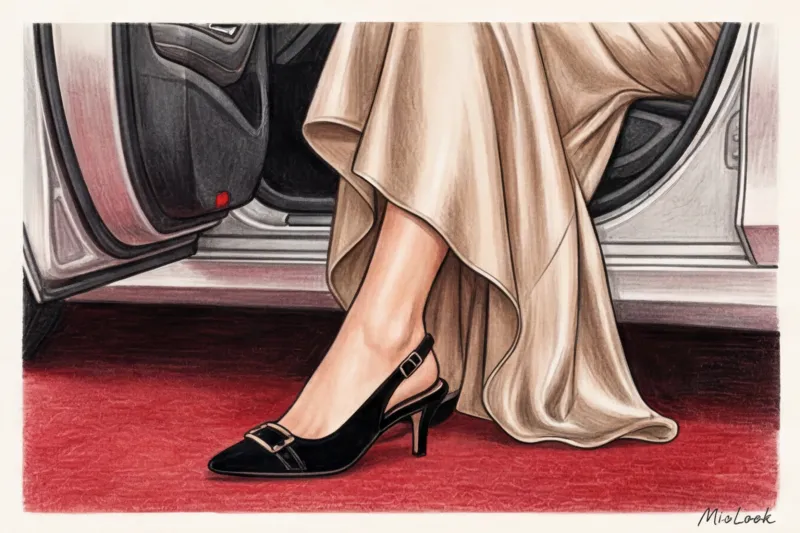
Slingbacks (closed-toe shoes with a delicate strap on the open heel) are perhaps the most elegant footwear for the office and evening wear. Remember the iconic two-tone styles dreamed up by Coco Chanel, which visually shorten the foot and lengthen the leg. They brilliantly solve the problem of transitioning from daytime business attire to an evening event. By day, you can wear them with a tailored fine wool pantsuit, and in the evening with a silk slip dress, and in both scenarios, the level of appropriateness remains at its peak.
Another phenomenon of recent seasons is the Mary Jane shoe. What began on the runways as a nostalgic micro-trend for preppy aesthetics quickly became a staple. The distinctive strap on the instep not only securely holds the foot in place but also adds a sophisticated, intellectual touch to the look. Today, a patent leather pair with a sturdy block heel easily replaces traditional evening sandals.
Over the years of preparing top managers for presentations at industry conferences and business photo shoots, I've developed an uncompromising rule: the status of a shoe is determined by the quality of its fittings, the impeccable seams, and the architectural shape of the heel, not the height of the stiletto.
How do you choose statement shoes that won't go out of style within a season? Whether on stage under the spotlight or in front of a camera, refined textures are essential. Cheap, plasticky hardware, glue marks on the welt, or an unstable last will instantly ruin the impression of even an impeccably tailored tuxedo. When investing in an evening pair costing €300–€500, you need to be confident in its combinations.
My personal life hack: before you print your receipt at the checkout, add a photo of your shoes to MioLook smart wardrobe If the algorithm or your imagination can't immediately create at least four diverse looks with them (from a theater premiere to an important presentation), the investment won't be worth it. Opt for complex, deep shades (burgundy, emerald, dark chocolate) and textured materials like suede or thick satin—they always look several times more expensive than their actual cost and remain relevant for decades.
The Anatomy of Comfort: How to Choose the Shoes You'll Wear
We're used to demonizing stiletto heels, but in reality, our spine's greatest enemy often disguises itself as the most innocuous footwear. Have you ever noticed how, after a whole day in completely flat sneakers or thin summer sandals, your lower back starts to throb and your heels start to ache?
According to the American Podiatric Medical Association (APMA, 2023), completely flat soles (such as classic ballet flats or sneakers with thin rubber soles) are just as detrimental to gait biomechanics as 5-inch stiletto heels. When the heel is level with the toe and the sole doesn't absorb the impact of walking on pavement, microtrauma is transmitted directly to the knee joints and lower back. This is why many popular flat shoes for women are a leading cause of painful plantar fasciitis.
Orthopedists agree: the optimal heel-to-toe drop should be between 1.5 and 3 centimeters. This is the physiological norm, ensuring body weight is distributed evenly across the foot and the Achilles tendon is not overstrained. Ideally, this drop is complemented by a built-in anatomical insole with longitudinal and transverse arch support.
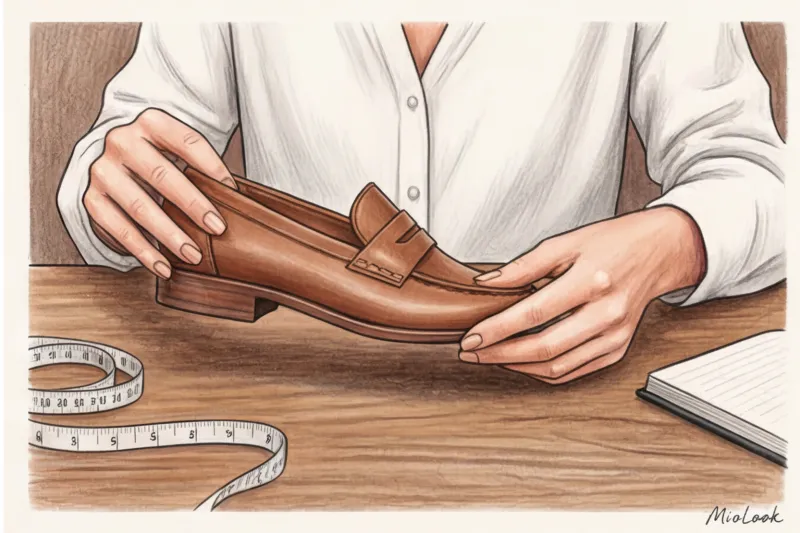
During personal shopping sessions, I never allow clients to evaluate shoes only in front of a mirror. We use a rigorous pre-purchase shoe checklist that eliminates 80% of beautiful but unwearable pairs:
- Sole flexibility: Take a shoe and try to bend it with your hands. A proper sole bends exactly along the third of the toe joint, not in half at the center of the arch. If the sole is "wooden," the foot will roll unnaturally, causing calf muscle spasms.
- Back stiffness: The heel should be securely in place. Press your thumb into the heel counter—if it creases easily, your foot will constantly move and slip, which will lead to deep blisters.
- Volume: Shoes should fit not only in length but also in volume. If the edges of your foot hang over the sole, the last is too tight. Always try them on in the afternoon, when your foot naturally swells and increases in volume by 5-8%.
To choose the right last, it's crucial to determine your arch. The simplest at-home test is to step on a sheet of thick paper with a damp foot. If the impression looks almost like a solid foot, you have a low arch (prone to flat feet) and absolutely need shoes with a firm arch support and a deep fit. If the impression is thin and significantly interrupted in the middle, you have a high arch. In this case, the main concern is finding shoes with good cushioning in the instep area, as the impact force during walking is concentrated only on the heel and balls of the feet.
Your ideal image
it begins Here
Join thousands of users who look flawless every day with MioLook.
Shoe integration into the capsule: the MioLook formulaMost women pack their suitcases following the same pattern: first, they carefully fold their clothes, then try to squeeze five pairs of bulky shoes and boots into the remaining gaps. The result is always predictable: overweight luggage and the eternal problem of "nothing to wear." In my consultations, I teach my clients to do just the opposite—to start assembling any capsule wardrobe with shoes. They're not just an accessory; they're a style guide that sets the tone for your entire look.
For short trips or creating a seasonal mini capsule, it works perfectly. The Three Pairs Rule Whether you're jetting off to a European capital for a week or packing your wardrobe for a busy October, you only need three functional roles:
- Workhorse: Shoes for 15,000-20,000 steps a day. These could be high-tech retro sneakers or anatomically shaped Chelsea boots. No compromises on comfort.
- Smart Base: A structured pair that instantly puts together a relaxed look. Rugged leather loafers or minimalist brogues. Wear them with jeans during the day, and they're perfect for a night out.
- "Joker": A statement pair that takes up minimal space but changes the mood. Textured mules, kitten heel slingbacks, or bright Mary Janes.
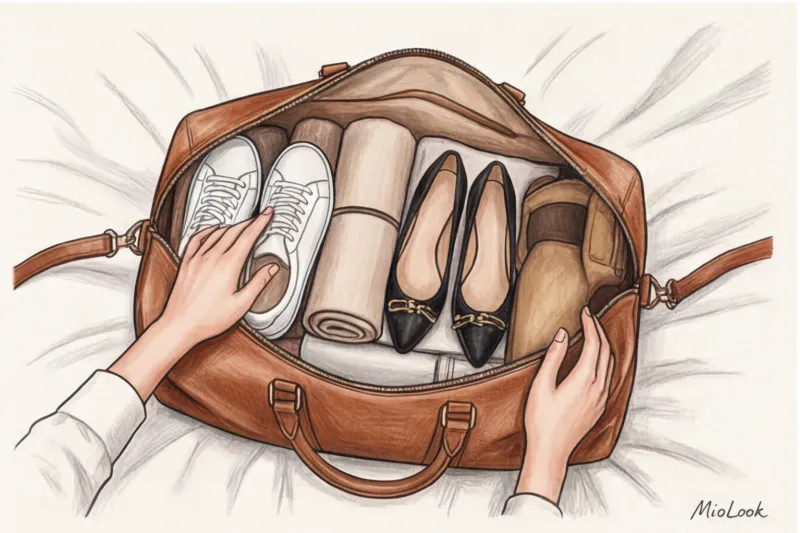
However, even the most relevant types of women's shoes They won't work if the silhouette's geometry is compromised. My basic algorithm for selecting shoes based on heel length is based on strict proportions:
- Wide cropped trousers (culottes) + ankle boots: The main rule is no gaps of bare skin. The boot shaft should be narrow (like sock boots) and extend at least a couple of centimeters under the pant leg.
- Midi skirts + tube boots: The skirt hem should overlap the top of the boots by 3-5 centimeters. This creates a continuous vertical line of color and visually elongates the height without cutting the leg into blocks.
- Full-length jeans (puddle pants) + shoes: A wide, slouchy trouser hem visually "eats" a round or square toe, making the foot appear shapeless. A pointed toe (pumps or Cossacks) is essential here, allowing it to peek out from under the fabric and add structure to the silhouette.
Any rules work better when they're backed by numbers. The human brain is prone to cognitive biases: we think we always wear that beautiful pair we bought emotionally. To get the real picture, I highly recommend digitizing your collection. Take 20 minutes on a weekend, photograph each pair in good light, and upload it to MioLook.
The app's artificial intelligence works like an impartial stylist and analyst. One of my clients, a team lead in IT, was convinced she urgently needed new office shoes. But MioLook's statistics showed that her 12 pairs of heels accounted for only 4% of her looks, while a single pair of basic sneakers, priced at €130, accounted for 70% of her actual looks.
Instead of buying yet another pair you don't need, AI analyzes your database and suggests dozens of new combinations with the shoes you already have on your shelf. You begin to see your wardrobe as a system, not a warehouse of disparate items.
Conclusion: Shoes as a Foundation of Personal Style
We're used to thinking of shoes as the "finishing touch"—something added at the very end. It's time to break that paradigm. Shoes are the foundation. The same minimalist slip dress in thick silk can feel completely different: with chunky Martins, it's weekend-ready grunge; with simple white sneakers, it's relaxed urban casual; and with elegant slingbacks, it's a ready-to-wear evening outfit.
By investing time in understanding your foot anatomy, exploring modern hybrid formats, and relying on honest wardrobe statistics, you gain incredible freedom. Freedom from foot pain, freedom from impulsive spending, and freedom to feel confident in every step.
Guide Chapters
Dumik boots: what they are, types, and what to wear them with
Jockey boots: what they are, their features, and what to wear them with
Desert boots: what they are, their features, and what to wear them with
Topsiders: What They Are, What They Are, and What to Wear Them With
Slouchy boots: what are they and what to wear them with
Gladiator sandals: what they are, types, and what to wear them with
What are lunar rovers: history, features, and what to wear them with
High-tops: What They Are, Their Distinctive Features, and What to Wear Them With
What are chukka boots: features and style rules
Slippers: What are they, their features, and style rules
Pumps: What They Are, Types, and What to Wear Them With
Creepers: What are they, their history, and what to wear them with?
Abarkas: What kind of footwear are they, their features, and what to wear them with
What are loafers: types and rules for combining them in clothing
Chelsea boots: what they are, their history, and what to wear them with
Oxfords: What They Are, Types, and What to Wear Them With | Glossary
What are mules in fashion: types, features, and what to wear them with
Over-the-knee boots: what they are, types, and what to wear them with
Cossack boots: what they are, their distinctive features, and what to wear them with
Ankle boots: what they are, the main types, and what to wear them with
What are espadrilles: features, types, and what to wear them with
Slip-ons: What they are, their distinctive features, and what to wear them with
Slingbacks: What They Are, the Main Types, and How to Wear Them
What are Mary Jane shoes: types and what to wear them with
Birkenstocks: What They Are, Their Features, and What to Wear Them With
What is a Derby: Features and Types of Classic Shoes
Brogues: What They Are, Types, and How to Wear Them | Glossary
What are clogs: the specifics of the shoes and what to wear them with
Tube boots: what they are, their features, and what to wear them with
Kitten Hill: What It Is, Features of the Shoe, and What to Wear It With
Moccasins: What They Are, Their Distinctive Features, and What to Wear Them With
Frequently Asked Questions
What dress code suits you?
Find out what style of clothing for work and life perfectly reflects you
About the author
Unlock MioLook
for €0.99
Start creating perfect outfits with artificial intelligence
Get access — €0.99 onceRelated Articles
Clothing Styles: Why Clean Looks Don't Work Anymore
Traditional clothing styles in their original form are a thing of the past. Find...
Types of Women's Bags: The Architecture of Your Style
A bag is more than just a container for your belongings; it's the focal point of...
What are loafers: types and rules for combining them in clothing
Types of outerwear: putting together a demi-season base
Demi-season clothing is the most profitable investment in your closet. Learn how...