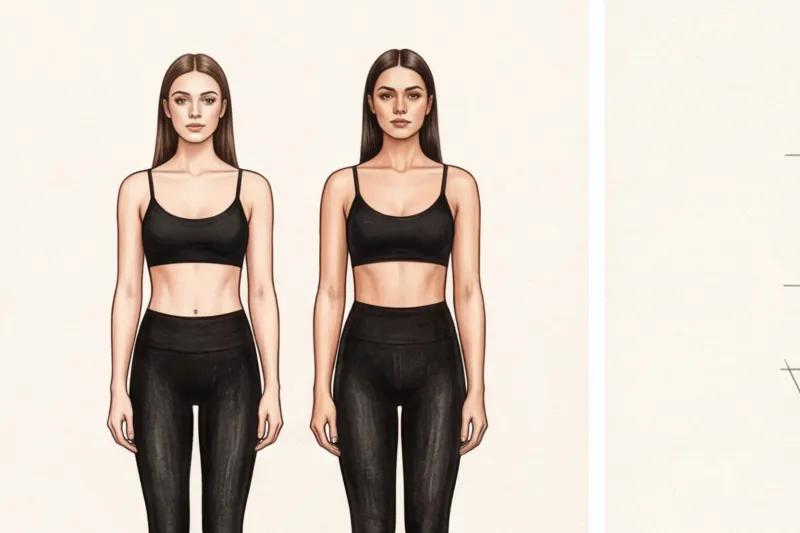
September 2018, backstage at Milan Fashion Week. A model stands before me, seemingly at the perfect height of 180 centimeters. Her comp card proudly lists her leg length as 110 cm. We dress her in luxurious, extra-high-waisted, wide-leg trousers from the new collection, expecting to see an endless, flowing silhouette. But the mirror reflects a disaster: she looks constricted, her proportions are off, and her torso seems comically short. Why? Because her hipbone (that aforementioned hip-drop) is positioned unusually low. The tape measure told us the truth about her height, but cruelly lied about her proportions.
Over 12 years as a stylist, I've learned one ironclad rule: height is just a number on your passport. Perceived height is an optical illusion governed by geometry. If you're still trying to figure out how to determine body proportions using the outdated fruit system ("apple," "pear") or a soft tape measure, you're wasting your time. The future of styling lies in vertical biomechanics, which artificial intelligence can now calculate with mathematical precision.
The Mirror Illusion: Why Old Measurement Methods No Longer Work
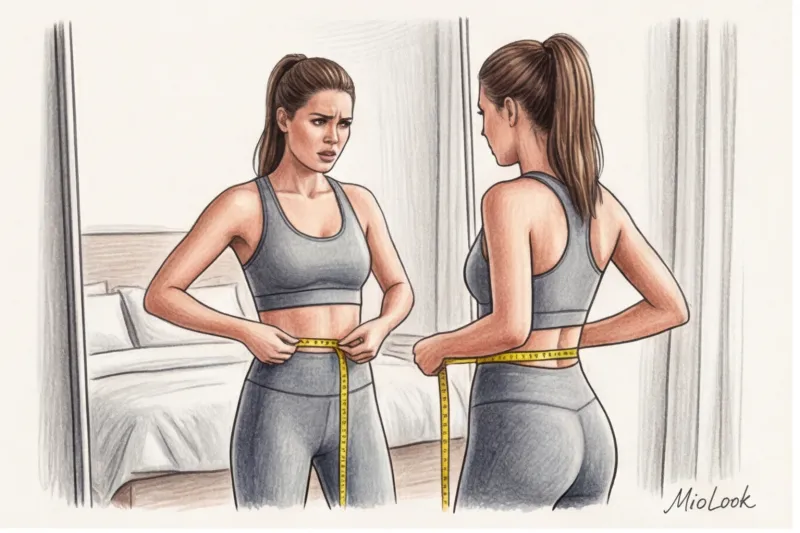
The fundamental error of classic body typing methods is that they measure exclusively horizontal dimensions. The classic 90-60-90 measurements only tell us about girth, completely ignoring the vertical axis. But the human eye scans the silhouette from top to bottom, not around the circle.
Moreover, we are unable to objectively assess ourselves in the mirror. Fitting room lighting, clothing color, fatigue, and even the angle of the mirror (remember the famous Zara mirrors, which are slightly tilted back to elongate the silhouette) distort reality. According to research by WGSN (2023) on body inclusivity, people's subjective assessments of their own proportions are inaccurate 78% of the time.
"Your smartphone camera exacerbates the problem. If you take a mirror selfie at chest level, the lens visually shortens your legs by 10-15%. If you shoot from the hip, it elongates them. Your brain memorizes this distorted image as normal."
That's why the human eye and tape measure are giving way to machine vision algorithms. Programs no longer ask what your hip circumference is. They analyze your skeletal matrix.
Access to MioLook for €0.99 — one-time payment
A smart AI stylist will select the perfect look based on your unique body geometry.
Get access — €0.99 onceSilhouette Mathematics: How to Determine Body Proportions Using AI
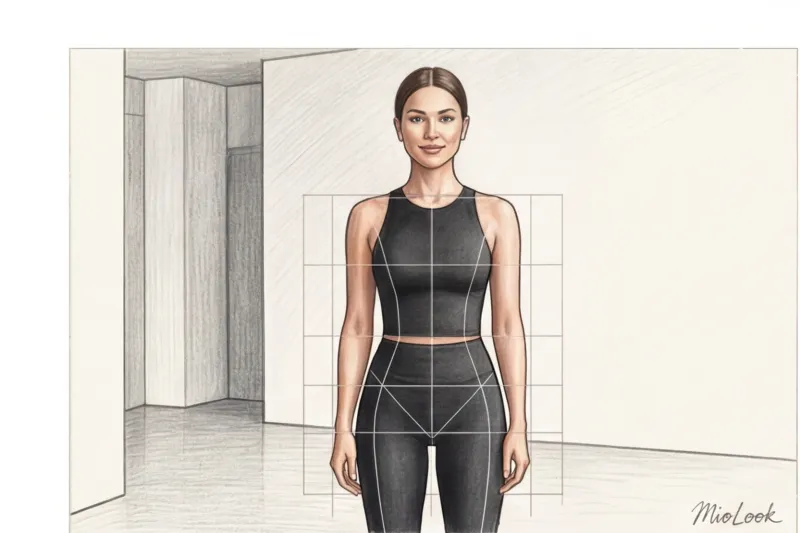
When you upload your photo to MioLook body analysis function , the algorithm doesn't look for your waist where it "should be" according to mass-market standards. Instead, the AI builds a map of your skeletal reference points—a modern digital equivalent of Leonardo da Vinci's Vitruvian Man.
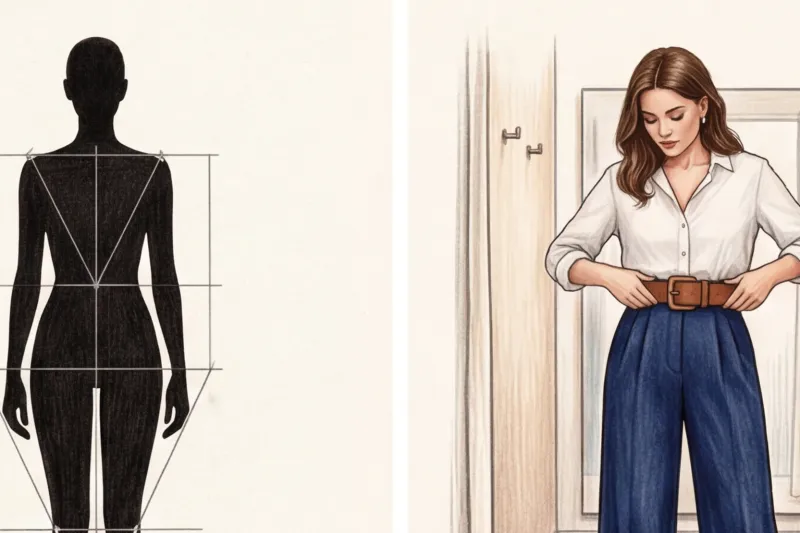
The system detects key markers: the shoulder joint line, the true anatomical waist (the narrowest point between the lowest rib and the iliac crest), the hip drop, and the knee line. The difference between how a human guesses the waist and how the AI calculates the skeletal midline is colossal.
Incidentally, machine vision is revolutionizing more than just shape analysis. If you think only shape analysis is subjective, consider color matching. We covered this in more detail in our complete guide on how MioLook's neural network will be able to determine a person's color type. with a precision inaccessible to the human eye.
Leg and Torso Index: The Key to Perceived Height
In biomechanics, there's the concept of the Cormick index—the ratio of your sitting torso height to your standing height. This index is the key to determining how you look in clothes.
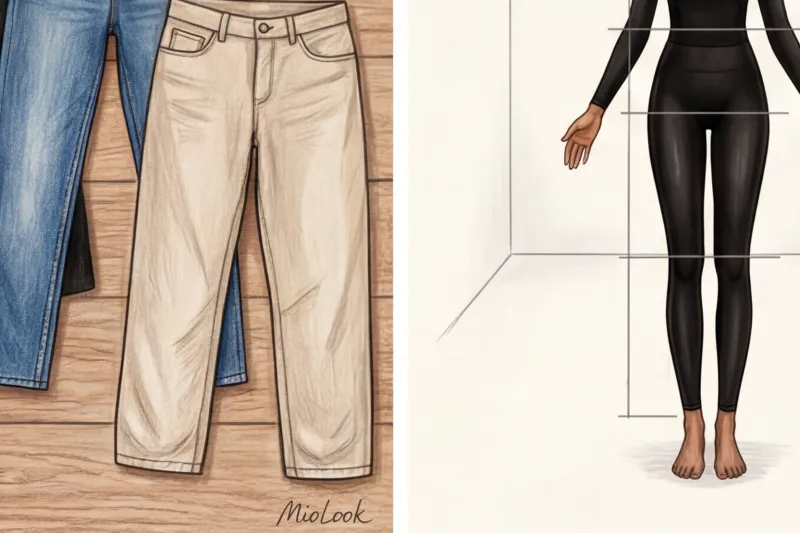
Imagine two women with exactly the same height—165 cm. The first has a high index (long torso, short legs). She will need trousers from the line Petite and long tops from the section Tall The second one has a low index (short torso, long legs). She needs jeans. Tall and cropped jackets. If they swapped clothes, both would look disproportionate, despite being identical in height on paper. Standard brand sizing completely ignores this nuance.
Height is just a number: how a neural network "reads" vertical
Herein lies the most counterintuitive insight that often shocks my clients: a woman who is 170 cm tall can visually appear shorter than a woman who is 160 cm tall. It all depends on how well-balanced the ratio of her legs to her torso is.
The neural network clearly distinguishes between your physical height and your stylistic Height. Once the algorithm understands your vertical, it begins to filter out dangerous trends. For example, according to Lyst's 2024 report, the Y2K aesthetic brought the extremely low rise back into fashion. However, for a long-torso profile, low-rise pants are stylistic suicide. They artificially lower the start line of the legs, visually squashing the figure.
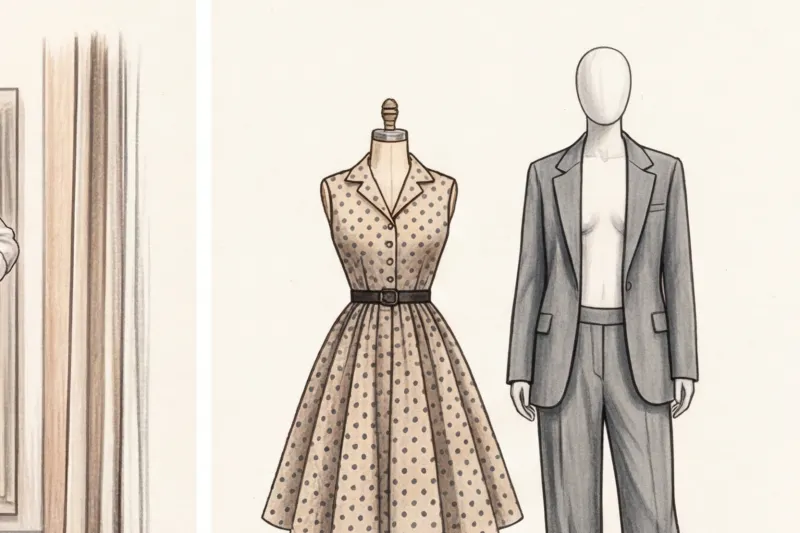
But algorithms have their limitations. This doesn't work if: Whether you're trying to analyze a figure in a voluminous hoodie or taking a photo from the bottom up, AI needs honest input to produce accurate results.
Your perfect look starts here
Join thousands of users who look flawless every day with MioLook, trusting in the mathematics of silhouette.
Get access — €0.99 onceHistorical context: from Dior's corsets to digital algorithms
Manipulating the proportions of the torso and legs is the oldest trick in fashion history. Take a look at Christian Dior and his iconic New Look of 1947. The famous jacket Bar Dior's wasp waist made history, not just because of its iconic design. Dior's genius lay in its architecture: he artificially raised the waistline several centimeters above the anatomical norm and widened the peplum at the hips.
What did this achieve? The legs (hidden under a full skirt) visually extended almost to the ribs, creating the illusion of incredible stature even for petite clients. Dior achieved this with the help of stiff canvas, whalebone, and dozens of hours of fittings.
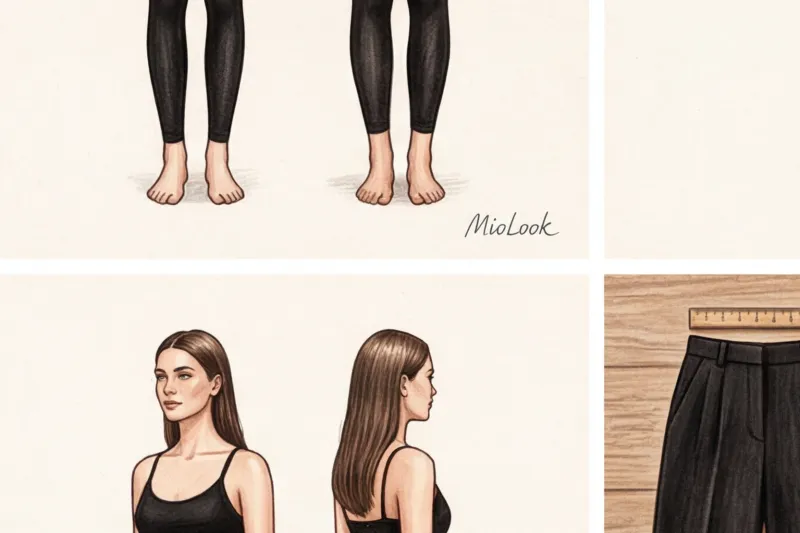
Today, modern AI like MioLook acts as a digital couturier. It analyzes your base and suggests the modern equivalent of Dior's tricks: where the hem of a shirt should end, at what level the jacket fastening should be, and what heel height will balance your body structure.
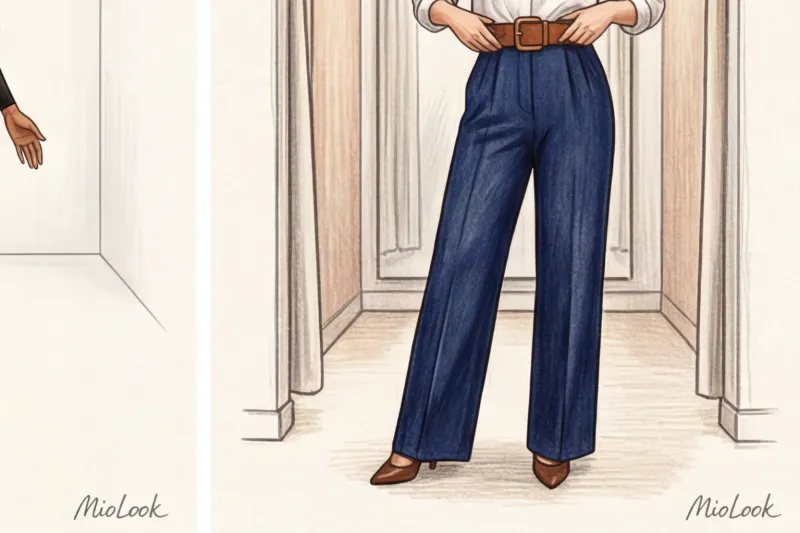
From Analysis to Wardrobe: How AI Selects Length and Fit
Raw data is useless unless it can be applied in the fitting room. Once AI calculates your exact proportions, it begins to act as a filter. Let's look at specific wardrobe scenarios.
Having long trousers shortened at a reputable European tailor will cost you around €15–20. However, you can't physically change the saddle rise. So, knowing your proportions can save you real money.
- If the algorithm detects a short torso and long legs: The neural network will forever eliminate wide, contrasting belts at the waist from your recommendations—they "eat up" the already short distance from the chest to the hips. Instead, the system will suggest mid-rise trousers from COS or Massimo Dutti (budget €70–€120) and longer tops.
- If you have a long torso and short legs: AI builds a strategy of "visual anchors." We wrote about this in detail in the article about clothes for a long torso and short legs Shoes that match the trousers, high-rise waists and cropped blazers will shift the focus upward.
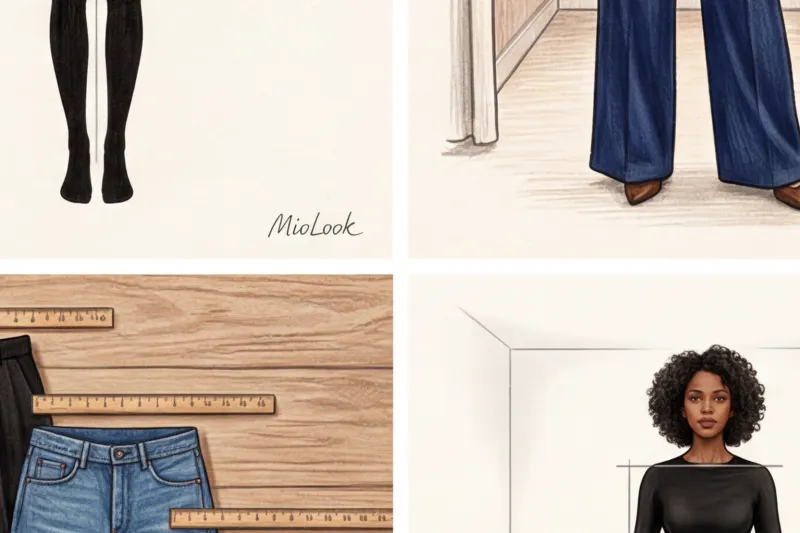
Necklines also play an important role. For a casual Friday office dress code where everyone wears basics, a V-neckline will create a powerful vertical line, elongating the upper body, while a boat neckline will create a horizontal line.
Ready to get started?
Try the MioLook plan for free—no commitments required. Find out your true proportions in just a few minutes.
Get access — €0.99 onceChecklist: How to Properly Prepare for a Body Neuroanalysis
The magic of artificial intelligence is destroyed by poor initial data. If you want the MioLook app to calculate your Cormic Index with millimeter accuracy, forget everything influencers have taught you.
A stylist's strict checklist before scanning:
- Neutral posture. No typical "Instagram poses." Don't stick your leg out to the side (this breaks the line of your hips), and don't arch your lower back (this distorts the length of your torso). Stand up straight, with your weight evenly distributed on both feet, and your arms slightly relaxed and away from your body.
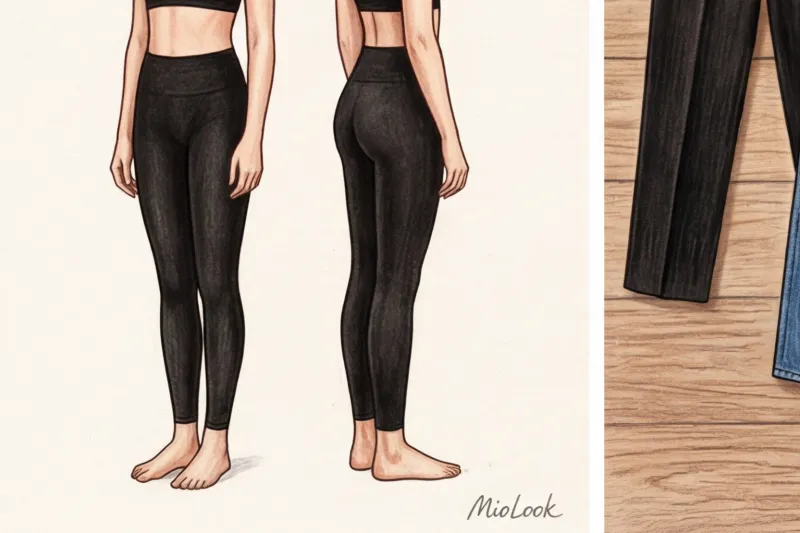
- Tight-fitting clothing. The AI should be able to see your outline. The ideal outfit: black leggings without a high waist and a fitted long-sleeve top or bodysuit. Clothing should not create unnecessary folds or alter the silhouette.
- Camera location. This is critical. The camera must be positioned exactly at your stomach level, perpendicular to the floor. No tilting of the lens.
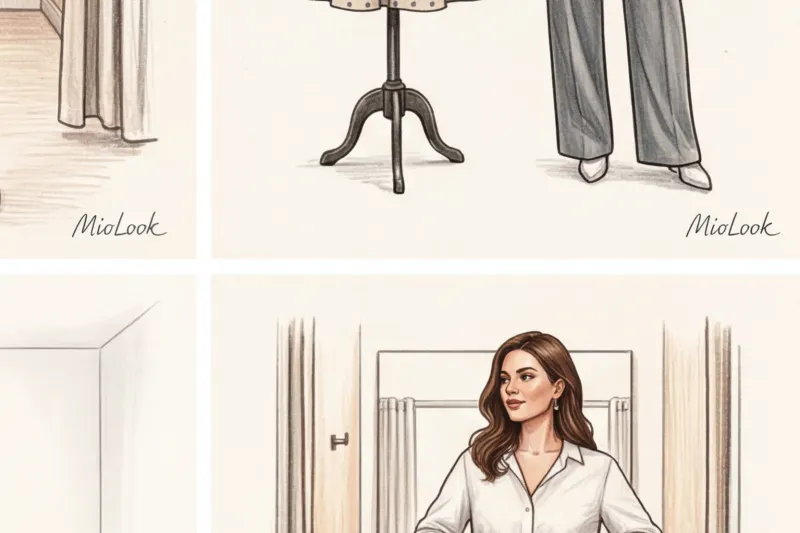
Understanding your own body proportions through precise data rather than subjective judgment is liberating. You no longer have to wonder why that stunning suit in the display case fits you differently than it does on the mannequin. Clothes should adapt to your body structure, not the other way around. And now, thanks to algorithms, you have a precise blueprint of that structure.