Kibby and Larson: Differences in Systems and Why the "Apples and Pear" Theory No Longer Works
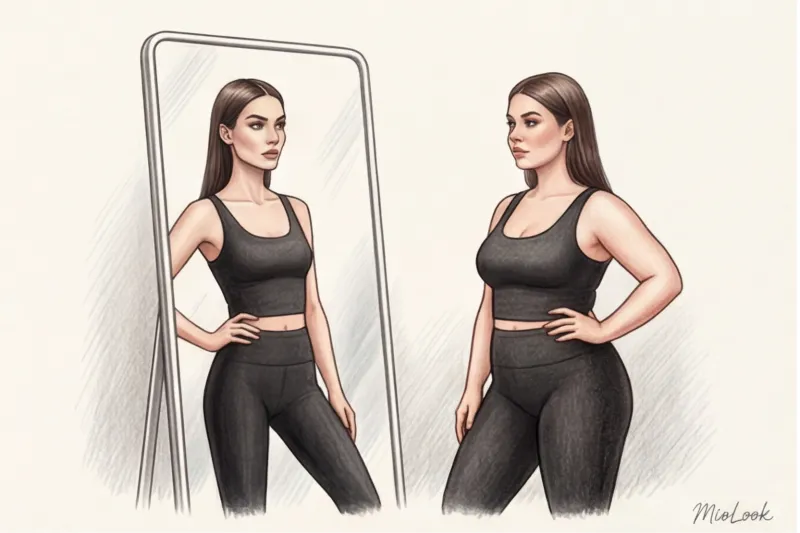
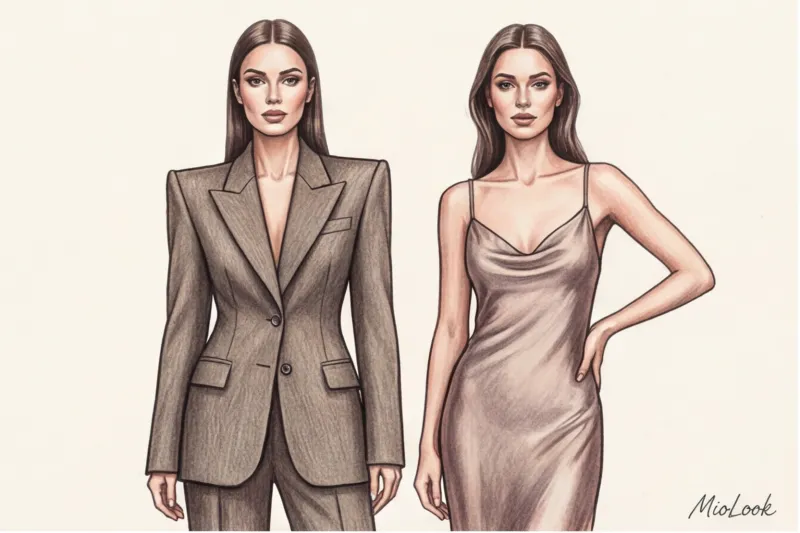
I vividly remember the day I finally forbade my clients from using the words "apple" and "pear" during fittings. Reducing the complex, three-dimensional architecture of the female body to the flat geometry of a fruit is, forgive me for being so blunt, a stylistic crime. Two women with identical hip measurements may require completely different silhouettes if one has the wide, blunt bones of a Natural, while the other has the thin, sharp bones of a Gamina.
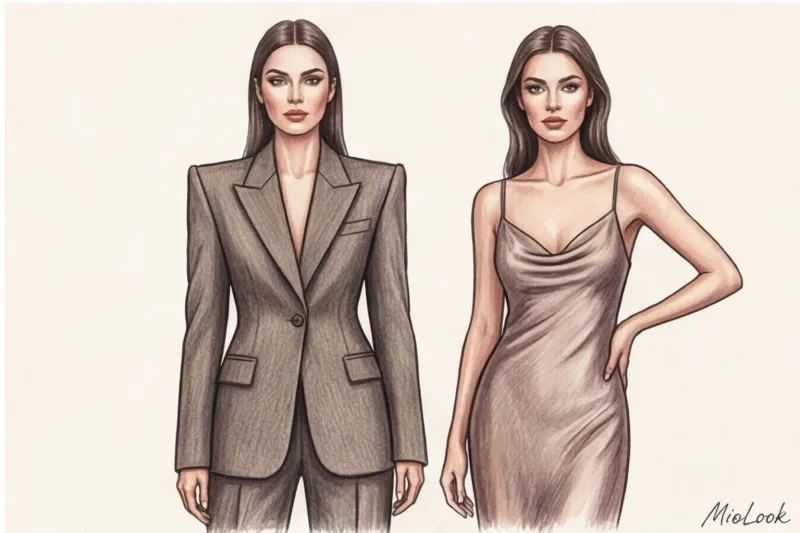
Blindly following outdated rules of visual correction leads to a bulging wardrobe, but still nothing to wear. That's why today we're talking about an investment approach to appearance—line-based typing. We've covered the basic principles of facial and body architecture in more detail in our The complete guide to Larson's personality types , which I recommend starting your immersion into the topic.
The main question I get asked at every other consultation on luxury wardrobe analysis: Differences between Kibby and Larson Why is there so much controversy surrounding these two names in the fashion industry, and whose recommendations should we trust? Let's examine both systems, not as theorists, but as practitioners who want to buy expensive clothes and look impeccable in them.
The David Kibbee System: A Brilliant Revolution of the 1980s
When David Kibbee's book "Metamorphosis" was published in 1987, it was a bombshell. Kibbee was the first to suggest stopping "fixing" the figure to achieve the mythical hourglass figure. Instead, he introduced the concept of balancing yin (softness, roundness, delicacy) and yang (hardness, angles, scale).
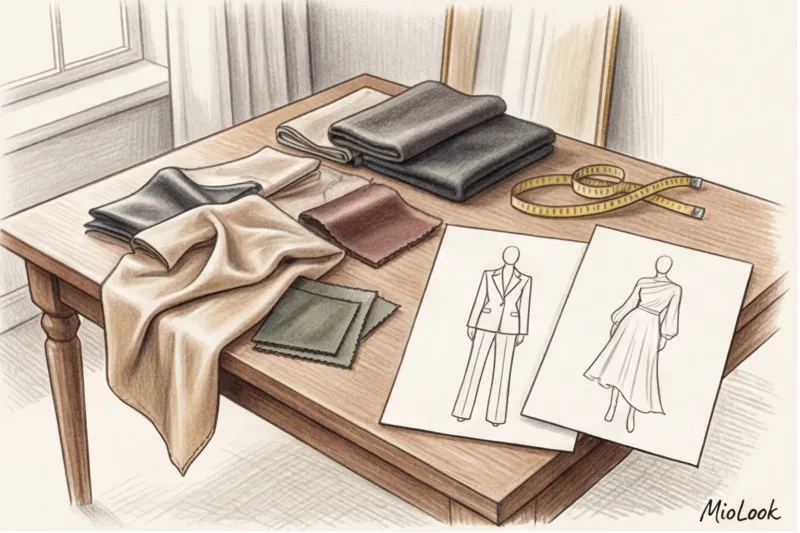
He identified 13 original personality types—from pure Yang energy (the Dramatic) to absolute Yin (the Romantic). His major breakthrough was his use of texture. Kibbee mathematically demonstrated why thick English gabardine weighing over 250 g/m² makes the Dramatic look luxurious, while on the Romantic it looks like a cardboard box. The Romantic, on the other hand, requires flowing silk crepe de Chine, which will accentuate curves without weighing them down.
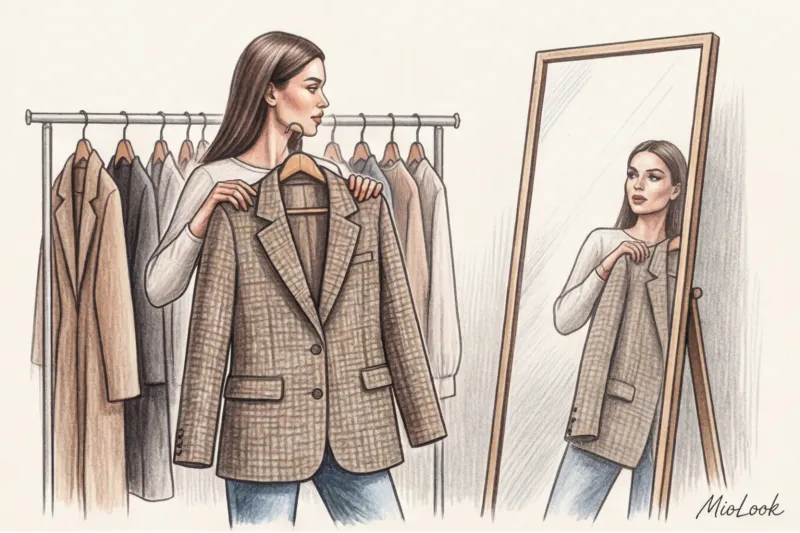
But Kibbe's ingenious system has a significant drawback for a 21st-century woman: it's too dogmatic and treats people as monoliths. I've experienced this myself. According to the tests, I'm a pure Dramatic. My height and bone structure require long, straight lines. But when I put on a tailored jacket with exaggerated shoulders, it looks like I'm wearing someone else's uniform. Why? Because of my soft facial features, which Kibbe simply averaged out, tailoring them to the overall "dramatic" mood.
Access to MioLook for €0.99 — one-time payment
A smart AI stylist will create the perfect look based on your individual lines and proportions.
Get access — €0.99 onceDvin Larson's Types: The Mathematics of Style and Breaking the Patterns
Where Kibby left blind spots, Californian artist Dwyn Larson built a veritable school of architecture. She refined the system to 20 types and made a key discovery: facial and body lines can belong to completely different worlds.
According to statistics from my consulting practice, about 85% of women have mixed features. You can have the angular figure of a teenager, yet the full lips and round cheeks of a Renaissance woman. Larson coined the term "dominant." She explained how to salvage your look if your body demands one silhouette, but your face requires a completely different frame.
Interesting fact: Larson completely eliminated the "Classic" as a distinct, pure type. Perfectly symmetrical faces and figures don't exist in nature. According to Larson, the Classic is always a perfectly balanced blend of other types, requiring pinpoint precision in cut.
Key differences: the battle of approaches in practice
Theory is great, but let's move on to your dressing room. When you stand in front of the mirror with a €500 item of clothing, you need to know exactly why it doesn't fit. The difference between the systems lies in scale and focal points.
Face vs. Body: Who Dictates the Rules?
The Kibbe system categorizes the overall look. For him, the body is the canvas, and the face merely complements the overall picture. If you're a Kibbe Natural, you wear relaxed tailoring from head to toe.
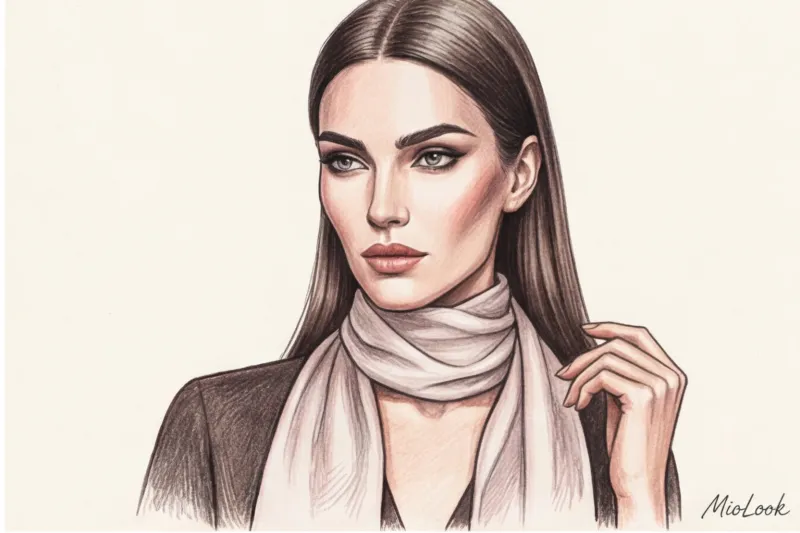
Larson works like a surgeon: she separates the zones of influence. The body dictates the silhouette, the length of trousers and coats, and the waist. But the face is the undisputed king of the portrait zone. It is the geometry of your face that determines the width of lapels, the shape of the neckline, the size of the print, and the design of the jewelry. If you have a Natural body and a Gamin face, a large floral print will kill your expressiveness, even if the dress fits perfectly.
Level of detail and micro-proportions
Kibby gives vibe-level recommendations: "be bold," "go for a soft watercolor." Larson provides the technical specifications. She specifies a precise scale in centimeters: what belt width you need, what size bag should be so it doesn't look like a duffel bag against your bone structure.
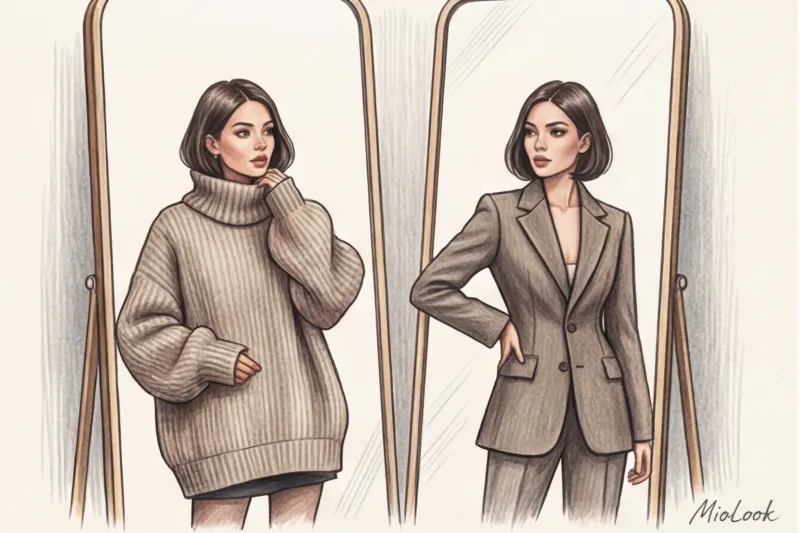
Your perfect look starts here
Join thousands of users who look flawless every day with MioLook. Forget about the "nothing to wear" problem.
Get access — €0.99 onceHow Typing Saves You From Costly Mistakes (Or Why Your Jacket Looks "Alien")
Knowing your lines isn't a pastime; it's a strategy for protecting your budget. According to a McKinsey study (2024), up to 40% of luxury purchases end up at the bottom of the closet. Why? Because luxury items have complex, architectural cuts. The more expensive the fabric, the more ruthlessly it reveals any discrepancies with your natural lines.
I had a client, a successful top manager, who bought the iconic Max Mara 101801 double-breasted coat. It's a legendary piece, costing around €3,000. It has a relaxed, slightly oversized cut with cap sleeves—an absolute masterpiece for a Natural type. The problem was that the client had a distinctly Gamine face: small, sharp, dynamic features. The coat simply "ate" her. She wore it twice. The cost-per-wear was €1,500—a disastrous investment.
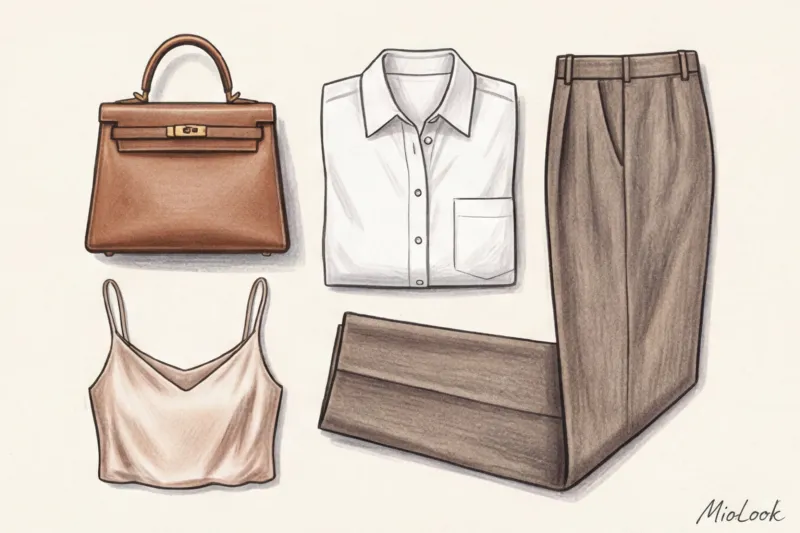
How did we save the situation? Larson gave us a tool. We couldn't change the cut of the coat, but we did change the portrait area. We added a crisp, graphic silk scarf with a small, contrasting print and a structured, rigid bag. The focus shifted to the face, and the coat no longer looked like it belonged on someone else's shoulder.
In a business dress code, this is crucial. Your suit is your armor. If you have a lot of Yin (softness), a classic office jacket made of stiff wool will make you look tired and insecure. Swap it for a jacket made of heavy jersey or tweed with slightly rounded lapels, and you'll regain your status.
Beginner's Misconceptions: When Typing Works Against You
In my practice, there's one situation when body typing is strictly contraindicated—when a woman perceives it as a prison. Blindly following your Kibbe type recommendations can add 10 years to your age. Remember this counterintuitive rule: body type is a tool for defining a look, not a style guide.
- Myth 1: Your type determines your style. No, and no again. Many people think that if they're Romantics, they're doomed to wear frills and flowers forever. In reality, a Gamin could be a corporate CEO in a formal suit (just cropped and contrasting), while a Dramatic could be a casual mom at a playground.
- Myth 2: You need to throw out half your wardrobe. If an item isn't your texture, simply move it away from your face. Wear the wrong color or print in shoes, skirts, or pants.
- Myth 3: Kibbe's retro-restrictions are still relevant. If Soft Classic were to wear a symmetrical midi skirt with a modest blouse today, as Kibby recommended in the '80s, she'd look like a museum piece. We're focusing solely on the physics of fabric, not on outdated cuts.

Checklist: Which System is Right for You?
So what should you choose? To stop buying things in the hopes of a miracle, ask yourself a few questions. The Kibbe system is ideal for you if you enjoy a conceptual approach and have distinct, "clean" features. It's great for creative types who just need to catch the right vibe.
You absolutely need the Larson system if:
- Have you noticed that your figure looks better in certain things, but your face requires completely different jewelry and necklines.
- You are putting together a rigid capsule or business wardrobe, where every detail matters.
- You are a pedant and love mathematical precision: you need to know whether to buy a bag that is 20 cm or 30 cm wide.
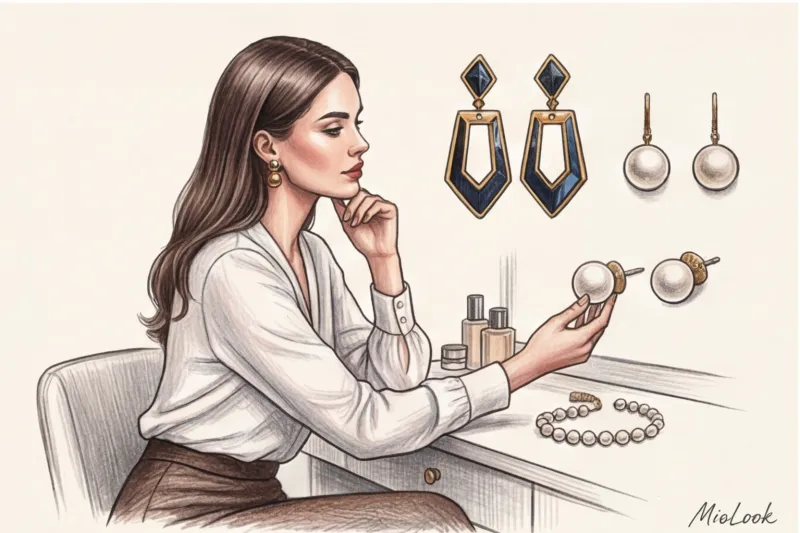
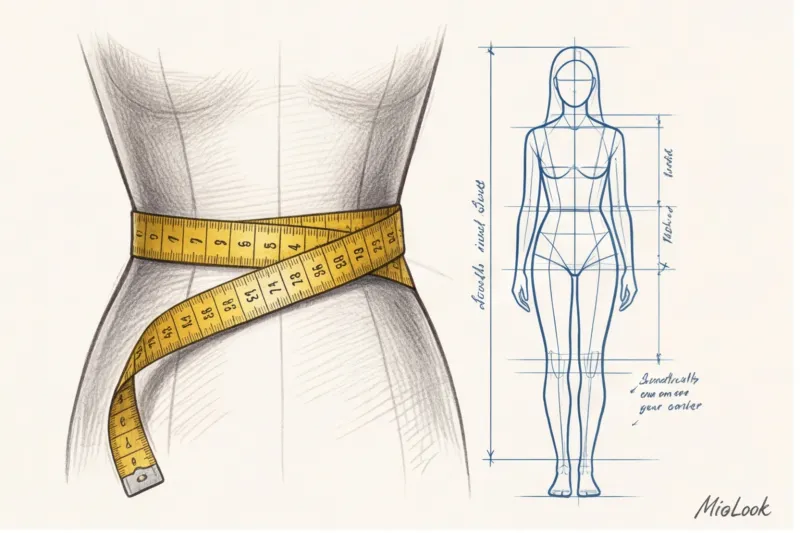
Where to start? Take a full-length photo of yourself in form-fitting clothing and a headshot without makeup. Analyze your bone structure: is it sharp or dull? Thin or wide? To avoid spending hours on your own measurements and tests, I strongly recommend delegating this routine to technology. MioLook , you can digitize your wardrobe and let smart algorithms select combinations that will perfectly match your architecture.
Ready to get started?
Try the MioLook plan for free—no commitments required. Organize your closet once and for all.
Get access — €0.99 onceStylist Resume: The Architecture of Your Personal Brand
Over 12 years of working in the luxury segment, I've learned one rule: a high-end look isn't about a logo on a bag, it's about a flawless fit. Knowing your Kibbe or Larson lines is the very foundation on which a personal style is built. Without it, any purchase becomes a game of roulette.
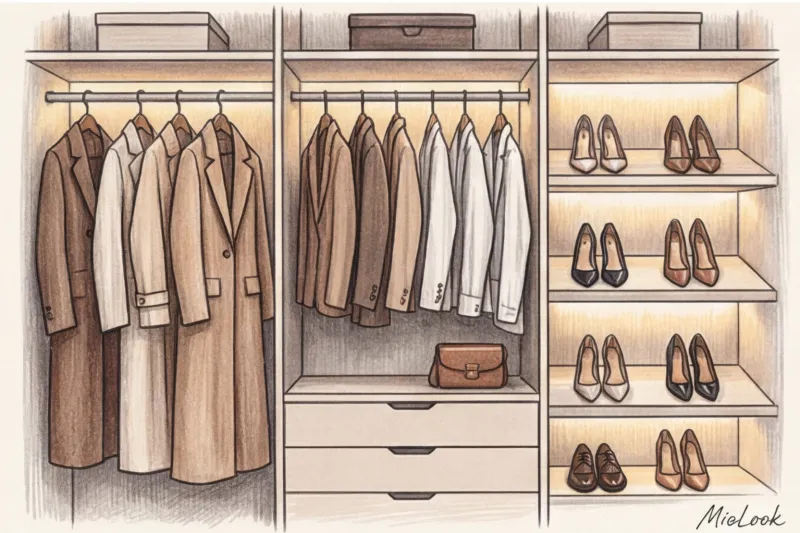
I offer you an elegant synthesis. Take inspiration and understanding of the energy of fabrics from David Kibby, and entrust the mathematics of cut, micro-proportions, and portraiture to Dwyn Larson. Review your wardrobe tonight. Choose one item you love but never wear. Test it through the prism of your lines—and you'll immediately understand why it doesn't work, and, most importantly, how to fix it.