

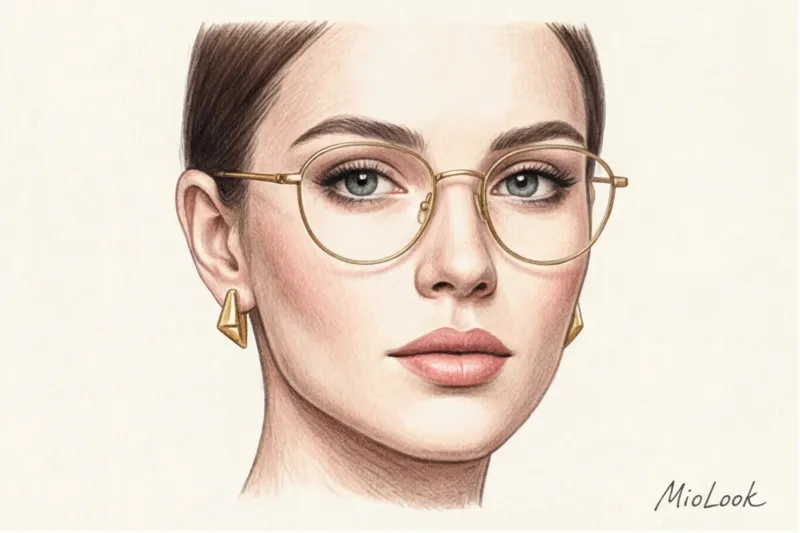
Are you familiar with the phrase: "If you're wearing statement glasses, your earrings should be invisible"? In the 2000s, this advice was featured in every women's magazine. It was assumed that tiny studs would save the face from looking overweight. But after 12 years of working as an image consultant, I've realized something paradoxical: it's precisely "invisible" earrings next to heavy frames that mercilessly accentuate age, making the face look tired, and the look unfinished.
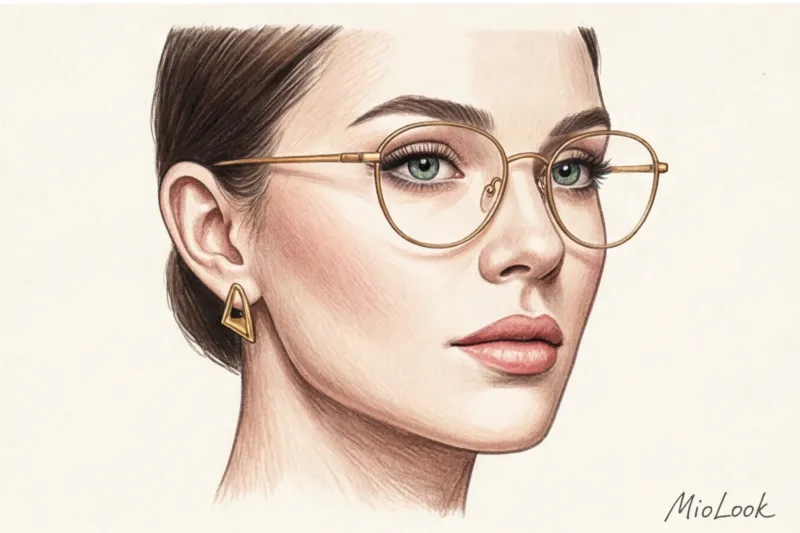
Today, we'll abandon outdated restrictions. Instead, I propose using a mathematical algorithm of "visual weight" and geometric balance. We'll view the portrait area not as a canvas for experimentation, but as a limited space with a strict limit on focal points. We discussed the basic principles of creating harmonious images in more detail in our complete guide. How to combine accessories without overloading , and here we will focus exclusively on the face and neck.
Facial Geometry: Why the Portrait Zone Is Unforgiving
Let's look at the numbers. The head, neck, and décolleté area make up only about 15% of our body surface area. However, according to eye-tracking research from the Nielsen Norman Group in 2023, up to 90% of a person's visual attention is directed here. The human eye unconsciously scans the "eyes-lips-ears" triangle.
Every face has its own "visual capacity"—a limit to the amount of detail beyond which visual noise sets in. Most women make the same mistake: trying to offset an overly simple basic outfit (like a gray sweater), they place three equally striking accents in a 25-square-centimeter area. Massive acetate frames alone can visually "eat up" up to 30% of the face's volume. Add giant rings and a heavily embellished hat, and you'll be completely overwhelmed by your own clothes.
"An intuitive approach to portraiture often fails. The mathematics of style come into play here: the geometry of lines, the area of color spots, and the reflective properties of materials."
The main question: how to combine glasses and earrings without the "Christmas tree" effect
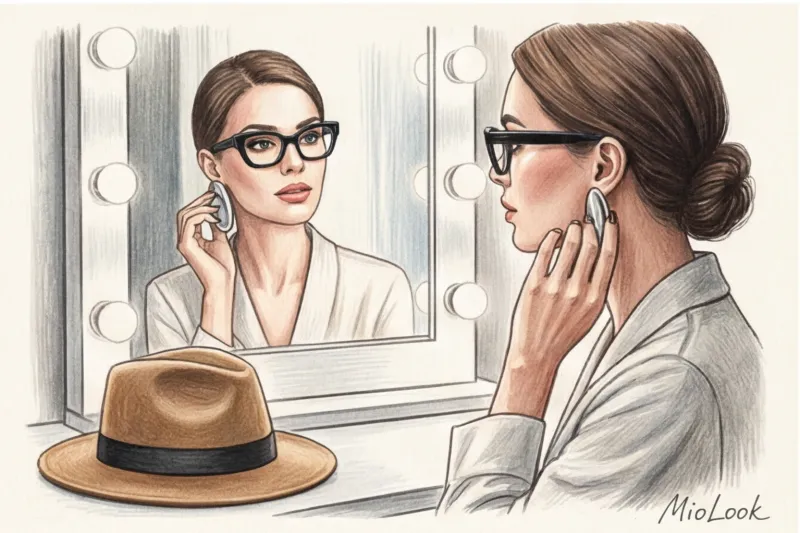
The most common request from my clients is How to combine glasses and earrings to look classy, not comical. I'll debunk the biggest myth: large earrings are not only allowed when wearing glasses, they're necessary for balance.
One day, a client came to see me, the CFO of a large IT company. She was wearing stunning Tom Ford horn-rimmed earrings (costing around €350) and those "right" tiny diamond studs. The effect was depressing: the heavy acetate was pulling her face down, and the micro-earrings were lost, creating a feeling of emptiness on her earlobes. As soon as we removed the "granny" studs and put on chunky, yet sleek, gold drop earrings in the style of Bottega Veneta, magic happened. Her face lifted, and her look became cohesive and luxurious.
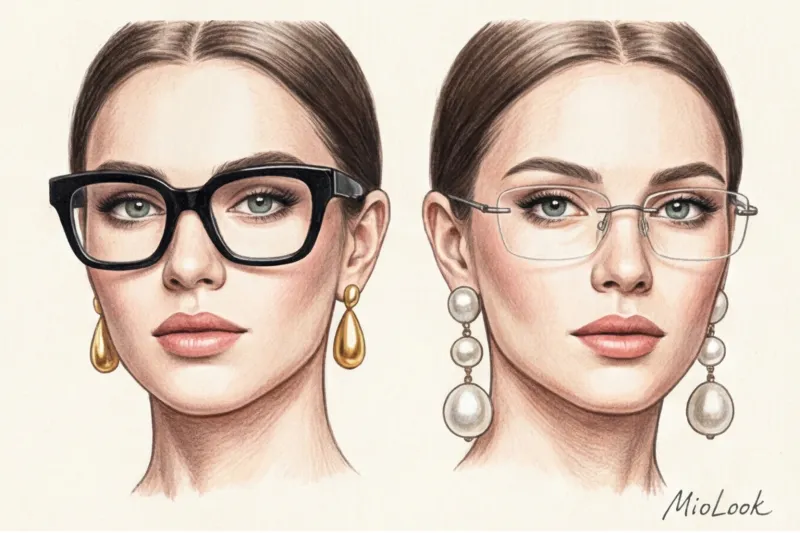
The rule of proportionality works like this:
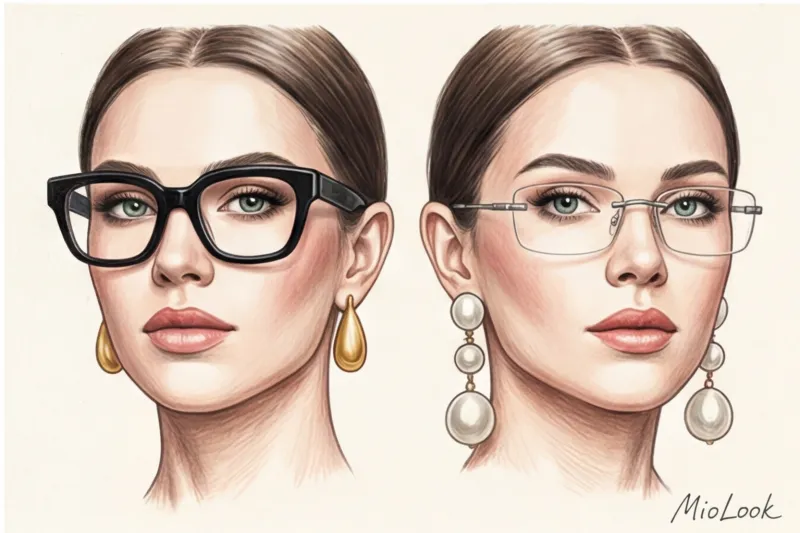
- Thin metal frame calls for subtle lines in earrings. These could be long chain earrings or elegant geometric earrings, but without heavy volume.
- Thick acetate Requires a smooth, voluminous metal. The earrings should visually support the weight of the glasses.
- The Law of One Texture: If the frame is tortoiseshell, variegated, or has a complex gradient, earrings should be solid. No scattered stones, complex enamel, or feathers. Smooth gold or silver are your best choice.
Pay attention to the shape. If you have round glasses, wearing hoop earrings (or hoops) will turn your face into a series of circles. It's best to balance the roundness of the frames with elongated, teardrop-shaped, or crisp rectangular ear shapes.
Metal, plastic, and stone: the formula for an ideal neighborhood
A common question: can you wear gold earrings with a silver (or steel) setting? Spoiler: yes. Modern fashion favors bicolor. The main thing is that it looks like intentional color blocking, not an accident. Support one of the metals with hardware on your bag or watch.
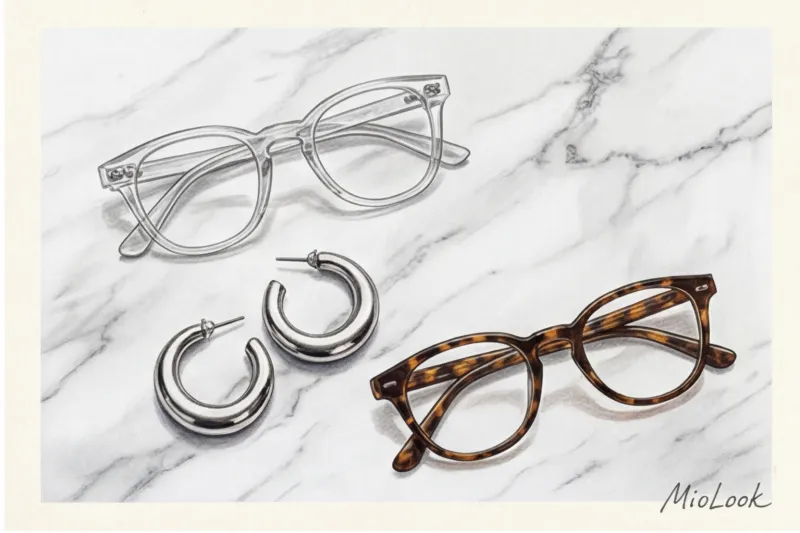
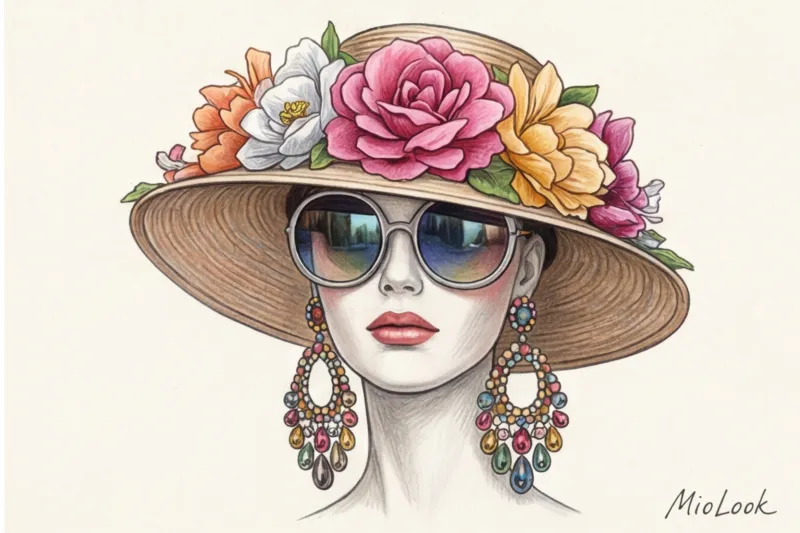
But clear plastic frames (whether budget mass-market ones for €25 or luxury optics) are the best companions for the wildest, most massive jewelry. Clear plastic lets light through, has no color of its own, and acts as an invisible frame. They can be worn with both large pearls and chunky crystals.
Your perfect look starts here
Tired of wondering if your favorite earrings match your new glasses? Upload photos of your accessories to the MioLook smart wardrobe, and the algorithm will suggest perfect combinations for every day.
Get access — €0.99 onceAdding a Hat: A Three-Element Balancing Algorithm
When a hat comes into play, we turn to the classic theory of composition from painting: "Main Object - Secondary Object - Background." It's impossible to make three accessories star at once.
It's important to understand the physics of light here. The wide brim of a classic fedora creates a harsh shadow on the upper third of the face (especially on a sunny day). The eyes are cast into darkness. That's why, when wearing a brimmed hat and glasses, You absolutely need shiny metal near your face In this case, smooth metal earrings act like reflectors in professional photography—they highlight the jawline and neck, lifting the face out of the shadows.
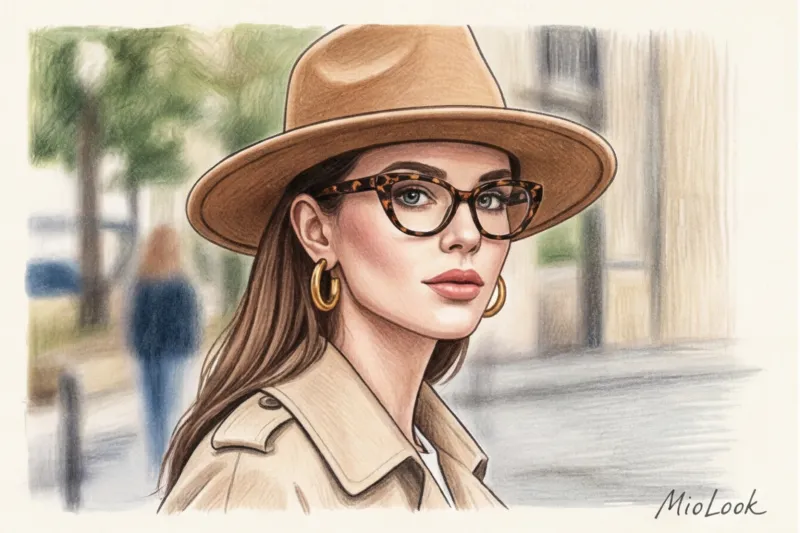
If you choose brimless hats (beanies, French berets), the temple area remains exposed. This gives you room to maneuver: you can play with extra-wide glasses frames or add tiered earrings without fear of the "sheath-like" effect, where the wearer is obscured by the garments.
Color Analysis: How Color Temperature Can Save a Busy Look
As a certified colorist, I often use color as a tool for reducing visual weight. You can wear three large pieces at once by combining them into a monochrome grouping.
Imagine a dark chocolate-colored felt hat, tortoiseshell-colored horn-rimmed glasses, and large, architectural earrings in matte bronze. It looks luxurious because the eye perceives it as a single splash of color. The shades flow seamlessly into one another, following the principle of analogous harmony in Itten's color wheel.
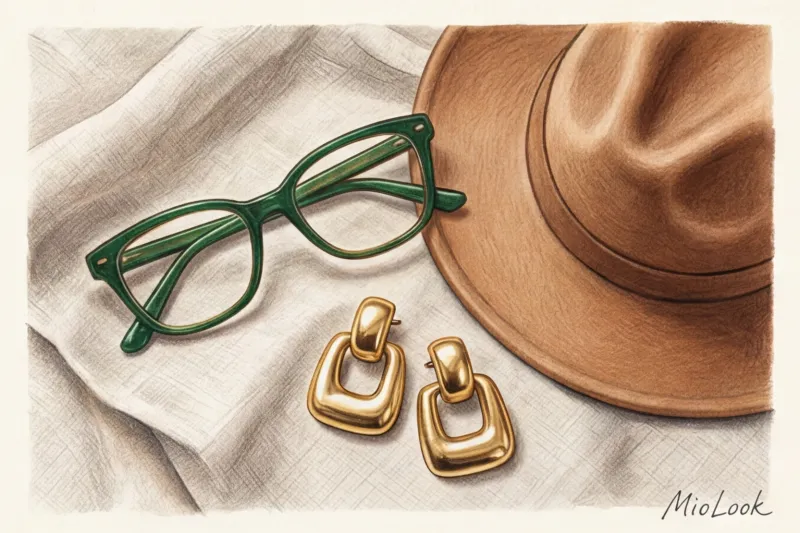
Use temperature to create movement. The cool metal of the earrings (white gold, steel, silver) against the warm caramel acetate of the frame creates a subtle sparkle, adding a modern touch.
A word of caution: all-black eyeshadow (a black hat and chunky black sunglasses) only suits women with high-contrast skin tones (for example, those with a "Winter" complexion). For others, black mercilessly pales the face, highlighting the nasolabial folds. If you're wearing black sunglasses and a black hat, be sure to break up the look with large earrings in a warm gold or pearl shade.
Frequently Asked Questions
What is your color type?
Find out your seasonal color type and choose clothes that highlight your natural beauty.
About the author
Unlock MioLook
for €0.99
Start creating perfect outfits with artificial intelligence
Get access — €0.99 onceRelated Articles
Stylist Tips: How to Wear a Flattering Oversized Scarf
A voluminous scarf not only provides warmth but also creates an optical illusion...

What earrings to wear with glasses: stylist tips
80% of the person's attention is focused on your face. We'll tell you how to pai...
How to combine accessories without overloading
Forget about endlessly struggling in front of the mirror. Discover clear algorit...

How to Choose Earrings for Your Face Shape: Stylist Tips
Some earrings visually enhance the face, while others add age. Discover modern s...